Quick answer
The Old Kingdom was Egypt’s first great age of centralised power, from about 2686 to 2181 BC, covering the Third to Sixth Dynasties. Ruled from Memphis, near modern Cairo, its kings built the Step Pyramid, the pyramids of Dahshur and Giza and the Great Sphinx, before falling royal power, rising provincial governors and failing Nile floods brought it to an end.
What was the Old Kingdom?
The Old Kingdom is the name Egyptologists give to the roughly 500 years when a single, all-powerful king ruled a unified Egypt from Memphis and poured the country’s resources into monumental tombs. It followed the Early Dynastic period, when the First and Second Dynasties had consolidated the unification of Upper and Lower Egypt around 3100 BC, and it ended in the fragmented First Intermediate Period.
Memphis sat at the junction of the Nile valley and the Delta, and its cemeteries stretch for more than 30 km along the desert edge west of the river, from Abu Rawash in the north through Giza, Abusir and Saqqara to Dahshur, with Meidum further south. Almost everything a visitor to Cairo sees from this era lies along that line.
The dates are approximate, and the division into “kingdoms” is modern: the Egyptians counted by kings, not eras. Our ancient Egyptian timeline shows how the Old Kingdom fits into 3,000 years of history.
Who were the key Old Kingdom pharaohs?
A handful of kings from the Third and Fourth Dynasties built the monuments that define the era, while later rulers left their mark in writing and administration.
| King | Dynasty | Approx. reign | Known for |
|---|---|---|---|
| Djoser | 3rd | c. 2670–2650 BC | The Step Pyramid at Saqqara, the first large stone building |
| Sneferu | 4th | c. 2613–2589 BC | Meidum, the Bent and Red Pyramids; the first true pyramid |
| Khufu | 4th | c. 2589–2566 BC | The Great Pyramid of Giza |
| Khafre | 4th | c. 2558–2532 BC | The second Giza pyramid, very probably the Great Sphinx |
| Menkaure | 4th | c. 2532–2503 BC | The third Giza pyramid and superb statue groups |
| Sahure and Niuserre | 5th | c. 2487–2421 BC | Pyramids and sun temples at Abusir |
| Unas | 5th | c. 2375–2345 BC | The first Pyramid Texts, carved inside his pyramid at Saqqara |
| Pepi II | 6th | c. 2278–2184 BC | One of the longest reigns in history; decline set in |
How did the pyramids develop?
In barely a century, Egyptian builders went from Djoser’s stack of six steps to the smooth-sided Great Pyramid, the largest stone building of the ancient world. The architect credited with the Step Pyramid, Imhotep, stacked ever-smaller mastaba tombs in stone. Under Sneferu, builders tried filling in the steps at Meidum, changed angle halfway up the Bent Pyramid at Dahshur when the structure showed signs of strain, and finally got it right with the Red Pyramid.
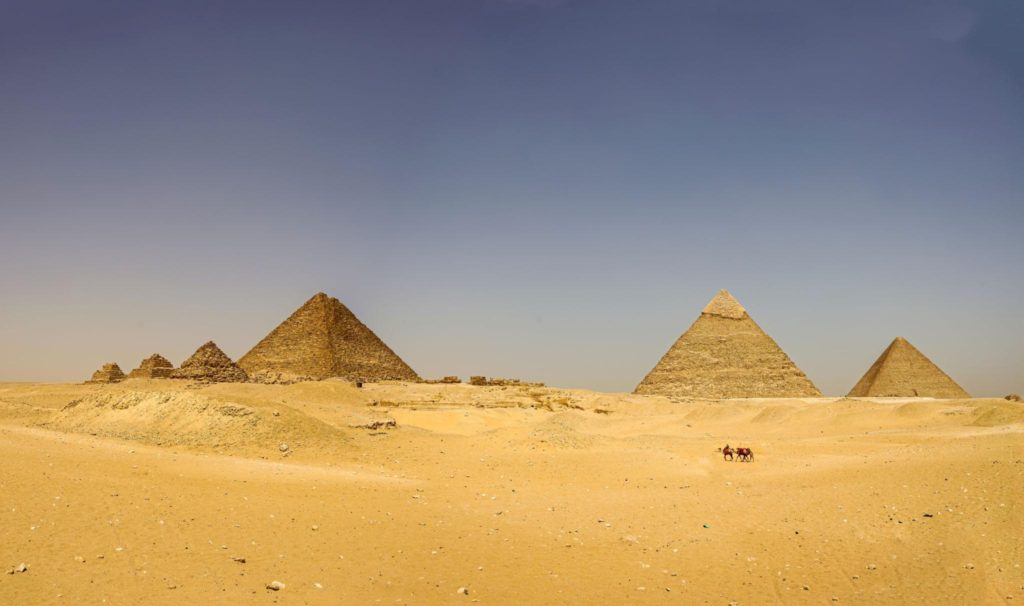
Khufu’s pyramid at Giza, built around 2560 BC, used an estimated 2.3 million blocks and was the tallest building on Earth for more than 3,800 years. After Menkaure, pyramids became smaller and more cheaply built, with rubble cores that have since slumped, while the Fifth Dynasty kings spent heavily on sun temples to Ra instead.
How the workforce actually raised the blocks is covered in our guide to how the pyramids were built, and every site is listed in Egypt’s pyramids: the complete list.
How was Old Kingdom Egypt run?
The king was a living god at the top of a bureaucracy of scribes, headed by a vizier, that could count the country’s cattle, tax its harvests and feed tens of thousands of workers. Egypt was divided into provinces (nomes), each run by an official answerable to the court, and regular censuses of livestock were used to date the years of a reign.
The workforce was not made up of slaves. Excavations south of the Giza plateau have uncovered a town of bakeries, breweries and barracks for the pyramid builders, and a cemetery where workers were buried with bread and beer for the afterlife. Many were labourers doing a rotating spell of service to the king, supported by a permanent core of skilled craftsmen.
The oldest inscribed papyri ever found, discovered in 2013 at Wadi al-Jarf on the Red Sea coast, include the logbook of an inspector named Merer, whose team ferried limestone blocks from the Tura quarries across the Nile to Giza for Khufu’s pyramid. It is a rare first-hand glimpse of the project from the inside.
What else did the Old Kingdom achieve?
Beyond the pyramids, the Old Kingdom set the rules of Egyptian art, wrote the first long religious texts and sent expeditions far beyond Egypt’s borders.
- Art: the conventions that lasted 3,000 years, such as the striding pose and the combined profile-and-front view of the body, were fixed now. Masterpieces include the diorite statue of Khafre and the painted pair statues of Rahotep and Nofret.
- Daily life in relief: the mastaba tombs of officials such as Ti and Mereruka at Saqqara are carved with farming, fishing, boat-building and butchery, the best record of everyday life from the period.
- Religious writing: the Pyramid Texts in the burial chamber of Unas, around 2350 BC, are among the oldest religious texts in the world.
- Expeditions: ships sailed to Byblos in Lebanon for cedar, miners worked turquoise and copper in Sinai, and the governor Harkhuf led caravans deep into Nubia. His tomb at Qubbet el-Hawa in Aswan quotes a letter from the boy king Pepi II, excited about the dancing pygmy Harkhuf was bringing home.
Why did the Old Kingdom collapse?
No single disaster ended it: royal power drained away to provincial governors over generations, and a run of low Nile floods towards the end appears to have tipped a weakened state into crisis. Sixth Dynasty kings granted land and tax exemptions to temples and officials, and provincial governors began building grand tombs at home rather than near the king, a sign their loyalties had shifted.
Pepi II is traditionally said to have ruled for over 90 years, though many scholars now think his reign was shorter; either way, a very long reign left a succession crisis. Climate evidence from across the Middle East points to a drier period around 2200 BC, and later texts describe famine. Egypt split into rival centres at Herakleopolis and Thebes, and it took until about 2055 BC for the Middle Kingdom to reunite it.
Where to see the Old Kingdom in Egypt today
Cairo is the place: almost all the major Old Kingdom monuments lie within about 90 minutes’ drive of the city.
- Giza: the Great Pyramid, the pyramids of Khafre and Menkaure, the Sphinx and the officials’ mastaba fields.
- Saqqara: Djoser’s Step Pyramid, the pyramid of Unas with its Pyramid Texts (when open) and the mastabas of Ti, Mereruka and Kagemni.
- Dahshur and Meidum: Sneferu’s experiments, with far fewer visitors; you can climb down into the Red Pyramid.
- Abusir: Fifth Dynasty pyramids, open by special arrangement.
- Grand Egyptian Museum: Khufu’s reassembled cedar boat, more than 4,500 years old, and Old Kingdom statuary; some masterpieces remain at the Egyptian Museum in Tahrir, so check which is where.
Our Cairo and pyramids stopover covers Giza, Saqqara and the GEM, and Dahshur can easily be added.
Frequently asked questions
When was the Old Kingdom of Egypt?
About 2686 to 2181 BC, covering the Third to Sixth Dynasties. The dates are approximate and vary slightly between reference books.
Why is the Old Kingdom called the age of the pyramids?
Because almost all of Egypt’s largest pyramids, from Djoser’s Step Pyramid to the Great Pyramid of Giza, were built in this period. Later kings built pyramids too, but smaller and mostly of mud brick.
Were the pyramids built by slaves?
No. Excavations of the workers’ town and cemetery at Giza show a paid and fed workforce of skilled craftsmen and rotating labourers, buried with honour near the pyramids they built.
What was the capital of the Old Kingdom?
Memphis, at the apex of the Nile Delta about 20 km south of central Cairo. Little of the city survives, but you can visit its open-air museum at Mit Rahina.
What came after the Old Kingdom?
The First Intermediate Period, roughly 2181–2055 BC, when Egypt was divided between rival rulers, followed by the reunified Middle Kingdom.