Quick answer
Islamic Cairo is the historic walled city founded by the Fatimid caliphs in 969 beside the older Arab capital of Fustat, then enriched for 900 years by Saladin's Ayyubids, the Mamluk sultans and the Ottomans. Its mosques, madrasas, gates and houses, listed by UNESCO as Historic Cairo in 1979, let you read that history building by building, from Ibn Tulun's mosque of 879 to Muhammad Ali's of the 1840s.
What is Islamic Cairo?
“Islamic Cairo” is the modern name for the medieval walled city and its surroundings, roughly between the Nile-side downtown and the Muqattam Hills, packed with monuments from the 9th to the 19th century. Cairenes rarely use the phrase; they talk of districts such as al-Gamaliya, al-Darb al-Ahmar and al-Khalifa. UNESCO inscribed the area as Historic Cairo in 1979, and it holds several hundred registered monuments.
The label is a little misleading, because this is no more “Islamic” than the rest of a city that is overwhelmingly Muslim. What sets it apart is age: the street plan, gates and many buildings date from the Fatimid, Mamluk and Ottoman centuries, and people still live, trade and pray in them.
Before Cairo: Fustat and Ibn Tulun (641–969)
The first Muslim capital was Fustat, the camp Amr ibn al-As set up beside the Roman fortress of Babylon in 641, and Cairo grew north and east from there in stages. Amr's mosque, rebuilt many times, still stands near Coptic Cairo, and Fustat became a busy river port and pottery town.
Each new dynasty added its own quarter. The Abbasids founded al-Askar in 750, and in 868 a Turkish officer, Ahmad ibn Tulun, sent to govern Egypt, made himself virtually independent and built a royal city called al-Qata'i. In 905 Abbasid troops razed it, sparing only his great mosque, completed in 879. Its vast courtyard and spiral minaret survive almost unaltered, which makes the Mosque of Ibn Tulun the best place to stand in pre-Cairo Cairo.
How did the Fatimids found al-Qahira?
In 969 the Fatimids, a Shia Ismaili dynasty from Tunisia, conquered Egypt, and their general Jawhar laid out a walled palace city north of Fustat called al-Qahira, “the Victorious”. Caliph al-Mu'izz moved in from North Africa in 973, and the name gave us “Cairo”.
Al-Qahira was a royal enclosure of two great palaces, government offices and barracks, closed to ordinary people, who lived and traded in Fustat. Jawhar began Al-Azhar Mosque in 970, and it soon became a teaching institution. The city's main street, the Qasaba, ran between the palaces; today it is Al-Muizz Street.
A century later, after famine and civil war, the vizier Badr al-Jamali rebuilt the walls in stone between 1087 and 1092. Three of his gates survive: Bab al-Nasr and Bab al-Futuh in the north, and Bab Zuweila in the south. In 1168, threatened by a Crusader army, the Fatimid vizier ordered Fustat burned rather than let it fall, and from then on the centre of gravity shifted to al-Qahira.
What did Saladin change?
Saladin (Salah al-Din), a Kurdish commander, ended the Fatimid caliphate in 1171, returned Egypt to Sunni Islam and began the Citadel on a spur of the Muqattam Hills in 1176. His Ayyubid dynasty opened the old palace city to everyone, built madrasas to teach Sunni law, and started a wall meant to enclose al-Qahira, Fustat and the Citadel in one circuit. A long stretch of it was uncovered during the creation of Al-Azhar Park.
The Citadel remained the seat of Egypt's rulers for almost 700 years. The last Ayyubid sultan, al-Salih Ayyub, built up a corps of slave soldiers called Mamluks, and after his death in 1249 they took power for themselves; his widow Shajar al-Durr briefly ruled as sultan in 1250, a rare female ruler in medieval Islam.
Why did the Mamluks build Cairo's greatest monuments?
The Mamluks, slave-soldiers from the steppes and the Caucasus who rose to rule as sultans from 1250 to 1517, poured their wealth into mosques, madrasas, hospitals and tombs that still define the skyline. Rank and land were not meant to pass to their sons, so a religious endowment (waqf) attached to a grand building was a way to win prestige, earn God's favour and secure an income for their families.
Their victory over the Mongols at Ain Jalut in 1260 made Cairo the leading city of the Islamic world, and it became one of the largest cities anywhere. The highlights read like a timeline:
- 1284–85: Sultan Qalawun's complex of hospital, madrasa and domed tomb on Al-Muizz Street.
- 1356–63: the colossal Mosque-Madrassa of Sultan Hassan, begun soon after the Black Death of 1348 had killed a large part of the city's people.
- 1382: the emir Jaharkas al-Khalili builds the caravanserai that gave Khan el-Khalili its name.
- 1470s: Sultan Qaitbay's funerary complex in the Northern Cemetery, with the finest carved stone dome in Cairo.
- 1503–05: Sultan al-Ghuri's mosque and mausoleum facing each other across the main street.
The best concentration is along Al-Muizz Street, and the great domed tombs stand in the City of the Dead.
What did Ottoman Cairo look like?
After Selim I's army defeated the Mamluks in 1517, Cairo became the capital of an Ottoman province, smaller in ambition but rich in fountains, schools, houses and pencil-thin minarets. The last Mamluk sultan, Tumanbay II, was hanged at Bab Zuweila.
Ottoman governors and local grandees built in a modest style that mixed Istanbul fashions with Cairene traditions: the Mosque of Sulayman Pasha in the Citadel (1528) was the first in the Ottoman style, while many patrons preferred the sabil-kuttab, a public water fountain with a Quran school above, such as Abd al-Rahman Katkhuda's of 1744 on Al-Muizz Street. Cairo grew rich on the coffee trade from Yemen, and merchants built courtyard houses with carved wooden mashrabiya screens. Bayt al-Suhaymi and the two houses of the Gayer-Anderson Museum show how they lived. By the 18th century Mamluk households had regained real power under nominal Ottoman rule.
How did the old city become “Islamic Cairo”?
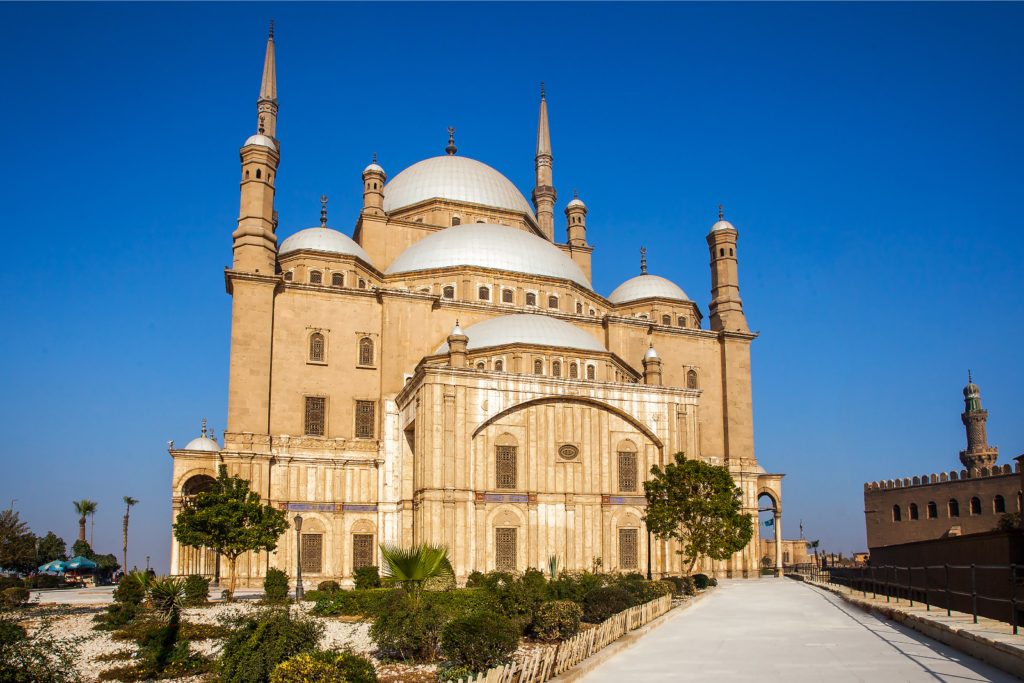
From 1798 Egypt's rulers looked west, and the medieval city was left behind as modern Cairo grew towards the Nile. Napoleon's troops shelled the Al-Azhar quarter during the revolt of October 1798 (see our guide to Napoleon in Egypt). Muhammad Ali, who ruled from 1805 to 1848, massacred the Mamluk leaders at the Citadel in 1811 and crowned it with his Istanbul-style mosque, built from 1830. His grandson Khedive Ismail laid out a European-style downtown in the 1860s and 1870s.
Concern for the old monuments led to the Comité de Conservation des Monuments de l'Art Arabe in 1881 and to the museum that became the Museum of Islamic Art. Since the 1990s, the restoration of Al-Muizz Street and the Aga Khan Trust for Culture's work around Al-Azhar Park, opened in 2005, have brought visitors back.
Where to see each era of Islamic Cairo today
Visit in chronological order and the city explains itself; two half-days, ideally with a guide, cover the essentials.
| Era | Building to see | Date |
|---|---|---|
| Early Arab | Mosque of Amr ibn al-As, Fustat | Founded 641–42, rebuilt |
| Tulunid | Mosque of Ibn Tulun | 879 |
| Fatimid | Al-Azhar; Bab Zuweila, Bab al-Futuh and Bab al-Nasr | 970; 1087–92 |
| Ayyubid | The Citadel walls | From 1176 |
| Mamluk | Qalawun complex, Sultan Hassan, Qaitbay | 1284–1474 |
| Ottoman | Bayt al-Suhaymi, Gayer-Anderson Museum | 16th–18th century |
| Muhammad Ali | Mosque of Muhammad Ali, Citadel | 1830–1848 |
A good plan is the Citadel, Sultan Hassan and Ibn Tulun on one morning, and Al-Azhar, Al-Muizz Street and Bab Zuweila on another, ending at Khan el-Khalili. Avoid Friday midday prayers, dress modestly, and carry a scarf for women; our guide to visiting mosques in Egypt covers etiquette. Most monuments sell tickets at the door; check current prices on egymonuments.gov.eg.
Frequently asked questions
Who founded Cairo?
The Fatimid general Jawhar al-Siqilli founded al-Qahira in 969 for Caliph al-Mu'izz. Earlier Arab capitals, starting with Fustat in 641, lay just to the south and were later absorbed into the city.
Why is it called Islamic Cairo?
It is a modern, mostly tourist label for the medieval city, distinguishing it from Coptic (Old) Cairo and the 19th-century downtown. Locals use district names such as al-Gamaliya and al-Darb al-Ahmar.
What is the oldest mosque in Cairo?
The Mosque of Amr ibn al-As is the oldest foundation (641–42), but it has been rebuilt so often that the Mosque of Ibn Tulun, completed in 879, is the oldest to survive in its original form.
Who were the Mamluks?
Soldiers bought as boys, mostly from Central Asia and the Caucasus, trained and freed to serve the sultan. They seized power in 1250 and ruled Egypt and Syria until the Ottoman conquest of 1517, building many of Cairo's finest monuments.
Is Islamic Cairo safe to walk around?
The main monument streets are busy and generally safe by day, and Al-Muizz Street is popular in the evening. Traffic, uneven paving and touts are the usual hassles. Check current advice on Smartraveller before you travel.