Quick answer
Napoleon Bonaparte invaded Egypt in July 1798 to strike at Britain's route to India, beat the Mamluk cavalry at the Battle of the Pyramids, and then lost his fleet to Nelson at the Battle of the Nile. He slipped back to France in 1799 and his army surrendered in 1801, but the scholars he brought produced the Description de l'Égypte and found the Rosetta Stone, launching modern Egyptology.
Why did Napoleon invade Egypt?
To hurt Britain: France could not invade England, so the government in Paris agreed to Napoleon's plan to seize Egypt, threaten the British route to India and win a colony. The ruling Directory was also happy to send a popular, ambitious general far away.
Egypt was formally an Ottoman province, but real power lay with rival Mamluk beys, above all Murad Bey and Ibrahim Bey. Napoleon claimed to come as a liberator from Mamluk misrule, issuing an Arabic proclamation that praised Islam and the Ottoman sultan. Few Egyptians were convinced. The fleet sailed from Toulon in May 1798, captured Malta from the Knights of St John on the way, and reached Alexandria at the start of July.
What happened during the French campaign?
The French took Alexandria and Cairo within a month, lost their fleet within six weeks, and spent the next three years cut off from home.
- 1–2 July 1798: landing near Alexandria and capture of the city.
- 21 July 1798: the Battle of the Pyramids, fought at Embaba on the west bank opposite Cairo with the pyramids on the horizon. French infantry squares broke Murad Bey's cavalry charges; Napoleon is said to have told his men that “forty centuries” looked down on them.
- 24 July: Napoleon enters Cairo.
- 1–2 August: Nelson destroys the French fleet at Abu Qir Bay.
- Late 1798 – 1799: General Desaix chases Murad Bey up the Nile as far as Aswan and Philae.
- February – May 1799: Napoleon invades Ottoman Syria and Palestine but fails to take Acre.
- 25 July 1799: he defeats an Ottoman landing at Abu Qir, then sails secretly for France on 23 August, where he soon seized power.
Why was the Battle of the Nile so decisive?
Because Nelson's victory at Abu Qir Bay, east of Alexandria, sank or captured almost the whole French fleet, trapping Napoleon's army in Egypt with no way home and no reinforcements. The French flagship L'Orient blew up during the night battle with a blast heard for miles along the coast.
The victory made Nelson a hero in Britain and encouraged the Ottomans and other powers to join the war against France. Underwater archaeologists have since mapped wrecks of the battle in the bay, which also hides the sunken Egyptian cities of Heracleion and Canopus; see our guide to Abu Qir Bay.
How did Egyptians experience the occupation?
As a foreign occupation with new taxes and harsh reprisals: Cairo rose in revolt twice, and the French answered with cannon. The best Egyptian account comes from the historian Abd al-Rahman al-Jabarti, who was both fascinated by French science and appalled by their conduct.
In October 1798, Cairenes angered by taxes and house searches rebelled around Al-Azhar. French guns on the heights above the city bombarded the quarter and cavalry rode into Al-Azhar Mosque itself, an insult remembered for generations. A second uprising in 1800 was crushed in the port district of Bulaq. That June, Napoleon's successor, General Kléber, was stabbed to death in his Cairo garden by Sulayman al-Halabi, a young student from Aleppo. The last commander, General Menou, converted to Islam and married an Egyptian woman, but could not hold the country.
Who were the savants, and what did they achieve?
Napoleon brought a Commission of Sciences and Arts of around 150 civilians, including the mathematicians Gaspard Monge and Joseph Fourier, the naturalist Étienne Geoffroy Saint-Hilaire and the artist Vivant Denon. In August 1798 he founded the Institut d'Égypte in requisitioned Mamluk houses in Cairo, where they studied everything from Nile fish to ophthalmia.
They measured temples, copied inscriptions and drew landscapes all the way to Philae, where an inscription in the first pylon's gateway records the French arrival in 1799. Denon's illustrated account appeared in 1802 and became a bestseller, and the official Description de l'Égypte, published in more than 20 large volumes between 1809 and the late 1820s, set off a craze for things Egyptian across Europe. In July 1799, French soldiers also found the Rosetta Stone near Rashid, the key to hieroglyphs.
Not everything they wrote holds up: the engineer Jacques-Marie Le Père wrongly calculated that the Red Sea stood about 10 metres higher than the Mediterranean, a mistake that delayed the Suez Canal for decades. And despite a persistent myth, French soldiers did not shoot the nose off the Sphinx, which was already missing in drawings of 1737.
How did the French occupation end?
A British and Ottoman army landed at Abu Qir in March 1801, beat the French outside Alexandria, and forced Cairo to surrender in June and Alexandria in early September 1801. Under the surrender terms, the French went home on British ships, but the antiquities they had collected, including the Rosetta Stone, were handed to Britain. The savants threatened to burn their notes rather than give them up, and were allowed to keep their papers and drawings.
What did Napoleon's expedition change?
It broke Mamluk power and opened the way for Muhammad Ali, an officer in the Ottoman army sent to expel the French, who made himself ruler of Egypt in 1805. His dynasty went on to modernise the army, schools and industry along European lines and ruled until 1952.
The expedition also tied Egypt to European scholarship and ambition for the next 150 years. Egyptology, Egyptomania in architecture and fashion, the scramble for antiquities, and Britain's determination to control the route to India all trace back, in part, to three years of French occupation.
Where to see traces of Napoleon in Egypt today
The expedition left few buildings, but you can stand where its key moments happened.
- Philae: the French inscription of 1799 in the central doorway of the first pylon; see our Philae Temple guide.
- Rashid (Rosetta): the Delta town where the stone was found, with the fort the French rebuilt as Fort Julien; see our Rashid guide.
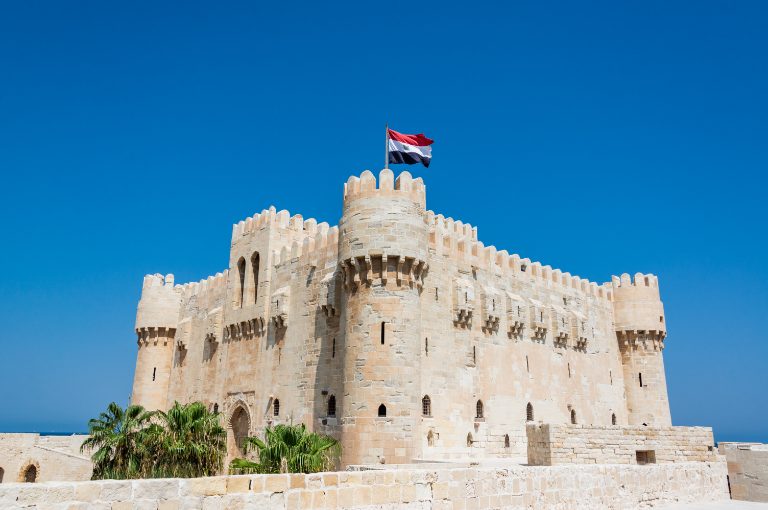
- Abu Qir Bay: the scene of both battles of Abu Qir, a short drive east of central Alexandria.
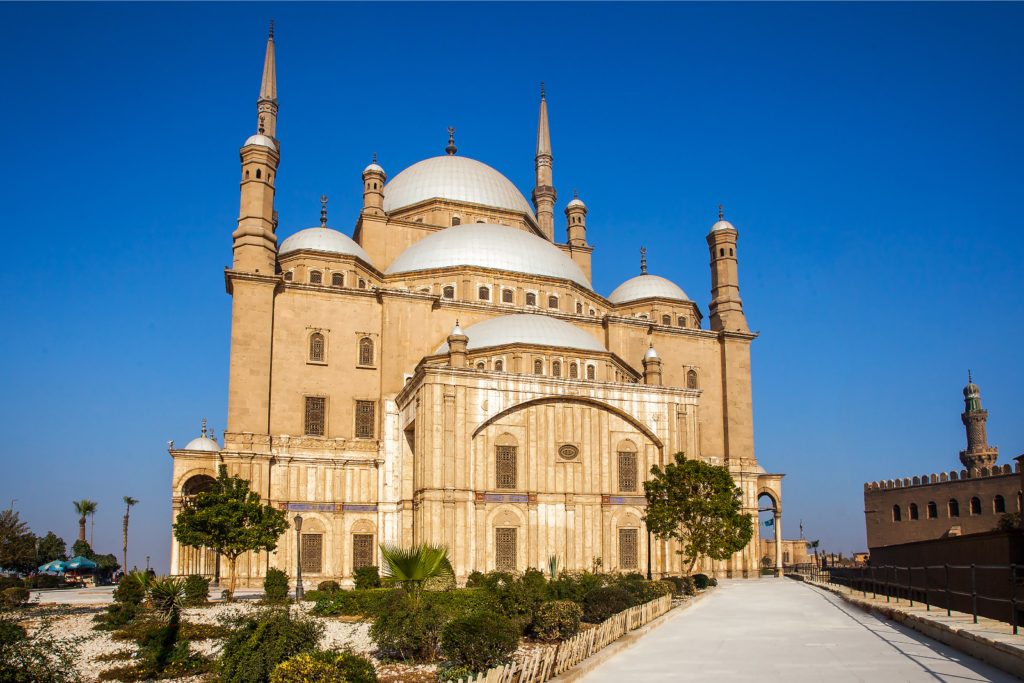
- Al-Azhar and the Citadel: the mosque the French stormed in 1798 and the fortress whose heights they used for their guns.
- The Sphinx: ask your guide to show you the old drawings that disprove the nose myth; see the Great Sphinx guide.
The Rosetta Stone itself is in the British Museum in London, and the Institut d'Égypte's later home near Tahrir Square was badly damaged by fire in December 2011, so check locally whether any related exhibitions are open when you visit.
Frequently asked questions
Why did Napoleon go to Egypt?
To weaken Britain by threatening its trade route to India, to found a French colony, and to win glory. The French government also wanted the ambitious general out of Paris.
Did Napoleon win in Egypt?
He won the land battles, including the Battle of the Pyramids, but lost the war: Nelson destroyed his fleet in August 1798, his Syrian campaign failed, and the army he left behind surrendered in 1801.
Did Napoleon's soldiers shoot the nose off the Sphinx?
No. Drawings by the Danish traveller Frederik Norden from 1737 already show the nose missing, and a medieval historian records the face being damaged in 1378.
What is the Description de l'Égypte?
The huge illustrated survey of Egypt's monuments, nature and people produced by Napoleon's scholars and published in Paris between 1809 and the late 1820s. Its plates are still used by Egyptologists.
How long was Napoleon in Egypt?
About 14 months, from July 1798 to August 1799. His army stayed until September 1801.