Quick answer
When the Aswan High Dam threatened to drown Abu Simbel, an international campaign led by UNESCO cut both of Ramesses II's rock temples into more than 1,000 blocks between 1964 and 1968 and rebuilt them about 65 metres higher, inside artificial hills on concrete domes. The same campaign moved Philae, Kalabsha, Amada and other Nubian temples, and it inspired the World Heritage Convention of 1972.
Why did Abu Simbel need saving?
Because the reservoir behind the new Aswan High Dam, Lake Nasser, would rise far above the temples, which Ramesses II had carved into a riverside cliff around 1264 BC. Once the dam was approved in the late 1950s, every monument in Lower Nubia, from Aswan to the Second Cataract in Sudan, faced the same fate.
Egypt and Sudan asked UNESCO for help in 1959. On 8 March 1960, its Director-General, Vittorino Veronese, launched a worldwide appeal, and roughly 50 countries eventually contributed money, experts or archaeological teams. Abu Simbel was the hardest and most expensive problem: two temples cut deep into living sandstone, too large to lift and too fragile to drag.
Which plans were rejected?
Several bold schemes were considered between 1960 and 1963 before engineers settled on the simplest: saw the temples into pieces.
- A protective dam: a French-led design to ring the temples with their own barrier dam. Costly, and vulnerable to seepage and failure.
- Jacking up the whole temple: an Italian proposal to cut the Great Temple free in one block, enclose it in concrete and raise it with hundreds of hydraulic jacks. Elegant, but enormously expensive and risky.
- Leaving it underwater: a British idea to keep the temples submerged in clean water and let visitors view them from underwater galleries.
- Floating it: a scheme to set the temple on a floating base that would rise with the lake.
In 1963 the Egyptian government chose a plan developed by the Swedish consultancy VBB to cut the temples into blocks and rebuild them on the cliff top. Time was short: the lake was already rising.
How were the temples cut up and moved?
An international consortium of contractors built a cofferdam to hold back the rising water, removed the hill above the temples, sawed the carved rock into blocks, and rebuilt everything on higher ground. The job took from 1964 to 1968 and involved thousands of workers.
- Protection: the facades were buried under sand to protect them, and a temporary dam kept the lake out of the work site.
- Removing the hill: the rock above the temples was taken off from the top so the decorated walls could be freed.
- Cutting: skilled stonemasons, many from Italian quarry towns, cut along carefully chosen lines with hand saws and power saws, keeping the cuts thin and placing them where they would show least. The soft sandstone was strengthened with injected resin, and steel lifting bars were fixed into the blocks.
- Moving: more than 1,000 numbered blocks, most of 20–30 tonnes, were lifted by crane and stored on the plateau.
- Rebuilding: the temples were reassembled about 65 metres higher and some 200 metres back from the old riverbank, against two huge reinforced-concrete domes, then covered with rock and fill to recreate the cliffs.
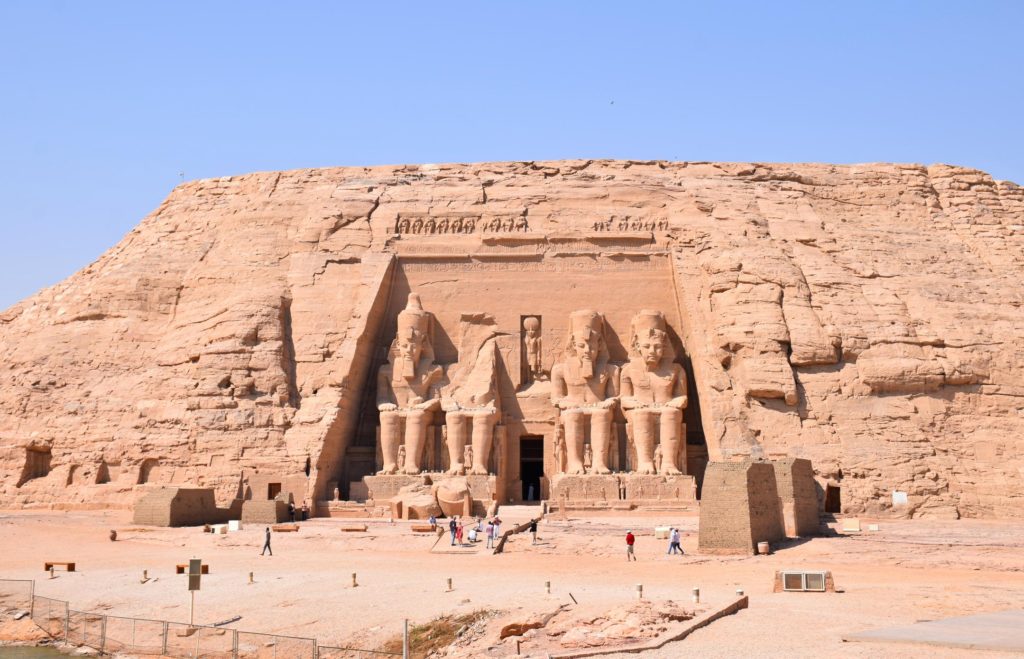
On 22 September 1968 the rebuilt temples were rededicated. The total cost of the Abu Simbel operation was around 40 million US dollars at the time. Look closely at the facade and you can still see the fine seams.
Did the move change the sun festival?
Only slightly: the engineers preserved the temple's east-facing orientation, and the sunrise that lights the sanctuary statues now falls about a day later than it did before the move. The twice-yearly event, around 22 February and 22 October, still draws crowds; our Abu Simbel Sun Festival guide explains how to see it.
What happened to Philae and the other Nubian temples?
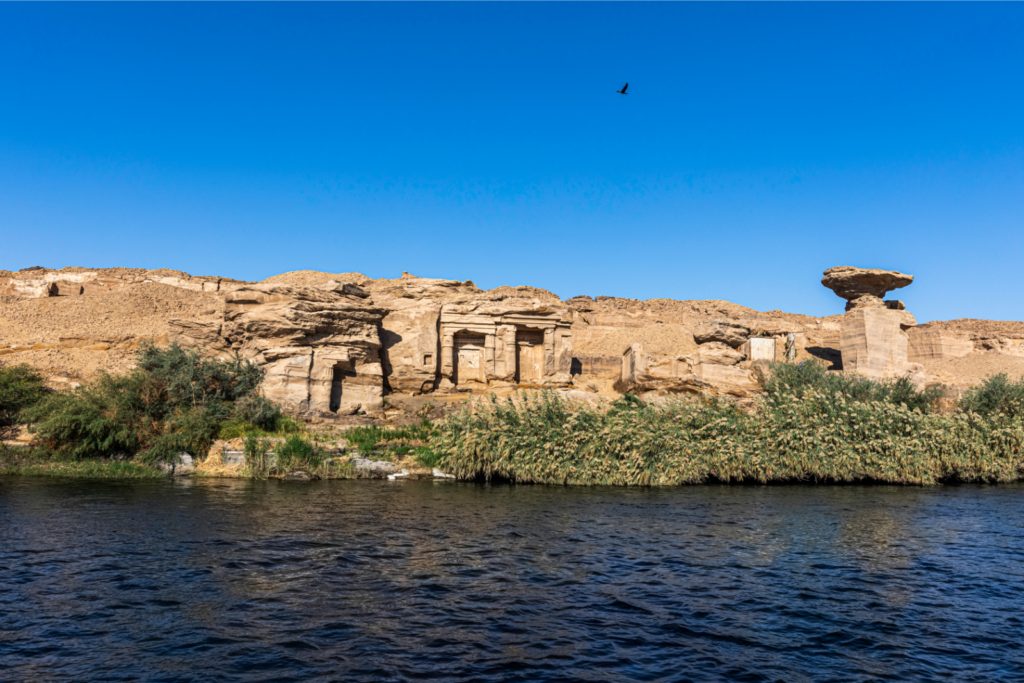
The campaign saved 22 monuments in Egypt and Sudan, moving most to new sites on the lake shore and giving several to the countries that helped.
- Philae: already half-drowned for most of each year since the first Aswan Dam of 1902, the Temple of Isis was dismantled and rebuilt from 1972 to 1980 on nearby Agilkia Island, landscaped to look like the original; see our Philae guide.
- Kalabsha: the largest free-standing temple of Egyptian Nubia, moved in the early 1960s with West German help to a headland by the High Dam; see the Kalabsha Temple guide.
- Amada: too delicately painted to be cut, it was moved 2.5 km in one piece on rails.
- Wadi el-Sebua, Dakka, Derr and others: regrouped at new sites along Lake Nasser.
- Gifts abroad: the Temple of Dendur went to the Metropolitan Museum in New York, Debod to Madrid, Taffeh to Leiden in the Netherlands and Ellesyia to Turin.
Archaeologists also excavated sites that could not be saved, such as the royal cemeteries of Ballana and Qustul. A Polish team removed the medieval wall paintings of Faras Cathedral in Sudan, now divided between museums in Warsaw and Khartoum. Only Qasr Ibrim, on its clifftop, was left in place, and it is now an island.
What did the rescue achieve, and what was lost?
It saved the monuments and created the idea of a shared world heritage, but it could not save Nubia itself. The cooperation behind the campaign led directly to UNESCO's World Heritage Convention of 1972, and in 1979 the rescued temples were inscribed together as the Nubian Monuments from Abu Simbel to Philae.
The people of the region had no such rescue. Around 100,000 Nubians in Egypt and Sudan lost their villages, fields and the river they had lived beside for millennia, and many were resettled far from the water. When you admire the engineering, it is worth remembering that the temples were moved and the communities around them were scattered.
Where to see the rescue story in Egypt today
Start in Aswan for the background, then see the results at Abu Simbel and on Lake Nasser.
- The Nubian Museum, Aswan: photographs and models of the rescue, and finds from sites now underwater.
- Abu Simbel: both temples, a visitor display on the move, and, when access is permitted, a look inside the concrete dome. The facade of the Temple of Nefertari was cut and rebuilt in the same way.
- Lake Nasser cruises: the regrouped temples of Kalabsha, Wadi el-Sebua and Amada, and a sail past Qasr Ibrim.
- The High Dam: a short stop on the way to Philae that shows the scale of the water the temples escaped.
Most visitors reach Abu Simbel on a day trip from Aswan by road, about three and a half hours each way, or on a short flight. Tickets are sold on site; check current prices on egymonuments.gov.eg.
Frequently asked questions
Why was Abu Simbel moved?
Because Lake Nasser, the reservoir created by the Aswan High Dam, would have submerged it. The temples were cut up and rebuilt on higher ground between 1964 and 1968.
How much higher is Abu Simbel now?
About 65 metres higher than its original position and some 200 metres further back from the old riverbank.
How many blocks was Abu Simbel cut into?
More than 1,000 blocks, most weighing around 20 to 30 tonnes; the commonly quoted figure is 1,036 for the two temples.
Can you see that Abu Simbel was moved?
Yes, if you look closely: thin joints run across the facade and the colossi, and the cliff behind is an artificial hill built over concrete domes.
Which other temples were moved?
Philae, Kalabsha, Amada, Wadi el-Sebua, Dakka, Derr and others in Egypt, plus temples given to New York, Madrid, Leiden and Turin.