Quick answer
Sneferu was the founder of Egypt’s Fourth Dynasty, ruling around 2613–2589 BC, and the father of Khufu. He built or completed three large pyramids – Meidum, the Bent Pyramid and the Red Pyramid – moving more stone than any other pharaoh and turning the step pyramid into the smooth-sided true pyramid. Later Egyptians remembered him as a kindly, approachable king.
Who was Sneferu?
Sneferu was the first king of the Fourth Dynasty, the father of Khufu and the most ambitious builder of the whole pyramid age. He ruled around 2613–2589 BC on conventional dates. His family background is unclear: he may have been a son of Huni, the last king of the Third Dynasty, by a lesser wife called Meresankh, and he probably strengthened his claim by marrying Hetepheres, a royal daughter who became the mother of Khufu.
The Turin King List gives him 24 years, but dated inscriptions on his pyramids, counted in biennial cattle censuses, have convinced many scholars that he ruled for 30 years or more. Either way, it was a long, stable reign, and he used it to experiment on a scale no king attempted before or since.
Sneferu’s pyramids at a glance
Sneferu built three large pyramids, each one teaching his builders something, and together they contain more stone than the Great Pyramid of his son. By common estimates his three monuments add up to around 3.6 million cubic metres, against about 2.6 million for Khufu’s pyramid at Giza.
| Pyramid | Where | What happened | Today |
|---|---|---|---|
| Meidum | About 100 km south of Cairo | Begun as a step pyramid (possibly by Huni), later filled in to make a true pyramid; the outer casing collapsed | A tower-like core about 65 m high; see Meidum Pyramid |
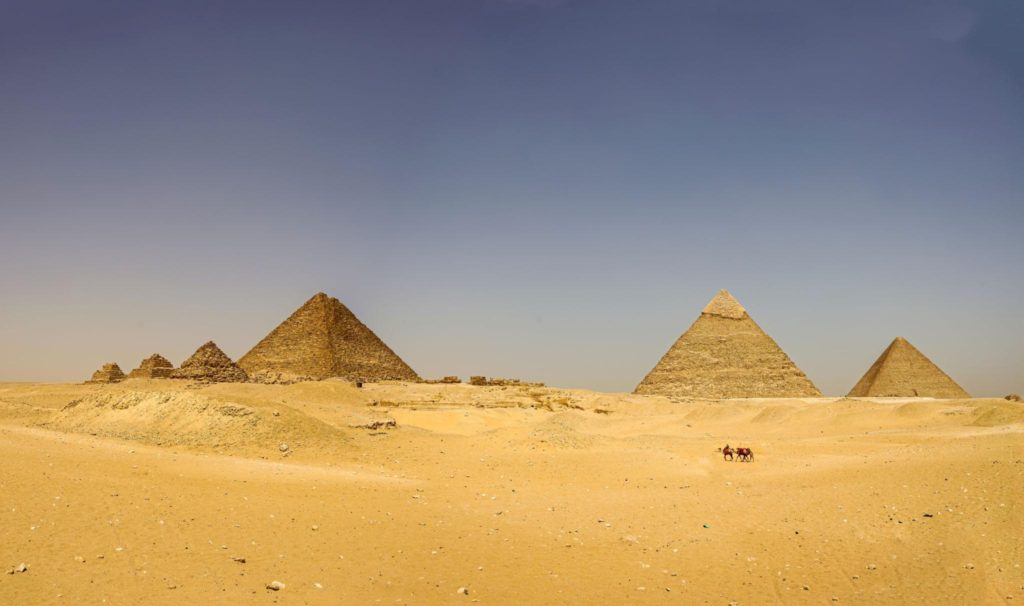
| Bent Pyramid | Dahshur | Started at about 54 degrees; the angle was cut to about 43 degrees halfway up as cracks appeared | About 105 m high, with the best-preserved original casing in Egypt |
| Red Pyramid | Dahshur | Built from the start at about 43 degrees: the first successful smooth-sided pyramid | About 105 m high; you can usually go inside |
A much smaller step pyramid at Seila, on the edge of the Fayoum, carries his name on a stela found beside it, and he may have built other small pyramids in the provinces. Our Dahshur guide covers the climb into the Red Pyramid and what to see at each site.
Why did one king build so many pyramids?
Because the first two did not go to plan: Sneferu was effectively inventing the true pyramid, and he was willing to start again. Each step solved a problem the last one revealed. The Bent Pyramid was set on soft clay and shale and built too steeply, so its chambers cracked under the growing load; the builders reduced the angle and later turned to a new site a couple of kilometres north. The Red Pyramid was laid out at the gentler slope from the beginning and stood firm.
Religious ideas were changing at the same time. A smooth pyramid echoed the sloping rays of the sun and the sacred benben stone of Heliopolis, and Sneferu’s reign marks the shift towards the solar kingship that his successors made explicit by calling themselves sons of Ra. Which pyramid he was finally buried in is not known for certain. Most scholars favour the Red Pyramid, where human remains were found in the burial chamber in the 1950s, though whether they are his has never been proven.
What else happened in his reign?
Beyond building, Sneferu sent trading fleets to Lebanon and military expeditions into Nubia, Libya and Sinai, according to a fragmentary royal annal known as the Palermo Stone. The annal records 40 ships arriving laden with cedar from the Levant, timber used for doors, boats and roof beams in a country with no tall trees of its own. It also claims a Nubian campaign that brought back 7,000 captives and 200,000 head of cattle; the figures are royal boasts, but they show the ambition of the new dynasty.
In Sinai, at Wadi Maghara, a rock relief shows Sneferu smiting a local chieftain at the turquoise mines. Centuries later, miners there still honoured him as a protector of the region, one of several signs that his memory was cherished long after his death.
Sneferu in story: the bored king and the rowing girls
Later Egyptians told stories about Sneferu as a good-natured king, and the best known is the boating tale in the Westcar Papyrus. Written down around 1600 BC, more than 900 years after his death, it is set at the court of Khufu, whose sons entertain him with tales of magicians. In one, a bored Sneferu is advised to go boating on the palace lake, rowed by 20 beautiful young women dressed in fishnet. When the lead rower drops her turquoise fish pendant and stops rowing, the magician Djadjaemankh folds one half of the lake on top of the other, picks the pendant off the dry bed and puts the water back.
A Middle Kingdom literary work, the Prophecy of Neferti, also chooses Sneferu’s court as its setting and shows him addressing his courtiers warmly as “my comrades”. Whether or not he was kind in life, Egyptians clearly remembered him as the model of a benevolent ruler, a contrast to the harsher reputation that Greek writers later gave his son Khufu.
The family Sneferu founded
Sneferu’s descendants built Giza: his son Khufu raised the Great Pyramid, and the official usually credited with designing it, Hemiunu, was probably his grandson. Hemiunu was a son of the vizier Nefermaat, who is usually thought to have been one of Sneferu’s sons and was buried at Meidum. Another likely son, Prince Rahotep, was buried at Meidum with his wife Nofret, and their painted statues are among the most lifelike portraits of the Old Kingdom.
Sneferu’s queen, Hetepheres I, has her own story. In 1925 an American team at Giza found a hidden shaft beside the Great Pyramid containing her sealed alabaster sarcophagus, which turned out to be empty, along with gilded furniture: a bed, an armchair, a carrying chair and a canopy frame. The wood had decayed, but the gold casing allowed the pieces to be reconstructed.
Where to see Sneferu in Egypt today
Visit Dahshur, about 40 km south of Cairo, where the Bent and Red Pyramids stand within a few kilometres of each other and are usually far quieter than Giza. Combine it with Saqqara to see the Step Pyramid that came first, then compare both with the Great Pyramid that came next.
- Meidum: a long half-day or a full day with Dahshur or the Fayoum, about 1.5–2 hours each way from Giza.
- Rahotep and Nofret, and Hetepheres’s furniture: these have long been displayed at the Egyptian Museum in Tahrir, with some collections moving to the Grand Egyptian Museum, so check where each is shown before you go.
- Tickets: sold at each site; current prices are on egymonuments.gov.eg.
If you are deciding how many pyramid sites to fit in, our comparison of Giza, Saqqara and Dahshur will help.
Frequently asked questions
Was Sneferu the father of Khufu?
Yes, by general agreement. Khufu’s mother, Queen Hetepheres I, carried the title “mother of the king”, and her burial goods were found beside Khufu’s pyramid at Giza.
How many pyramids did Sneferu build?
Three large ones – Meidum, the Bent Pyramid and the Red Pyramid – plus a small step pyramid at Seila near the Fayoum. Meidum may have been started by his predecessor Huni and finished by Sneferu.
Why is it called the Red Pyramid?
Its fine white limestone casing was stripped away for building stone, exposing the reddish limestone of the core, which glows in the late-afternoon sun.
Where is Sneferu buried?
Probably in the Red Pyramid at Dahshur, but this is not certain. Human remains were found in its burial chamber in the 1950s; they have never been conclusively identified as the king’s.
Is Dahshur worth visiting if I have seen Giza?
Yes. It shows the experiments that made Giza possible, it is far less crowded, and going inside the Red Pyramid is usually easier and quieter than entering the Great Pyramid.