Quick answer
The pyramids were built by organised crews of Egyptian workers, fed and housed by the state, using copper tools, stone pounders, wooden sledges and ramps of mud brick and rubble. The Great Pyramid took about 20 years around 2560 BC, and workers' towns, quarries, ramps and a logbook from Khufu's reign show how it was done. Slaves, aliens and lost civilisations have no supporting evidence.
The short answer: practice, organisation and muscle
Egyptians learned to build pyramids by trial and error over about a century, and the failures are visible on the ground. The first was the Step Pyramid of Djoser at Saqqara, around 2670 BC, designed by his official Imhotep as six stacked stone platforms; our guide to Djoser and Imhotep tells that story.
Djoser’s successors experimented. Sneferu, Khufu’s father, built at least three large pyramids: Meidum, whose outer casing later collapsed, and two at Dahshur. The Bent Pyramid there changes angle partway up, from about 54 to about 43 degrees, almost certainly because the structure was showing signs of instability. The neighbouring Red Pyramid, built at the gentler angle from the start, is the first successful smooth-sided pyramid. Only after that learning curve came the Great Pyramid of Khufu at Giza. That sequence of experiments, mistakes and corrections is itself one of the strongest pieces of evidence for who built them.
Who built the pyramids? Not slaves
The pyramids were built by Egyptians: a core of skilled, permanent craftsmen plus rotating crews of labourers called up from the villages, all fed and housed by the state. The slave image comes from Hollywood and a misreading of the Bible; the Exodus story is set more than 1,000 years after the Giza pyramids and never mentions them.
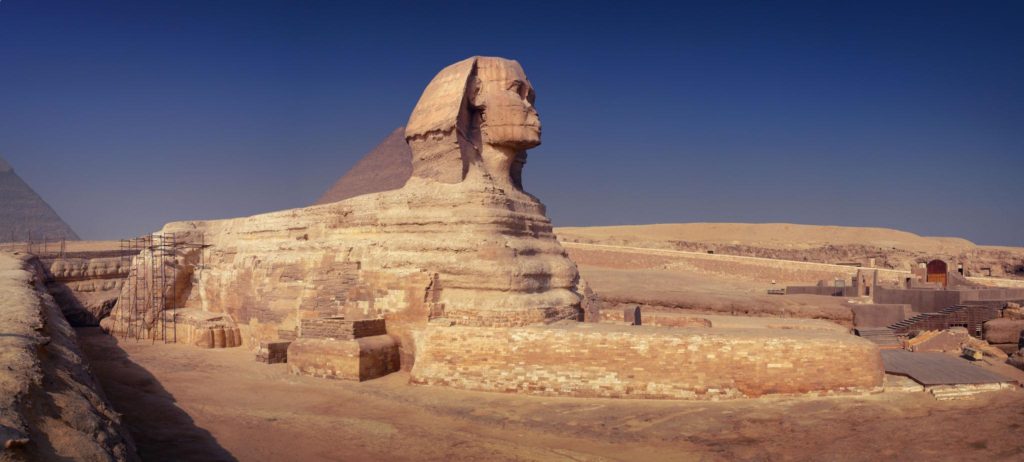
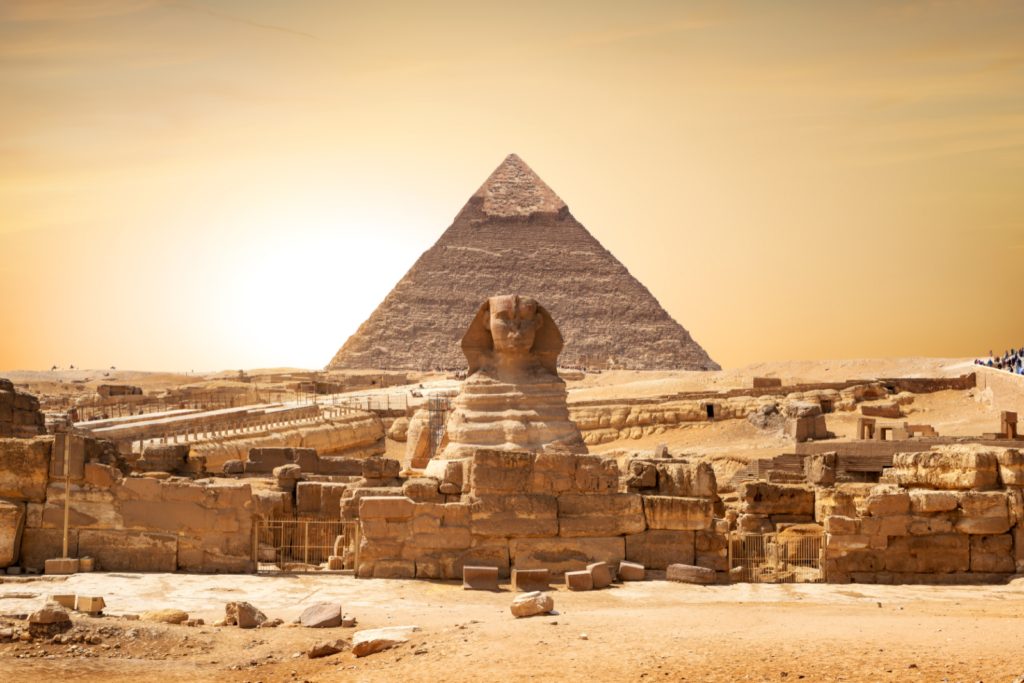
Since 1990, excavations led by Zahi Hawass and Mark Lehner south of the Sphinx have uncovered the builders’ world. A cemetery of workers’ tombs carries titles such as overseer of the side of the pyramid. Skeletons show heavy wear from labour, but also fractures that were set and healed, evidence of medical care. Nearby, the workers’ town of Heit el-Ghurab had bakeries, breweries, galleries for sleeping and enough cattle, sheep and goat bones to show that the workforce ate meat regularly.
Graffiti left inside the monuments name the work gangs, with titles such as Friends of Khufu and Drunkards of Menkaure. Labourers were organised into crews, then into groups of about 20 men, a system of rotation that also served as national service. This was compulsory labour owed to the king, so not quite volunteering, but it was not slavery either.
Where did the stone come from, and how was it cut?
Most of the stone was quarried right beside the pyramids; only the fine casing and the granite travelled any distance. The core blocks of the Great Pyramid came from a quarry immediately to its south, where you can still see the stepped faces left by the workmen.
- Limestone core: cut with copper chisels and levered free; blocks average around 2.5 tonnes.
- White casing limestone: quarried at Tura on the east bank of the Nile, across the river from Giza, and ferried over.
- Granite: for the King’s Chamber, floated roughly 800 km downriver from Aswan. Granite is too hard for copper chisels, so quarrymen pounded it out with balls of dolerite, as the Unfinished Obelisk in Aswan shows, and sawed it with copper blades fed with quartz sand as an abrasive.
Copper itself was mined in Sinai and the Eastern Desert, and tool sharpening alone must have consumed huge quantities. The state also had to supply bread, beer, rope, timber and gypsum mortar, which is why scholars see the pyramids as an achievement of administration as much as engineering.
How did they move the blocks?
By boat as far as possible, then on wooden sledges dragged over prepared tracks, with water poured on the sand to cut the friction. In 2013 a French-Egyptian team at Wadi al-Jarf on the Red Sea coast found the oldest inscribed papyri known, including the logbook of an inspector named Merer from the end of Khufu’s reign.
Merer records his crew of around 40 men shipping limestone blocks from Tura to Giza, sailing along canals during the Nile flood to a harbour basin close to the plateau, under the authority of Ankhhaf, Khufu’s half-brother. It is the nearest thing we have to an eyewitness account.
On land, a painting in the Middle Kingdom tomb of Djehutihotep at Deir el-Bersha shows a colossal statue on a sledge hauled by rows of men, while one man pours liquid in front of the runners. In 2014 physicists at the University of Amsterdam showed that wetting desert sand to the right degree roughly halves the force needed to pull a sledge across it.
How did they get the stones to the top?
With ramps of mud brick, rubble and gypsum, probably combined with levers for the final courses; the exact ramp layout is still argued about. Remains of construction ramps survive at several pyramids and quarries, and mud-brick ramps can still be seen behind the unfinished First Pylon at Karnak.
The most striking find came in 2018 at the Hatnub alabaster quarry in Middle Egypt: a steep ramp flanked by staircases and rows of post holes, dated by inscriptions to Khufu’s reign. The posts appear to have anchored ropes, letting teams haul sledges up slopes far steeper than previously thought possible.
The main proposals for the pyramids are:
- A straight ramp up one face, which works for the lower levels but would become impossibly long near the top.
- A zigzag or spiral ramp climbing the faces of the rising pyramid.
- An internal ramp spiralling inside the structure, proposed by the architect Jean-Pierre Houdin; it is ingenious, but there is no physical evidence for it.
Geometry helps: half the volume of a pyramid lies in the bottom fifth of its height, so most of the stone went up a relatively short, wide ramp. The narrow summit needed far fewer blocks and could have been finished with smaller ramps and levers. The casing was then dressed smooth from the top down as the ramps were removed.
How were they so precise?
With simple instruments used very carefully: sighting tools, plumb lines, set squares, water levels and the stars or the sun. The sides of the Great Pyramid are aligned to true north to within a small fraction of a degree, and its base is close to a perfect square of about 230 metres a side.
How the builders found north is debated. One theory has them watching two stars circling the celestial pole; another uses the sun’s shadow on a vertical rod, which tests have shown can achieve similar accuracy. Measurements were in royal cubits of about 52.4 cm, and slopes were set by the seked, the horizontal run per cubit of height, a method recorded in the Rhind Mathematical Papyrus.
What about aliens, Atlantis and lost technology?
The evidence does not support any of them: the pyramids are among the best-documented building projects of the ancient world. Fringe claims, whether about aliens, a lost Ice Age civilisation, machine-cut stone or pyramids as power plants, ignore what has actually been found.
We have the quarries with tool marks and abandoned blocks, the ramps, the workers’ town and cemetery, the bakeries, the Merer logbook, the gangs’ graffiti and the earlier failed pyramids. Radiocarbon dates from organic material in the mortar fall broadly within the 4th Dynasty, give or take a century or two. The medieval legend that the pyramids were Joseph’s granaries has no basis either.
Real questions remain, and they are more interesting. In 2017 the ScanPyramids project used cosmic-ray particles called muons to detect a large void above the Grand Gallery, and in 2023 confirmed a sealed corridor behind the north face. Their purpose is unknown, but they are architectural puzzles, not mysteries about who built the pyramid.
Where to see how the pyramids were built
Follow the pyramids in the order they were built and the engineering story tells itself.
- Saqqara: Djoser’s Step Pyramid, the first large stone building in the world.
- Meidum: Sneferu’s tower-like pyramid surrounded by the rubble of its fallen outer layers; you can go inside.
- Dahshur: the Bent and Red Pyramids, usually far quieter than Giza.
- Giza: the Great Pyramid, its quarry, and the workers’ cemetery south of the Sphinx (access varies, so ask your guide). Khufu’s reassembled boat is at the Grand Egyptian Museum.
- Aswan: the Unfinished Obelisk shows granite quarrying in action.
Our list of Egypt’s pyramids covers every site worth visiting. A full day from Cairo covers Saqqara and Dahshur comfortably; Meidum is about 100 km south of Cairo, roughly one and a half to two hours each way by road, so it usually needs a separate day.
Frequently asked questions
Were the pyramids built by slaves?
No. The evidence from the Giza workers' town and cemetery shows Egyptian labourers who were housed, fed with bread, beer and meat, given medical care and buried with honour near the king. Many were conscripted for a period, but they were not slaves.
How long did it take to build the Great Pyramid?
About 20 years, which matches both Herodotus's account and the length of Khufu's reign, roughly 2589–2566 BC. Building had to finish within the king's lifetime or soon after.
How many people built the Great Pyramid?
Most Egyptologists estimate 20,000 to 30,000 workers at any one time, including quarrymen, haulers, bakers, brewers and administrators, with labourers rotating in and out. Herodotus's figure of 100,000 is generally thought to be too high.
Did aliens or a lost civilisation build the pyramids?
No. There is no evidence for either, and a great deal of evidence for Egyptian builders: quarries, tools, ramps, worker settlements, papyri and a century of earlier, less successful pyramids. The idea also underestimates what ancient people could organise.
Why did the Egyptians stop building pyramids?
They didn't stop at once. Middle Kingdom kings built smaller pyramids with mud-brick cores, but by the New Kingdom, around 1550 BC, kings were buried in hidden rock-cut tombs in the Valley of the Kings, partly for security against robbers.