Quick answer
Memphis was Egypt's capital for much of the pharaonic era, and its ruins lie under palm groves and fields at the village of Mit Rahina, about 20 km south of Cairo. The small open-air museum there displays a fallen 10-metre limestone colossus of Ramesses II and a large alabaster sphinx, and makes a 45-minute stop between Saqqara and Dahshur.
What was Memphis?
Memphis was the political and religious capital of Egypt through the Old Kingdom and a major royal city for some 3,000 years, founded according to tradition by the first king, Menes, around 3100 BC. Its position at the point where the Nile valley opens into the Delta let whoever held it control both halves of the country. The pyramid fields of Giza, Abusir, Saqqara and Dahshur are all, in effect, the cemeteries of Memphis.
The city's early name was Ineb-hedj, 'White Walls'. 'Memphis' comes, via Greek, from Men-nefer, the name of the nearby pyramid town of Pepi I. Its great god was Ptah, the creator and patron of craftsmen, and his temple, Hut-ka-Ptah, gave the Greeks the word Aigyptos, from which we get 'Egypt'. After Alexandria was founded in 331 BC Memphis slowly declined, and in the medieval period its stone was carted off to build Cairo.
What can you see at the open-air museum?
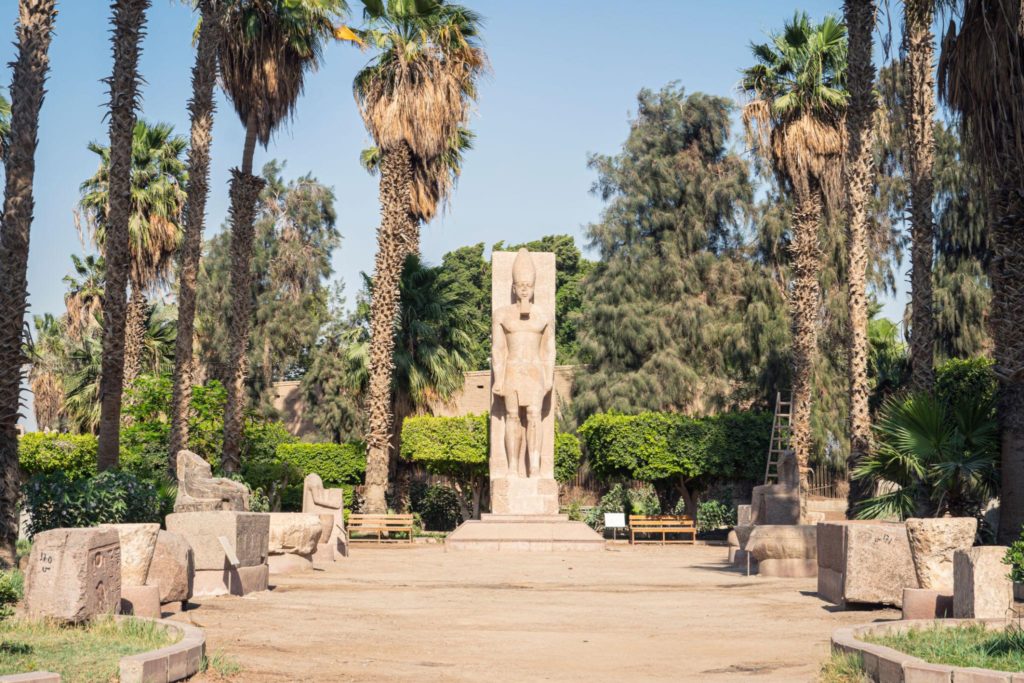
The museum is a walled garden of statues and architectural pieces, built around a pavilion that houses a colossal limestone statue of Ramesses II lying on its back.
- The colossus of Ramesses II: about 10 metres long even without its lower legs, carved in fine limestone with crisp detail: the king's cartouches on his shoulder, chest and belt, a dagger in his sash and the braided false beard. A gallery runs around it so you can look down on the face. It was found in 1820 near the Temple of Ptah. Its partner, a granite standing colossus found at the same time, stood in Cairo's Ramses Square for half a century and now greets visitors at the Grand Egyptian Museum.
- The alabaster sphinx: about 8 metres long and carved from a single block of calcite, it is one of the largest sphinxes made from that stone. It carries no inscription; most scholars date it to the 18th Dynasty, around the time of Amenhotep II or Hatshepsut.
- Statues in the garden: granite standing figures of Ramesses II, columns, stelae and sarcophagus lids, set among palms and casuarinas.
- The embalming house of the Apis bulls: nearby lie the huge calcite tables on which the sacred bulls of Ptah were embalmed before burial in the Serapeum at Saqqara. Whether they can be visited varies.
Is Memphis worth visiting?
Yes, as a short stop: the Ramesses colossus alone justifies 30 minutes, but do not expect a ruined city. Almost nothing of ancient Memphis stands above ground today; the temple sites are low walls in waterlogged fields, and the high water table makes excavation difficult. Visitors who arrive expecting Karnak can be disappointed, while those who come for the sculpture enjoy the shady garden and the chance to get close to a royal colossus.
It also helps explain what you see elsewhere. Standing in the place that ran the country, with Djoser's Step Pyramid visible across the fields to the west, makes sense of why so many pyramids cluster along this stretch of desert. For more on the king behind the statues, see our Ramesses II profile.
How do you fit Memphis into your trip?
Visit Memphis on the same day as Saqqara and Dahshur: it lies on the valley floor a few kilometres east of Saqqara, about 15 minutes' drive away, and roughly 45 minutes to an hour from Giza. Most itineraries do Saqqara first at opening, Memphis mid-morning and Dahshur after, back in Cairo by mid-afternoon.
The museum is small, flat and largely shaded by trees, which makes it a pleasant break from the open desert of the necropolis; it is also easy for less mobile travellers. There are souvenir stalls by the entrance. Tickets are sold at the gate; check current prices on egymonuments.gov.eg. For other combinations, see day trips from Cairo.
Tips for a smooth visit
Go mid-morning between Saqqara and Dahshur, look at the colossus from the upper gallery first, and politely decline detours you did not ask for.
- See the face from above: climb to the gallery around the colossus before walking the floor level; the carving of the eyes and mouth reads best from there, and the cartouches on the shoulder and belt are easy to pick out.
- Bring small notes: the stalls at the gate sell papyrus, scarabs and alabaster pieces, and toilet attendants expect a few pounds.
- Carpet 'schools': drivers on the Saqqara road sometimes suggest a stop at a carpet-weaving workshop. These are sales outlets; go only if you want to shop.
- Light: the garden is shaded by palms, so photographs of the alabaster sphinx are best when the sun is high, from late morning.
- Context first: if you can, visit after Saqqara so the Memphis gods and kings already have names.
Memphis (Mit Rahina): FAQs
How long do you need at Memphis?
Thirty minutes to an hour is enough to see the colossus of Ramesses II, the alabaster sphinx and the garden of statues.
Where is ancient Memphis today?
At the village of Mit Rahina, about 20 km south of central Cairo on the west bank of the Nile, a few kilometres east of Saqqara.
Is the Ramesses II statue at Memphis the same as the one at the GEM?
No. Both were found at Memphis in 1820. The limestone colossus lying at Memphis stayed there; the granite standing colossus went to Ramses Square in Cairo and is now in the Grand Egyptian Museum's atrium.
Is Memphis worth it if I'm short on time?
It is a worthwhile 30-minute stop when you are already at Saqqara, but not worth a separate trip. Prioritise Saqqara and Dahshur if you must choose.