Quick answer
Ptolemaic Egypt was the period from 305 to 30 BC when Egypt was ruled by a Macedonian Greek dynasty founded by Ptolemy I, one of Alexander the Great’s generals, and ended by Cleopatra VII. The Ptolemies governed from Alexandria, the greatest city of the Hellenistic world, while presenting themselves as pharaohs to Egyptians and building the best-preserved temples on the Nile: Edfu, Dendera, Kom Ombo and Philae.
What was Ptolemaic Egypt?
Ptolemaic Egypt was the last dynasty of independent pharaohs: Macedonian Greeks descended from Ptolemy, a general and boyhood friend of Alexander the Great, who ruled Egypt for almost three centuries. After Alexander died in 323 BC his empire was divided among his generals. Ptolemy took Egypt as governor, secured Alexander’s body as a symbol of legitimacy, and in 305 BC declared himself king. His descendants ruled until 30 BC, when Cleopatra VII died and Rome annexed the country.
The kings were all named Ptolemy, and the queens were mostly called Arsinoe, Berenice or Cleopatra, which makes the family notoriously confusing. Modern numbering of the Ptolemies is itself a convention, and scholars still argue about some of it.
Who were the key Ptolemaic rulers?
You do not need all fifteen Ptolemies; these rulers shaped what travellers see today. Reign dates are conventional and approximate, and several reigns overlapped through co-rule and civil war.
| Ruler | Reigned | Known for |
|---|---|---|
| Ptolemy I Soter | 305–282 BC | Founded the dynasty, the Library and the cult of Serapis |
| Ptolemy II Philadelphus | 282–246 BC | Completed the Pharos lighthouse; married his sister Arsinoe II; began the Isis temple at Philae |
| Ptolemy III Euergetes | 246–222 BC | Campaigns in Syria; founded Edfu Temple in 237 BC and the Serapeum of Alexandria |
| Ptolemy IV Philopator | 222–204 BC | Won the battle of Raphia (217 BC) with Egyptian troops; revolts followed |
| Ptolemy V Epiphanes | 204–180 BC | Crowned at Memphis; the Rosetta Stone (196 BC) records a priestly decree in his honour |
| Ptolemy VI Philometor | 180–145 BC | Main builder of Kom Ombo |
| Ptolemy XII Auletes | 80–51 BC (with an exile) | Father of Cleopatra; finished Edfu and began the present Dendera temple |
| Cleopatra VII | 51–30 BC | Last ruler; allied with Julius Caesar and Mark Antony |
How did Greek kings rule as pharaohs?
The Ptolemies had two faces: Greek monarchs in Alexandria, and traditional pharaohs in the temples of the Nile Valley. Government, the army and the law courts for Greeks ran in Greek, and Greek settlers were given land, especially in the newly drained Fayoum. Yet the kings funded Egyptian temples generously, attended the burials of sacred Apis bulls at Memphis, and are carved on temple walls in pharaonic crowns offering to the gods.
The priests were the crucial partners. National synods of priests issued decrees honouring the king, written in hieroglyphs, demotic Egyptian and Greek; the Rosetta Stone, now in the British Museum, is a copy of one, which is why it unlocked hieroglyphs (see our guide to the Rosetta Stone). An Egyptian priest named Manetho wrote a history of Egypt in Greek for the early Ptolemies, and his division of the kings into 30 dynasties is still the framework Egyptologists use. The partnership was not always calm: from 205 to 186 BC the south broke away under its own Egyptian pharaohs in the Great Theban Revolt.
From Ptolemy II onwards the kings often married their full sisters, copying Egyptian gods such as Osiris and Isis. According to Plutarch, Cleopatra VII was the first of the family to speak Egyptian.
Why was Alexandria so important?
Alexandria was the largest city of the Mediterranean for much of the period and its intellectual capital, home to the Library, the Mouseion and the Pharos lighthouse. The Mouseion was a research institution where scholars lived at royal expense. Euclid wrote his geometry here; Eratosthenes, a librarian, estimated the circumference of the Earth with remarkable accuracy; and Jewish scholars translated the Hebrew Bible into Greek, the version known as the Septuagint. The Pharos, completed around 280 BC on the island at the harbour mouth and more than 100 metres tall by most estimates, was one of the Seven Wonders of the ancient world.
Very little of Ptolemaic Alexandria survives above ground. The Citadel of Qaitbay stands on the site of the Pharos, the ruins of the Serapeum lie beside Pompey’s Pillar, and the modern Bibliotheca Alexandrina honours the ancient Library near the old royal quarter.
Why are the best-preserved temples Ptolemaic?
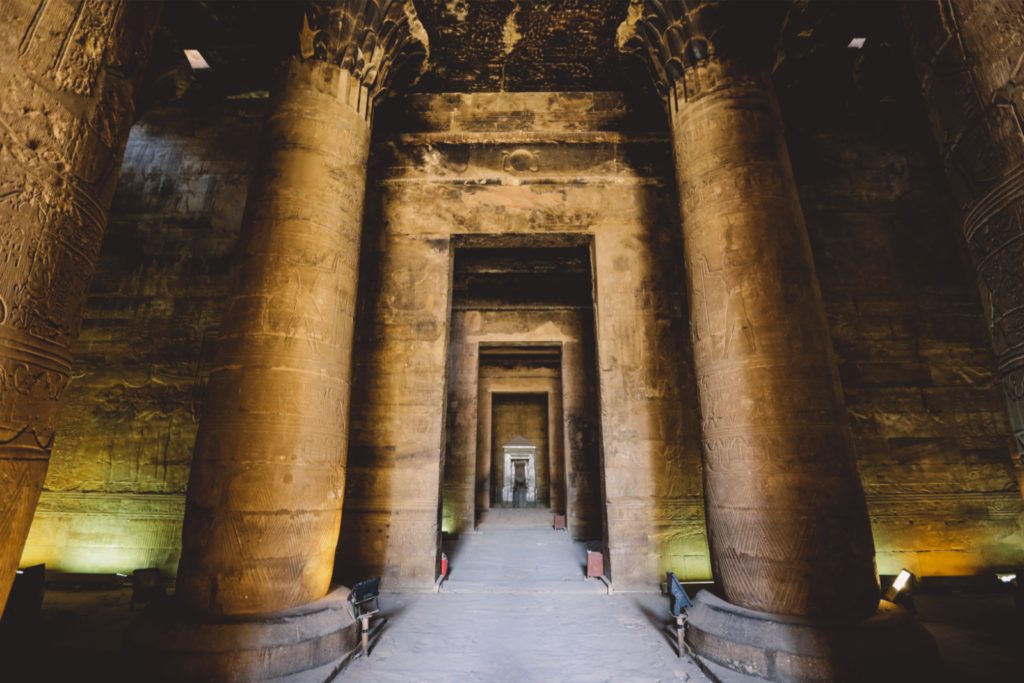
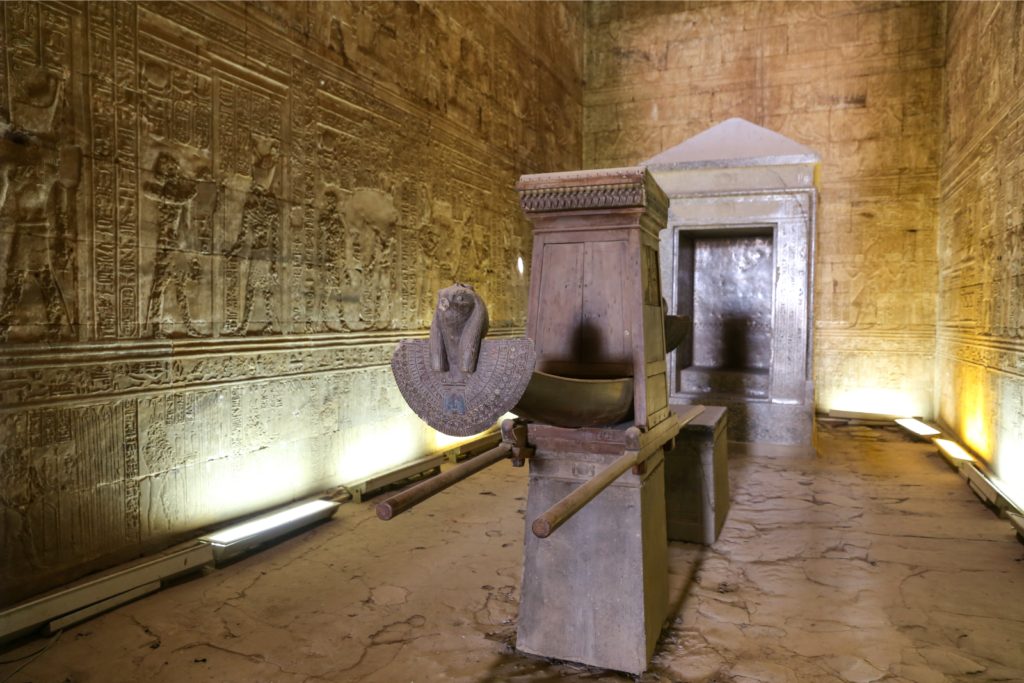
Because they are the youngest: built between about 280 and 30 BC, and often finished under Rome, they have had less time to decay, and several were protected by sand, silt or later reuse. The Ptolemies rebuilt ancient sanctuaries on a grand scale, following traditional plans but adding new features: screen walls between columns, birth houses (mammisi) celebrating the divine child, and walls packed with texts in an expanded hieroglyphic script of several thousand signs.
| Temple | God | Built | How most travellers visit |
|---|---|---|---|
| Edfu | Horus | 237–57 BC | Nile cruise stop, between Luxor and Aswan |
| Dendera | Hathor | From the 50s BC, finished under Rome | Day trip from Luxor, about 1–1.5 hours each way |
| Kom Ombo | Sobek and Horus the Elder | Mainly 2nd century BC | Nile cruise stop, 45 km north of Aswan |
| Philae | Isis | Mainly from Ptolemy II, 3rd century BC | Short boat ride from Aswan |
How did Ptolemaic Egypt end?
It ended when Rome, which had been steadily drawing Egypt into its orbit, defeated Cleopatra VII and Mark Antony and annexed the country in 30 BC. Roman power was felt long before: in 168 BC a Roman envoy, Popillius Laenas, drew a circle in the sand around the Seleucid king Antiochus IV outside Alexandria and ordered him to promise to leave Egypt before stepping out of it. By the first century BC, Ptolemy XII depended on Roman backing to keep his throne.
His daughter Cleopatra VII restored Egypt’s fortunes through her alliances with Julius Caesar and then Mark Antony. After their defeat at Actium in 31 BC, Octavian, the future Augustus, took Alexandria; Antony and Cleopatra took their own lives in August 30 BC, and Egypt became a Roman province. The story continues in our guide to Roman Egypt.
Where to see Ptolemaic Egypt today
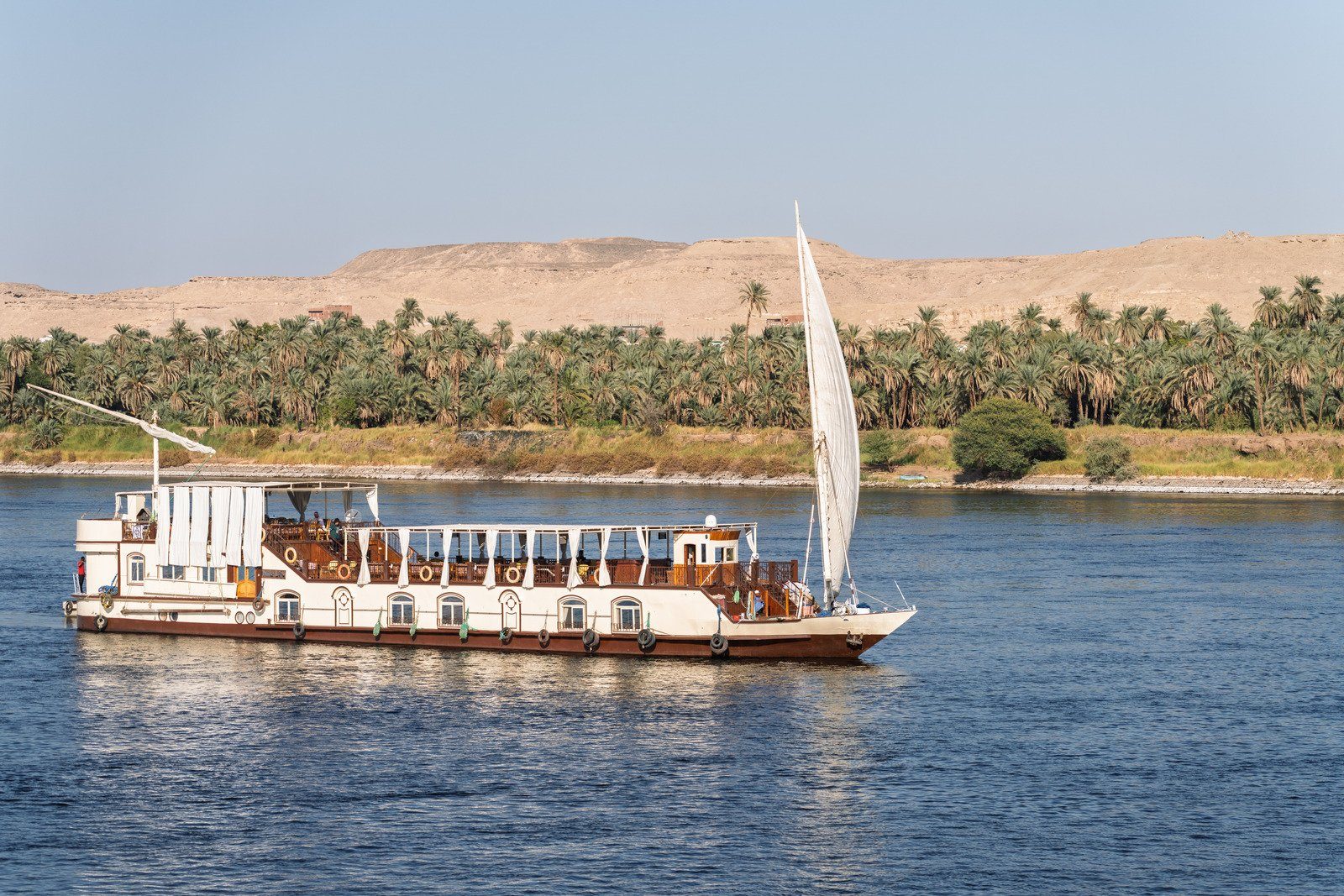
A Luxor–Aswan Nile cruise is the easiest way: it stops at Edfu and Kom Ombo and ends near Philae, three of the four great Ptolemaic temples, and Dendera is a half-day trip from Luxor. A dahabiya on the same stretch lets you visit them outside the cruise-ship rush.
- Karnak: the tall Ptolemaic gateway in front of the Temple of Khonsu, built under Ptolemy III, is easy to miss.
- Deir el-Medina: a small, perfectly preserved Ptolemaic temple of Hathor stands above the workmen’s village.
- Tuna el-Gebel: the tomb of the priest Petosiris, from around the time of Alexander’s conquest, mixes Egyptian and Greek styles.
- Alexandria: a day trip from Cairo, about 3 hours each way by road, for the Pharos site, the Serapeum and the city museums.
Tickets for all of these are sold at each site; current prices are on egymonuments.gov.eg.
Frequently asked questions
Were the Ptolemies Egyptian or Greek?
They were Macedonian Greeks descended from Ptolemy I, Alexander’s general, and they married mostly within the family. They ruled as pharaohs and supported Egyptian religion, but their court language was Greek.
How many Ptolemies were there?
Fifteen kings named Ptolemy are conventionally numbered, though the numbering has gaps and overlaps that scholars still debate. Several queens, including Cleopatra VII, ruled in their own right.
Was Cleopatra the last pharaoh?
Cleopatra VII was the last active ruler of the dynasty. Her son Caesarion was co-ruler and was killed on Octavian’s orders in 30 BC. Roman emperors were later depicted as pharaohs on temple walls, but they ruled from Rome.
Which Ptolemaic temple should I visit if I only have time for one?
Edfu, for its completeness: pylon, courts, halls and sanctuary all survive with the roof. If you prefer colour and atmosphere, Dendera’s restored ceilings are the most vivid.
Does anything remain of the Library of Alexandria?
Nothing identifiable. The Library declined over centuries rather than in a single fire. The modern Bibliotheca Alexandrina, opened in 2002, stands near the ancient royal quarter.