Quick answer
Cleopatra VII ruled Egypt from 51 to 30 BC, the last active ruler of the Ptolemaic dynasty founded by a general of Alexander the Great. A shrewd, multilingual politician, she allied herself with Julius Caesar and then Mark Antony to keep Egypt independent of Rome, and died by her own hand at 39 after their defeat, when Egypt became a Roman province.
Cleopatra in brief: what most people get wrong
The real Cleopatra was a Greek-speaking head of state fighting to keep her kingdom independent, not the seductress of Roman propaganda and Hollywood. A few corrections worth knowing before you go:
- She was not ethnically Egyptian, but she was Egypt’s queen: her father’s line descended from Ptolemy I, a Macedonian general of Alexander the Great. The identities of her mother and paternal grandmother are uncertain, so scholars still argue about the rest of her ancestry.
- She lived closer in time to us than to the building of the pyramids: about 2,500 years separate the Great Pyramid from Cleopatra.
- Her beauty is unrecorded: Plutarch, writing about a century later, says her looks were not incomparable but her conversation was irresistible. Her coins show a strong, hooked nose.
- She spoke Egyptian: according to Plutarch she was the first of her dynasty to learn it, and she spoke several other languages.
- She was not rolled in a carpet: Plutarch says she was smuggled to Caesar inside a bedding sack. The carpet is a later embellishment.
How did Cleopatra come to power?
She inherited the throne at about 18 in 51 BC, jointly with her younger brother Ptolemy XIII, in a kingdom heavily in debt to Rome. Her father, Ptolemy XII Auletes, had kept his throne only by bribing Roman politicians, and the family had a long habit of brother-sister marriage and murderous rivalry. Within a couple of years Ptolemy XIII’s advisers had driven Cleopatra out of Alexandria, and she raised an army on the Syrian border.
Rome’s civil war then arrived in Egypt. In 48 BC the defeated Roman general Pompey sailed to Egypt seeking refuge and was murdered on landing on the orders of Ptolemy XIII’s court. Julius Caesar, following Pompey, reached Alexandria and set himself up as arbiter between the siblings. Cleopatra got herself into the palace to plead her case, and won him over. In the fighting that followed, known as the Alexandrian War, Ptolemy XIII drowned in the Nile, and Caesar installed Cleopatra with a still younger brother, Ptolemy XIV, as co-ruler. For the dynasty she belonged to, see our guide to Ptolemaic Egypt.
What was Cleopatra’s relationship with Caesar and Antony?
Both were political alliances as much as love affairs: each Roman needed Egypt’s grain and gold, and Cleopatra needed Roman power to keep her throne.
Julius Caesar. In 47 BC Cleopatra gave birth to a son, Ptolemy Caesar, nicknamed Caesarion, whom she named as Caesar’s child. She lived in Caesar’s villa in Rome from about 46 BC, scandalising Roman society, and left after his assassination in March 44 BC. Back in Egypt, Ptolemy XIV died, possibly poisoned on her orders, and she made the young Caesarion her co-ruler.
Mark Antony. In 41 BC Antony summoned her to Tarsus, in modern Turkey; she arrived on a gilded barge dressed as Aphrodite, a scene Shakespeare borrowed almost word for word from Plutarch. Twins, Alexander Helios and Cleopatra Selene, followed in 40 BC and a son, Ptolemy Philadelphus, in 36 BC. In the Donations of Alexandria of 34 BC, Antony assigned eastern territories to her and their children, which Octavian, Caesar’s adopted heir, used to turn Rome against them.
How did Cleopatra die?
She took her own life in Alexandria in August 30 BC, aged 39, about nine days after Octavian’s army entered the city and Antony had died by his own sword. The final break came at the naval battle of Actium, off western Greece, on 2 September 31 BC, when Antony and Cleopatra’s fleet was defeated and they fled back to Egypt.
The famous snakebite is the version Octavian promoted, parading an image of her with an asp in his triumph in Rome. But the ancient writers themselves were unsure: Plutarch says no one knew the truth, and mentions a poisoned pin or ointment as alternatives. Many modern historians think poison is at least as likely as a snake.
Caesarion, then 17, was hunted down and killed on Octavian’s orders. Her children by Antony were taken to Rome and raised by Antony’s former wife Octavia; Cleopatra Selene later became queen of Mauretania in North Africa. Egypt became a Roman province, the personal property of the emperor, and the story continues in our guide to Roman Egypt.
Has Cleopatra’s tomb been found?
No. Ancient writers say she and Antony were buried together in a mausoleum beside the royal palace in Alexandria, an area that has long since been built over or has sunk beneath the sea. Earthquakes and subsidence submerged much of the old royal quarter around the Eastern Harbour, and underwater surveys since the 1990s have mapped harbour works, statues and sphinxes there.
Since the mid-2000s the Dominican archaeologist Kathleen Martinez has excavated at Taposiris Magna, a temple about 45 km west of Alexandria, arguing the couple could be buried there. Her team has found coins with Cleopatra’s image and a long rock-cut tunnel, but no tomb, and most Egyptologists consider the theory unproven.
Where to see Cleopatra in Egypt today
Her best surviving portrait in Egypt is carved on a temple wall at Dendera, while Alexandria gives you her city, even if almost nothing of her palace survives above water.
- Dendera Temple, north of Luxor: on the outer rear wall, Cleopatra and Caesarion make offerings to the gods in full pharaonic dress, the only large-scale relief of her you can easily visit.
- Alexandria: look over the Eastern Harbour, where her palaces stood, from the Citadel of Qaitbay, then see statues and objects raised from the sunken royal quarter at the Alexandria National Museum.
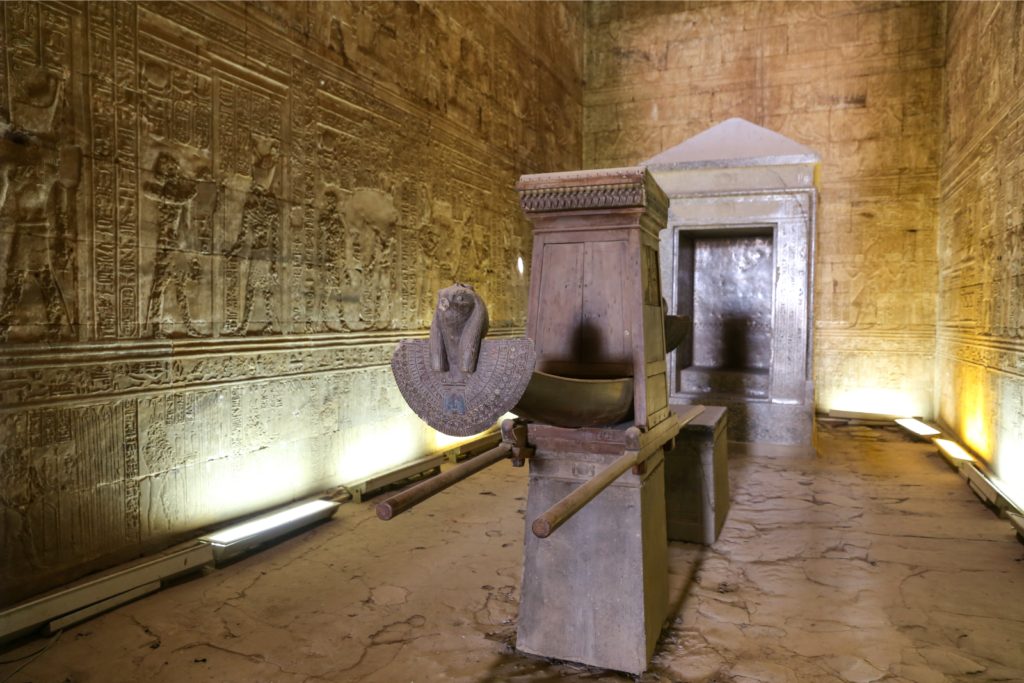
- Edfu Temple: its great pylon was decorated for her father, Ptolemy XII, and shows how the Ptolemies presented themselves as traditional pharaohs.
Beware of borrowed names: Cleopatra’s Spring at Siwa and the “Cleopatra’s Needles” obelisks now in London and New York have no proven link to her. The obelisks were carved for Thutmose III and only moved to Alexandria under Roman rule. Our Ultimate Egypt journey includes Alexandria, and Dendera features on our Luxury Egypt tour.
Frequently asked questions
Was Cleopatra Egyptian?
She was queen of Egypt and born in Alexandria, but her father’s family was Macedonian Greek. Her mother’s identity is uncertain, so part of her ancestry is unknown.
Did Cleopatra really die from a snakebite?
That is the traditional story, promoted by Octavian, but ancient writers such as Plutarch admitted nobody knew for sure. Poison is a serious alternative.
How many children did Cleopatra have?
Four: Caesarion, her son with Julius Caesar, and the twins Alexander Helios and Cleopatra Selene and their brother Ptolemy Philadelphus, her children with Mark Antony.
Is Cleopatra’s tomb in Alexandria?
Ancient sources place it beside the royal palace in Alexandria, but it has never been found. The theory that it lies at Taposiris Magna, west of the city, is unproven.
Was Cleopatra the last pharaoh?
She was the last active ruler of independent Egypt. Her son Caesarion was nominally co-ruler and was killed soon after her death, and later Roman emperors were also depicted as pharaohs on temple walls.