Quick answer
Horus was the falcon-headed Egyptian god of the sky and kingship, and every living pharaoh was considered his earthly form. As the son of Isis and Osiris he fought his uncle Seth for the throne and lost an eye that became the protective wedjat symbol. His best-preserved temple is at Edfu, between Luxor and Aswan.
Who was Horus?
Horus was the god of kingship: the reigning pharaoh was Horus on earth, and on death became Osiris, while his successor became the new Horus. He is one of Egypt’s oldest gods. A falcon perches on the king’s name on some of the earliest royal monuments, and the Narmer Palette of about 3100 BC shows a falcon holding a captive. From then on every king had a “Horus name”, written inside a rectangular frame topped by a falcon.
“Horus” was really a family of falcon gods that merged over time. Horus the Elder (Haroeris) was a sky god whose eyes were the sun and moon; Horus son of Isis was the avenger of Osiris; Horus the Child (the Greeks’ Harpocrates) was the infant in his mother’s lap; Horus of Behdet was the winged sun of Edfu; and Ra-Horakhty fused him with the sun god Ra. Egyptians themselves blended these identities freely.
How is Horus depicted?
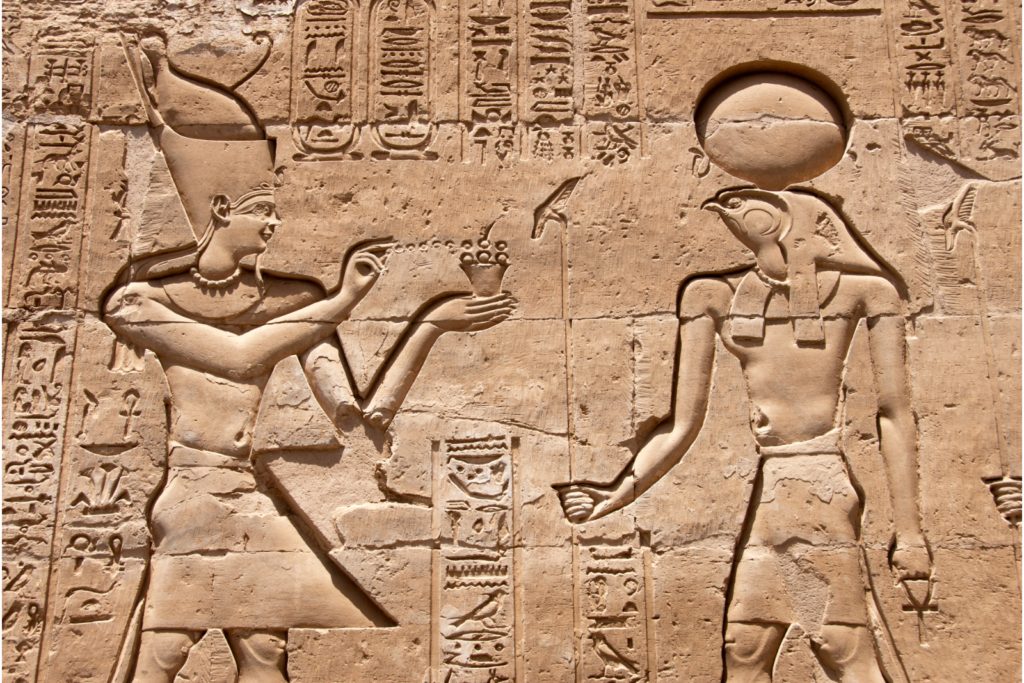
Horus is a falcon, or a falcon-headed man wearing the double crown of Upper and Lower Egypt. The red-and-white crown signals his claim to rule the whole country. Over temple doorways you will see a sun disc with spreading falcon wings: this is Horus of Behdet, protecting the entrance.
As a child he is shown naked with a sidelock of hair and a finger to his lips. Greek visitors misread the gesture as a call for silence, and Harpocrates became a god of secrecy in Roman times, though in Egypt it simply marked him as a child. One of the most memorable images of Horus as the king’s protector is the diorite statue of Khafre, the Giza pyramid builder, with a falcon’s wings wrapped around the back of the king’s head.
Horus and Seth: the battle for the throne
After Seth murdered Osiris, his son Horus fought Seth for the throne of Egypt and eventually won. The fullest telling, the Contendings of Horus and Seth, survives on a papyrus written around 1150 BC. It is less a solemn myth than an earthy comedy: the gods’ tribunal dithers for eighty years; the rivals turn into hippopotamuses to see who can stay underwater longest; Horus builds a boat of wood plastered to look like stone, while Seth’s real stone boat sinks. Seth tears out Horus’s eyes, and Hathor restores them with gazelle milk. In the end a letter from Osiris in the underworld settles the matter, and Horus is crowned.
Older texts tell it differently. In the Pyramid Texts it is Thoth who heals Horus’s eye, and Horus injures Seth in return. At Edfu, the conflict became a ritual drama in which Horus harpoons Seth in the shape of a hippopotamus, carved in a sequence of reliefs along the temple’s enclosure wall.
What does the Eye of Horus mean?
The Eye of Horus, or wedjat (“the sound one”), stands for healing, wholeness and protection, because the eye Seth damaged was restored. It was linked with the moon, which wanes and returns to fullness each month, and it became one of Egypt’s most popular amulets, worn by the living and placed in mummy wrappings. Every offering in a temple could be called “the Eye of Horus”, as Horus had given his restored eye to Osiris.
You will often read that the parts of the eye stand for the fractions ½ to 1/64 used to measure grain. That idea comes from early 20th-century scholarship; more recent research suggests the fraction signs developed separately and were only later associated with the eye, so treat the neat diagrams you see in souvenir shops with caution. The Eye of Horus is also distinct from the fierce Eye of Ra. Our guide to ancient Egyptian symbols explains how to tell them apart.
Edfu: the Temple of Horus
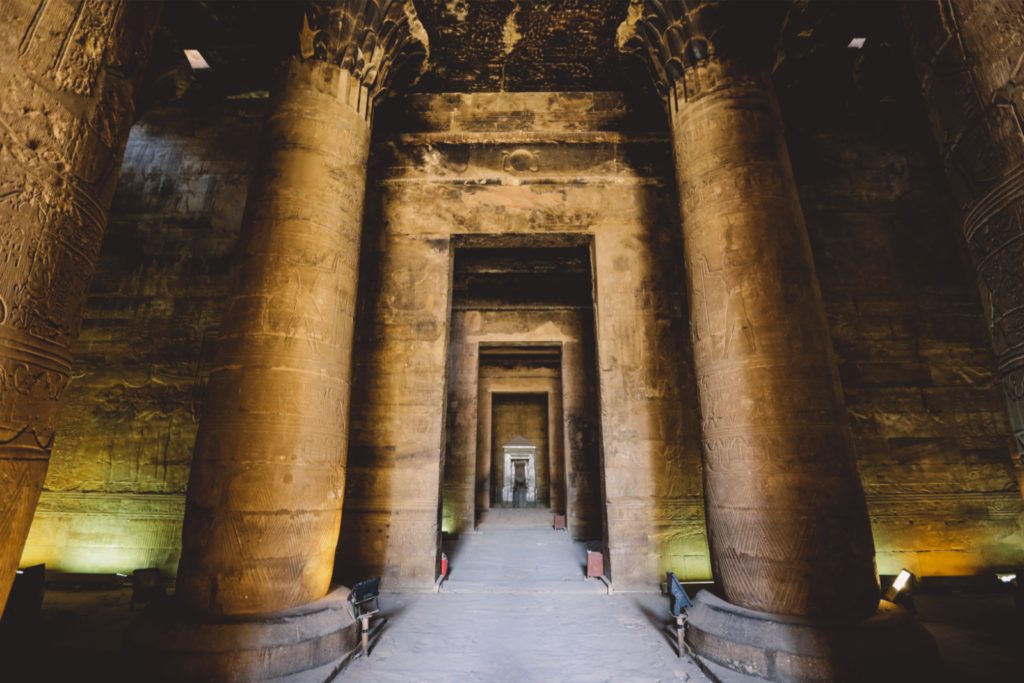
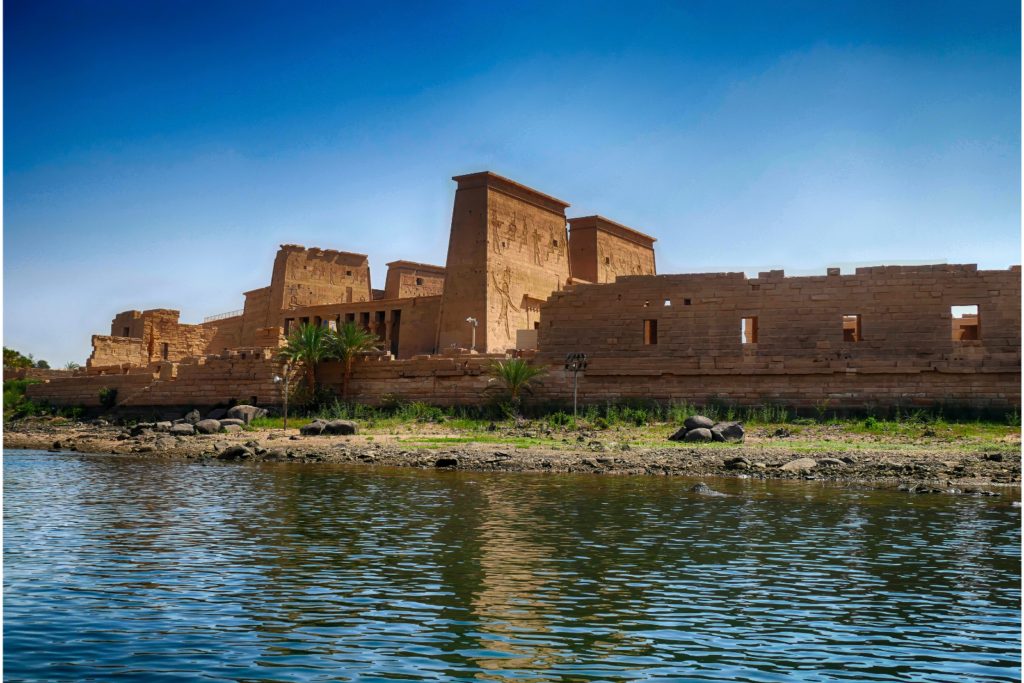
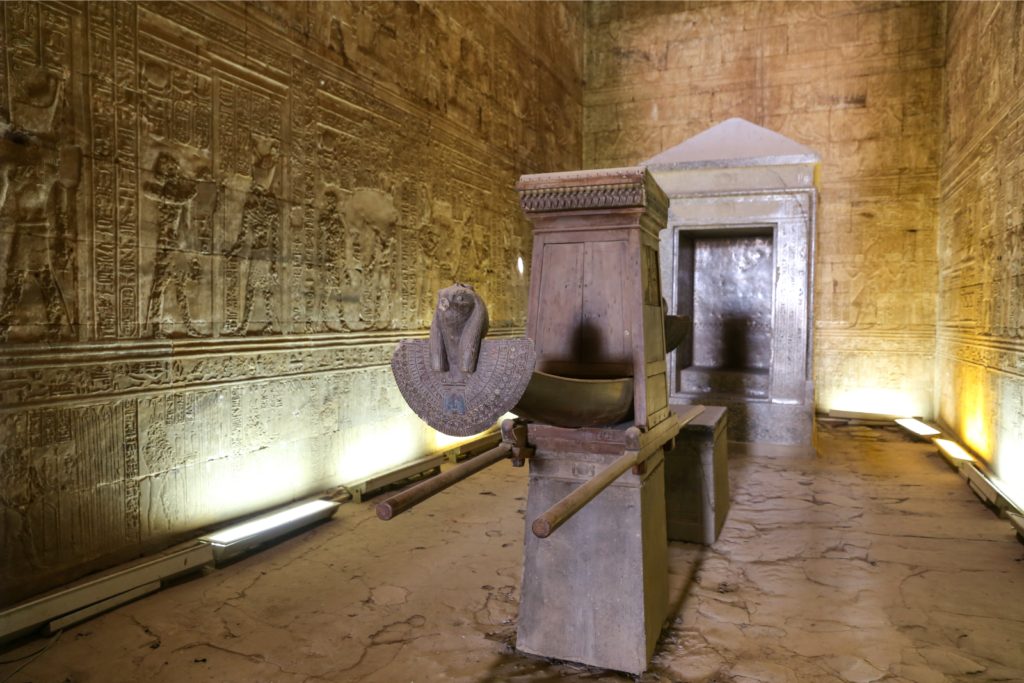
Edfu is the most complete temple surviving from ancient Egypt, built for Horus of Behdet between 237 and 57 BC under the Ptolemies. Because it was buried in sand and silt for centuries, its pylon (about 36 m high), courtyard, halls, roof and enclosure wall all survive. Two granite falcons guard the entrance, and in the sanctuary a dark granite shrine from the reign of Nectanebo II still stands, with a replica of the god’s sacred boat in front of it.
Edfu’s walls record its own building history and festivals in exceptional detail. The most charming is the Festival of the Beautiful Meeting: each summer Hathor’s statue sailed upriver from Dendera to spend about two weeks with her husband Horus at Edfu, accompanied by crowds, music and feasting.
Where to see Horus in Egypt today
Start with Edfu, about 110 km south of Luxor, which every Nile cruise and most Luxor–Aswan drives visit; allow about 90 minutes. Arrive early or late to avoid the cruise-ship rush, and walk the narrow passage between the temple and the enclosure wall to find the reliefs of Horus harpooning Seth.
- Kom Ombo: a unique double temple, one half for Horus the Elder and the other for the crocodile god Sobek.
- Philae: the birth house celebrates the birth of Horus to Isis.
- Egyptian Museum, Tahrir: the Narmer Palette, showing the earliest royal falcon, is among the museum’s great treasures at the time of writing.
- El Kab: across the river lies Nekhen (Hierakonpolis), the ancient falcon city, an archaeological site rather than a visitor attraction.
Frequently asked questions
Is the Eye of Horus the same as the evil eye?
No. The Eye of Horus is an ancient Egyptian symbol of healing and protection. The blue glass eye charm sold widely in Egypt and the Middle East today is a separate tradition against envy.
Is Horus the same god as Ra?
They are different gods, but they merged as Ra-Horakhty, the falcon-headed morning sun wearing a sun disc. Horus on his own normally wears the double crown.
Why is Horus a falcon?
The falcon flies higher than other birds and seems to rule the sky, making it a natural emblem for a sky god and for kingship. Falcons were also native to the Nile valley and widely revered.
How long do you need at Edfu Temple?
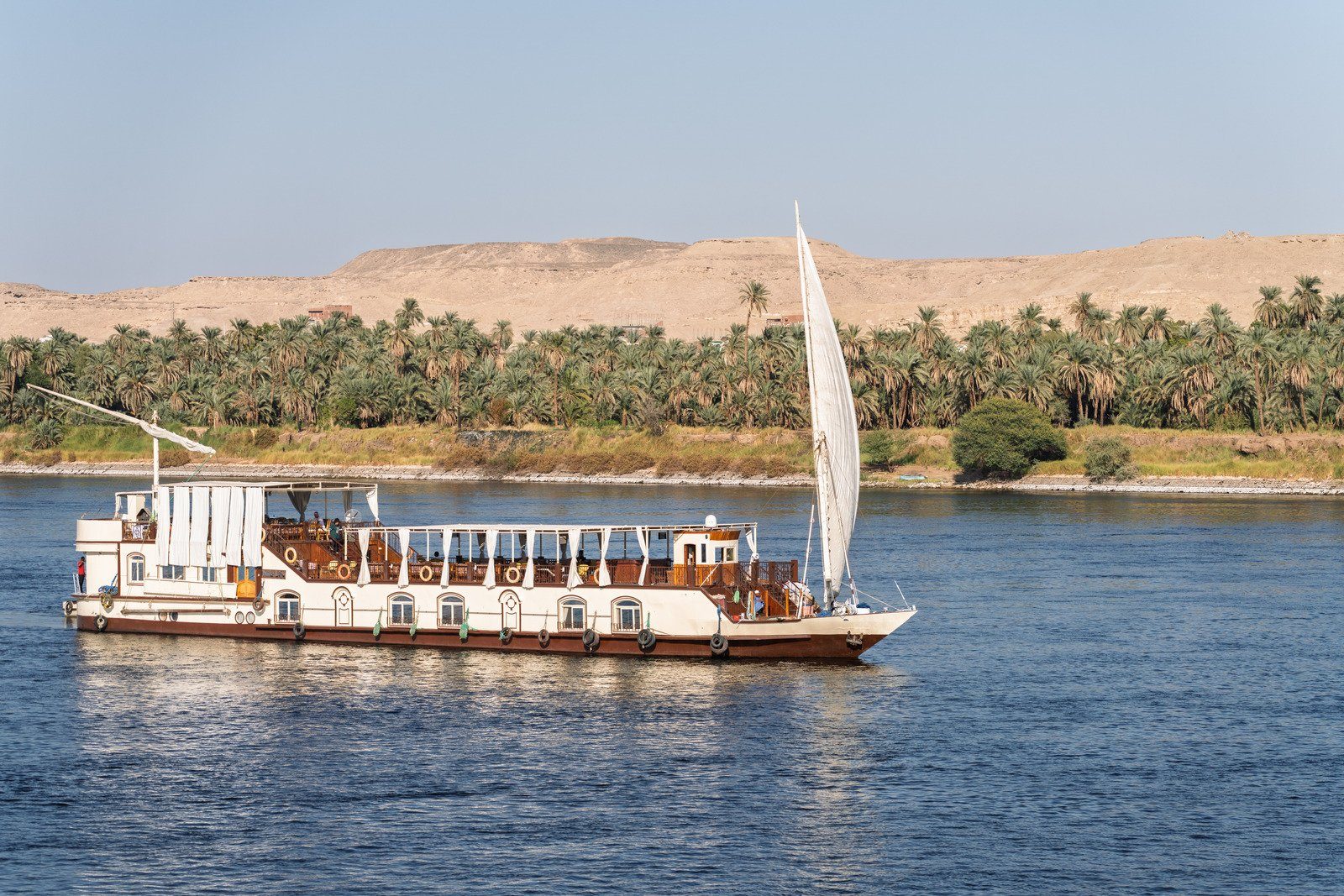
About 60–90 minutes. Cruise passengers usually visit early in the morning, travelling from the mooring by horse-drawn carriage or minibus.
Which Horus is worshipped at Edfu?
Horus of Behdet, a form of Horus the Elder linked with the winged sun disc, together with his wife Hathor and their son Harsomtus.