Quick answer
Anubis was the jackal-headed Egyptian god of embalming and cemeteries, who protected the dead, prepared their bodies and led them to judgement; he was the leading funerary god before Osiris rose to prominence. His black colour stood for rebirth, not death. See him in Hatshepsut’s temple in Luxor and on Tutankhamun’s Anubis shrine at the Grand Egyptian Museum.
Who was Anubis?
Anubis was the guardian of the dead and the god of embalming, and for much of the Old Kingdom he was the most important funerary god of all. Early tomb inscriptions ask Anubis, rather than Osiris, to grant offerings to the deceased, and Osiris only joins and then overtakes him from about the Fifth Dynasty. Anubis’s titles describe his job: “he who is upon his mountain” (watching over the desert cemeteries from above), “lord of the sacred land” (the necropolis) and “he who is in the place of embalming”.
He was a protector, not a god of death itself, and certainly not a sinister figure, whatever Hollywood suggests. The Egyptians had no single death god; dying was a passage, and Anubis was the one who saw you safely through it.
Canine gods guarded the dead long before Osiris became prominent. At Abydos, the title “Foremost of the Westerners” – the westerners being the dead, buried on the desert edge where the sun sets – first belonged to a local canine god, Khentyimentiu. Over time it was absorbed by Osiris, while Anubis kept his role as the practical guardian of the body and the burial ground.
Jackal, dog or wolf – and why is he black?
Anubis is shown as a black canine lying on a shrine, or as a man with a canine head, and the black is symbolic: it is the colour of fertile Nile silt and of the embalmed body, both signs of rebirth. Real jackals are tawny, so no one in ancient Egypt mistook Anubis for a portrait.
The animal is traditionally called a jackal, and wild canines prowling desert graveyards are the obvious inspiration. Zoology adds a twist: genetic work published in 2015 showed that the Egyptian “jackal” is in fact a distinct species, now usually called the African golden wolf. Many of the dogs buried in Anubis’s catacombs were ordinary domestic dogs. Don’t confuse Anubis with Wepwawet, a separate wolf-like god of Asyut whose name means “opener of the ways”, often shown standing on a standard.
Anubis in myth
Anubis’s great mythical deed was embalming Osiris after Seth’s murder, making the god the first mummy and every later embalming a repeat of that act. His parentage changes from source to source. Some early texts make him a son of Ra; others name the cow goddess Hesat or the cat goddess Bastet as his mother. Plutarch’s version, from around AD 100, says he was the son of Osiris and Nephthys, and that Isis raised him as her own.
A Ptolemaic papyrus tells how Seth disguised himself as a leopard to attack Osiris’s body, and Anubis caught and branded him – explaining, it says, the leopard’s spots and the leopard skins worn by priests. In the judgement of the dead, Anubis leads the deceased by the hand and checks the scales as the heart is weighed against the feather of Ma’at.
Anubis and the embalmers
The chief embalmer played the role of Anubis, and at least one priest’s jackal mask survives to prove it. A Late Period pottery mask with eye-holes, now in Hildesheim, Germany, was probably worn in ritual. Tomb paintings show an Anubis figure bending over the mummy on its lion-headed bed, and at the Opening of the Mouth ritual a priest in the Anubis role holds the coffin upright at the tomb door.
Anubis also guarded the tomb itself. The seal of the royal necropolis at Thebes showed a recumbent jackal above nine bound captives, the traditional enemies of Egypt, and it was stamped on the doorways of the royal tombs, including Tutankhamun’s. The Greek historian Herodotus, visiting in the 5th century BC, says the whole embalming process took seventy days, a figure that matches several Egyptian sources. For the process Anubis oversaw, see our guide to mummification.
Cynopolis and the dog catacombs of Saqqara
Anubis’s main cult town was Cynopolis, “dog city”, in Middle Egypt, but the place where his worship can still be grasped is North Saqqara. Little survives at Cynopolis. At Saqqara, the Late Period temple complex known as the Anubieion stood on the escarpment above Memphis, and beneath it run catacombs packed with mummified dogs. A Cardiff University-led study estimated they held about eight million animals, most only hours or days old, bred and offered by pilgrims.
The dog catacombs are not part of the standard Saqqara visit at the time of writing; ask your guide whether any special access is possible. More on this mass devotion in our guide to animal mummies.
Where to see Anubis in Egypt today
The finest Anubis in Egypt is the chapel dedicated to him in the Temple of Hatshepsut at Deir el-Bahari, on the north side of the middle terrace, where the paint is still bright. Columns lead to a vaulted shrine where Hatshepsut and Thutmose III make offerings to a deep-black, jackal-headed Anubis.
- Grand Egyptian Museum, Cairo: Tutankhamun’s Anubis shrine – a black resin-coated wooden jackal with gilded ears and eyes of calcite and obsidian, lying on a gilded chest with carrying poles. It was found guarding the entrance to the tomb’s Treasury in 1926.
- Deir el-Medina, Luxor: the tomb of Sennedjem shows Anubis tending the mummy on its bier, one of the best-loved scenes on the West Bank.
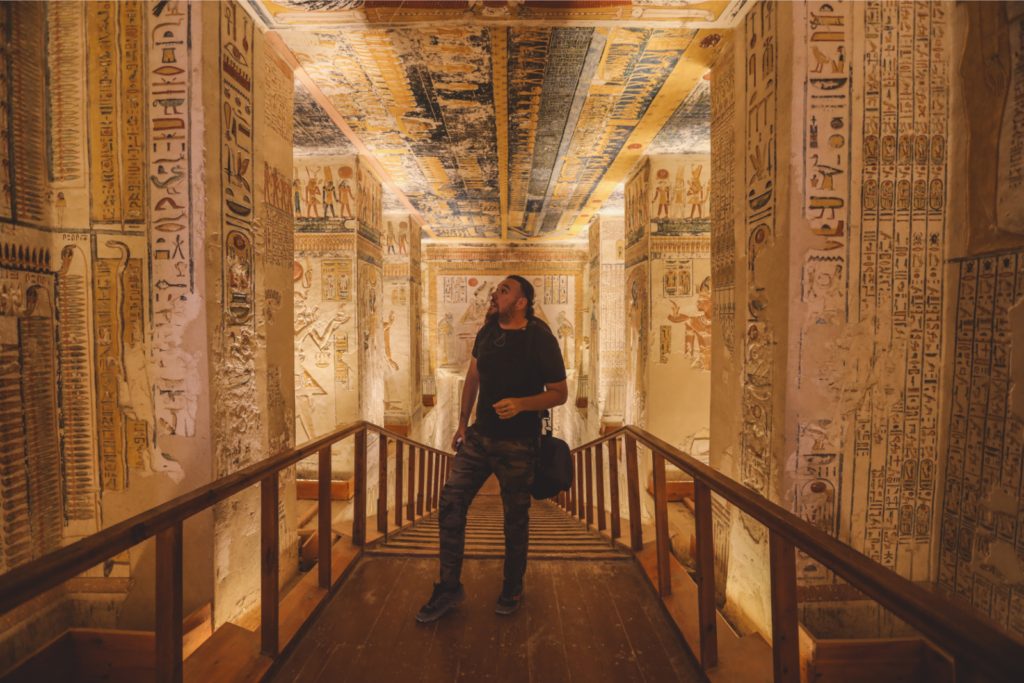
- Valley of the Kings: Anubis appears in many royal tombs, receiving the king alongside Osiris and Hathor.
Frequently asked questions
Is Anubis evil?
No. Anubis was a protector of the dead and the guardian of cemeteries. His sinister image comes from modern films and novels, not from Egyptian beliefs.
Why is Anubis black?
Black symbolised the fertile Nile silt and the colour of an embalmed body, both linked with rebirth. It was not meant to show a real jackal’s fur.
Is Anubis the god of death?
He was the god of embalming and the guardian of the dead rather than a god of death. Osiris ruled the underworld; Anubis prepared and protected people on their way there.
Where is Tutankhamun’s Anubis statue now?
The Anubis shrine is in the Tutankhamun galleries of the Grand Egyptian Museum near Giza, which opened in full in November 2025 with the complete Tutankhamun collection.
Does Anubis weigh the heart?
In most Book of the Dead scenes Anubis operates or checks the scales, Thoth records the result and Osiris presides as judge. Details vary between papyri.