Quick answer
Hathor was the Egyptian goddess of love, music, dance, joy and motherhood, shown as a cow, a woman with cow horns and a sun disc, or a face with cow’s ears. She was also the fierce Eye of Ra and a welcoming guardian of the dead. Her finest temple is at Dendera, about an hour north of Luxor.
Who was Hathor?
Hathor was the goddess of everything that made life sweet – love, sex, music, dance, beauty and drink – and a nurturing mother to the king. Her name, Hut-Hor, means “House of Horus”, referring to the sky in which the falcon god lived. She was variously Horus’s mother and his wife, and at Edfu she is his consort. A famous cow statue from her shrine at Deir el-Bahari shows Hathor emerging from the papyrus marshes and suckling the young king Amenhotep II.
Few gods had a broader portfolio. Hathor protected women in childbirth; the “Seven Hathors” appeared at a baby’s birth to announce its fate. She was Lady of the West, welcoming the dead into the Theban hills, and Lady of foreign lands, worshipped at Byblos in Lebanon, in the land of Punt and at the turquoise mines of Serabit el-Khadim in Sinai.
How was Hathor depicted?
Hathor takes three main forms: a cow, a woman wearing cow horns around a sun disc, and a woman’s face with cow’s ears. The face is unusual in Egyptian art because it is shown head-on rather than in profile. It tops the sistrum, a sacred rattle shaken in her rituals, and the capitals of the famous Hathor columns at Dendera.
Her other emblem is the menat, a heavy beaded necklace with a counterpoise, rattled by priestesses. From the New Kingdom, Isis borrowed Hathor’s horns and disc, so the two can be hard to tell apart; check the hieroglyphic label, where Hathor’s name is written as a falcon inside a house. Many Hathor faces at Dendera were deliberately hacked away. The damage is often blamed on early Christians, which is plausible for some of it, though defacement happened over many centuries.
Hathor’s two faces: the Eye of Ra and the Festival of Drunkenness
The same goddess who brought joy could become the raging lioness Sekhmet, the destructive Eye of Ra. In the Book of the Heavenly Cow, Ra sends her to punish rebellious humanity; she is stopped only when Ra floods the land with red-dyed beer, which she drinks and sleeps off. In a related myth of the Distant Goddess, the Eye storms off to the Nubian desert as a lioness and must be coaxed home – by Thoth or Shu in different versions – her return coinciding with the Nile flood.
Egyptians celebrated her pacification with a Festival of Drunkenness, when people drank deeply, played music and danced so the goddess would stay gentle. At the temple of Mut at Karnak, excavators found inscriptions naming a “porch of drunkenness” built in Hatshepsut’s reign, which they connect with this festival.
How was Hathor worshipped?
Hathor’s worship was noisy and joyful: music, dance, drink and beauty were all forms of devotion. Her priestesses, often women of high rank, shook the sistrum and the menat necklace, whose rattling was believed to soothe the goddess and drive off evil. Dancers and musicians appear in her temples and in private tomb scenes of banquets, and mirrors with Hathor-faced handles were common, linking her with beauty and self-care.
Ordinary people came to her with very personal concerns. At her shrine at Deir el-Bahari, women left small offerings such as fertility figurines, painted cloths and model cows, hoping for children or a safe birth. At Dendera, a mud-brick sanatorium beside the temple let pilgrims bathe in water that had run over statues inscribed with healing spells, and sleep there hoping for a cure or a dream from the goddess.
Dendera: the Temple of Hathor
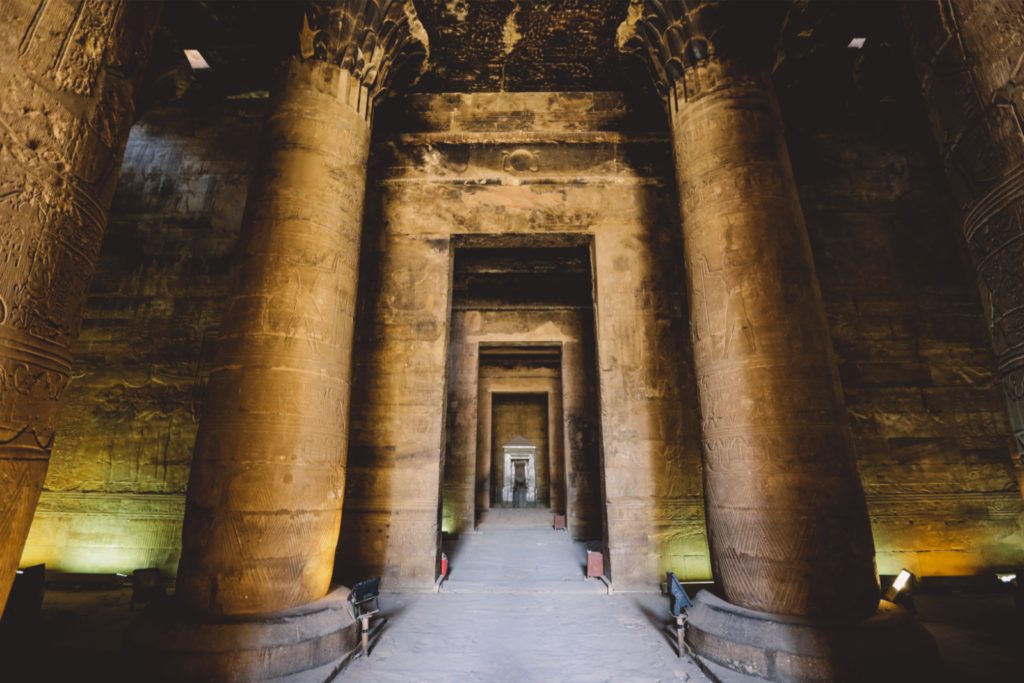
Dendera is the best-preserved temple of the Greco-Roman period after Edfu, and the place to understand Hathor. The present building was begun around 54 BC under Ptolemy XII, Cleopatra’s father, and decorated well into Roman rule, on a site sacred since the Old Kingdom. Its great hall of Hathor-headed columns has a ceiling of sky goddesses, constellations and boats of the sun, with colour revealed by recent cleaning.
Climb the stairs to the roof, carved with priests carrying the goddess’s statue up for the New Year ceremony, when she was united with the sun. On the roof, a chapel holds a cast of the circular Dendera zodiac; the original was removed in 1821 and is in the Louvre. Some crypts are open, including one with the relief that fringe writers call the “Dendera light bulb”: its captions identify it as a lotus giving birth to a snake, an image of creation. On the rear outer wall, Cleopatra VII and her son Caesarion make offerings to the gods – one of very few images of Cleopatra on an Egyptian temple.
Where to see Hathor in Egypt today
Go to Dendera, about 60 km north of Luxor (roughly an hour to 90 minutes by road), and allow two hours on site. It is far quieter than Karnak and combines well with Abydos in a full day.
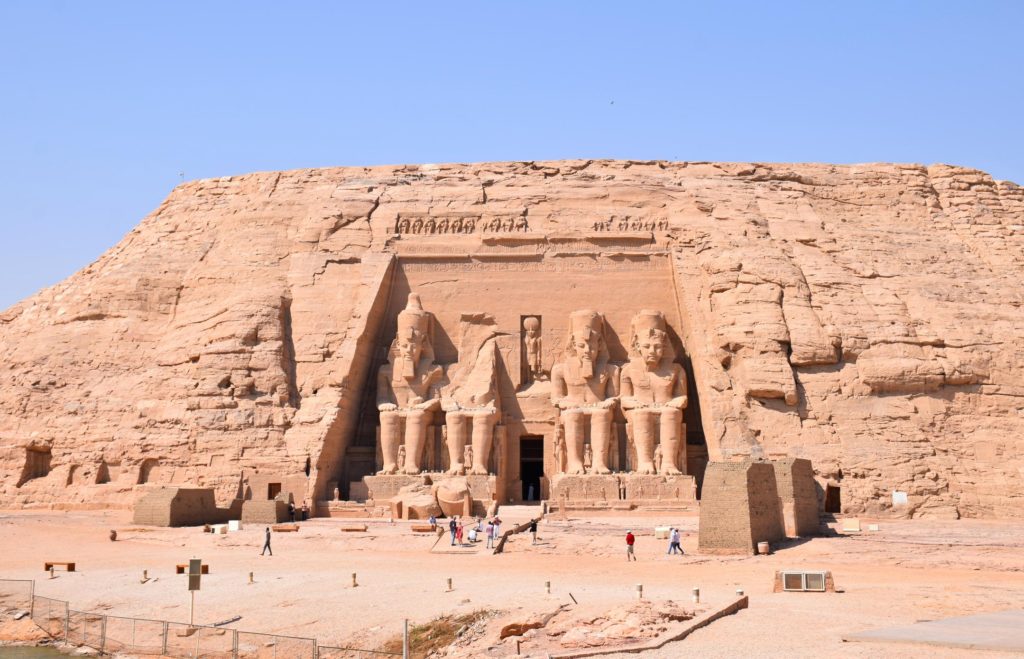
- Temple of Nefertari, Abu Simbel: the smaller temple was dedicated to Hathor and Queen Nefertari, with Hathor-headed pillars and the queen shown in Hathor’s horns and plumes.
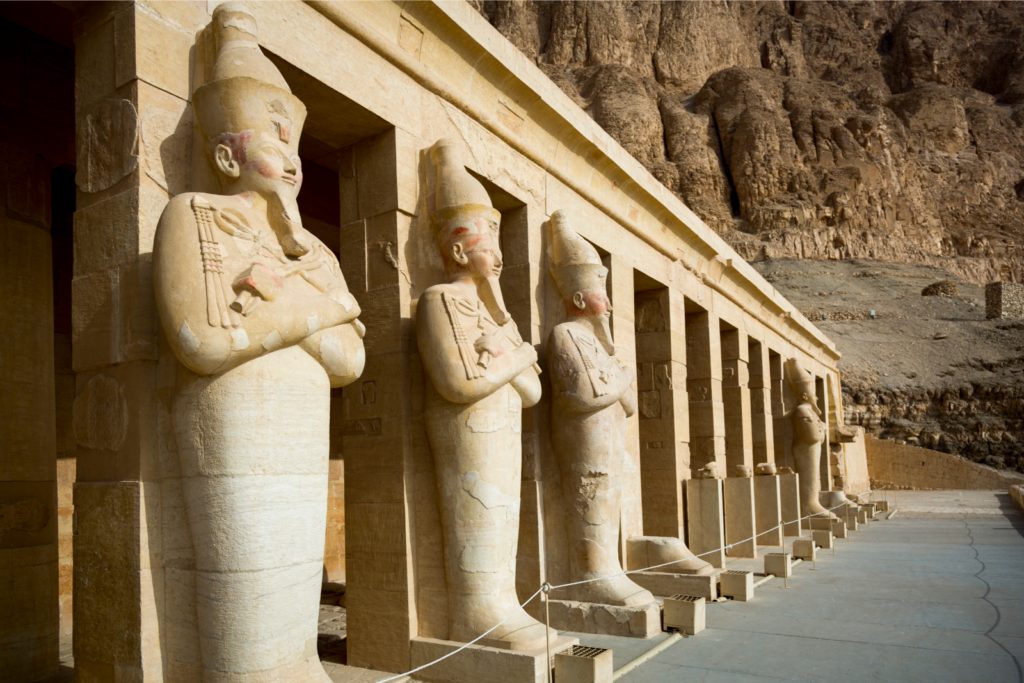
- Temple of Hatshepsut: the Hathor chapel at the southern end of the middle terrace has Hathor-capital columns and scenes of the cow goddess.
- Deir el-Medina: a small, well-preserved Ptolemaic temple to Hathor overlooks the workmen’s village.
- Philae: a small Hathor temple shows musicians, including Bes playing the harp and tambourine, entertaining the goddess.
Frequently asked questions
Is Hathor the same as Sekhmet?
They were distinct goddesses, but myth treats Sekhmet as Hathor’s furious form when she acts as the Eye of Ra. Calmed, the lioness becomes the gentle cow goddess again.
Is the Dendera zodiac original?
No. The ceiling at Dendera is a cast. The original sandstone zodiac was cut out and taken to France in 1821 and is displayed in the Louvre in Paris.
What is the Dendera light?
A relief in one of the temple’s crypts that some fringe writers claim shows an electric bulb. Its hieroglyphic captions describe a lotus flower producing a snake, a creation image linked to the god Harsomtus. Egyptologists do not consider it evidence of electricity.
How do you get to Dendera from Luxor?
By private car or as part of a day tour, about 60 km north; some Nile cruises of more than four nights stop there too. Allow two hours at the temple.
What is Hathor holding in temple reliefs?
Usually a sistrum (sacred rattle), a menat necklace or the ankh. Priestesses shook the sistrum and menat in her honour to soothe and please the goddess.