Quick answer
An Egyptian temple was a god's house, not a place for public worship: a sequence of gateways, courts and halls leading to a dark sanctuary where priests cared for the god's statue every day on the king's behalf. Walking from the pylon to the sanctuary, floors rise, ceilings drop and the light fades, while the walls show the king making offerings to the gods.
What was an Egyptian temple for?
A temple was the earthly home of a god, where the god’s spirit dwelt in a statue that priests fed, clothed and honoured every day so the god would keep the world in order. The Egyptian term was hut-netjer, “mansion of the god”. In theory the king was the only priest, and on every wall it is the king you see making offerings; in practice priests acted in his name.
Ordinary Egyptians did not go inside. They could pray at the outer gates, leave offerings at small shrines built for the purpose, such as the “chapel of the hearing ear” on the east side of Karnak, and see the god in person only when its statue was carried out in procession at festivals. Temples were also great landowners and employers, with fields, herds, workshops and granaries.
What are the parts of an Egyptian temple?
Almost every temple follows the same sequence from entrance to sanctuary, and once you know it you can find your way round any of them.
- Processional avenue: often lined with sphinxes, like the avenue linking Karnak and Luxor Temple.
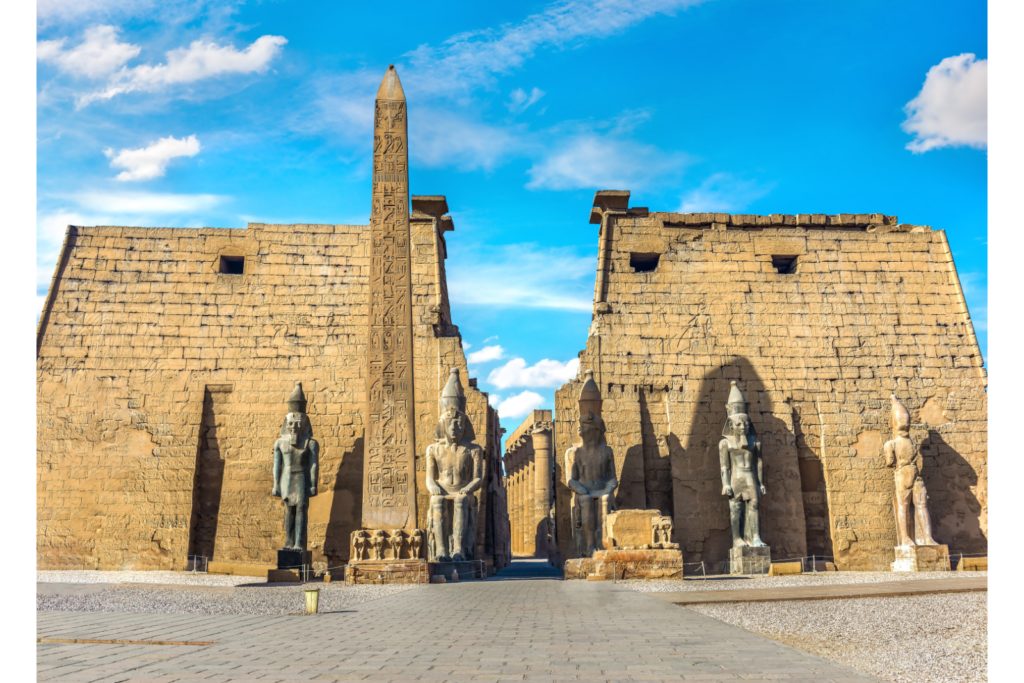
- Pylon: the monumental gateway of two sloping towers, echoing the hieroglyph for the horizon, with the sun rising between two hills. Vertical grooves held tall cedar flagpoles; the hieroglyph for “god” is a flag on a pole. Obelisks and colossal statues often stood in front.
- Open court: a sunlit courtyard surrounded by colonnades, the furthest point that a wider group of people might reach on festival days.
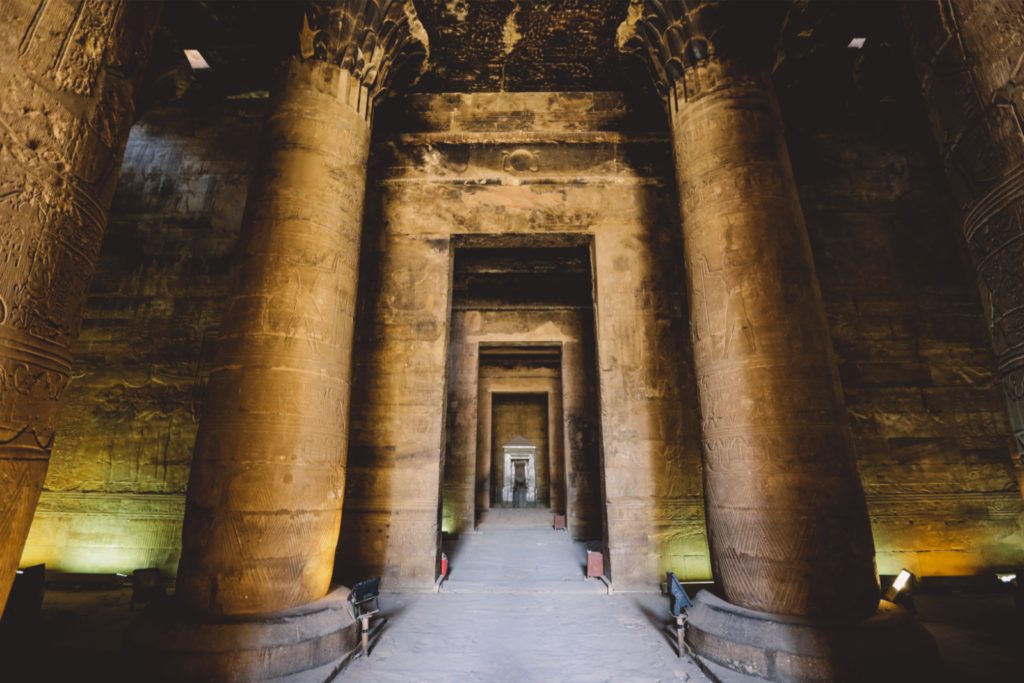
- Hypostyle hall: a roofed hall crowded with columns shaped like papyrus, lotus or palm plants, recreating the marsh that rose from the waters at creation.
- Offering halls and vestibules: smaller, darker rooms where offerings were prepared and presented.
- Sanctuary: the innermost room, holding the god’s statue in a stone shrine (naos) and its portable boat shrine. Edfu’s granite naos, dedicated by Nectanebo II, is older than the temple around it.
As you walk inwards the floor rises and the ceiling drops, so light fades step by step until the sanctuary is almost dark. The sanctuary stood on the symbolic mound of creation, the first land to emerge from the primeval waters.
What else stood inside the temple walls?
A temple was a whole complex inside a massive mud-brick enclosure wall, not just the stone building at its centre. Look for these as you explore:
- Sacred lake: a stone-lined pool where priests purified themselves; Karnak’s is the largest.
- Birth house (mammisi): a small temple celebrating the birth of the divine child, found at Dendera, Edfu and Philae.
- Nilometer: a stairway or well marked with levels to measure the flood, which set the year’s taxes; Kom Ombo and Philae have them.
- Roof chapels, crypts and stairways: Dendera has all three, including stairways carved with priests carrying the god’s statue to the roof for the New Year festival.
- Storerooms and granaries: the Ramesseum’s vaulted mud-brick magazines show the scale of temple wealth.
What did priests do every day?
They ran a daily cycle of rituals, opening the sanctuary at dawn, waking, cleaning, dressing and feeding the god’s statue, then sealing it again. The high priest broke the clay seal on the shrine doors, lit incense, sang hymns, removed the previous day’s linen, anointed the statue and presented a meal. The food was then “reverted” and shared out among the temple staff. As he left, the priest swept away his own footprints.
The staff had a clear hierarchy. The “god’s servants” (often translated prophets) performed the main rites, the High Priest of Amun at Karnak being among the most powerful people in Egypt. Lector priests read the sacred texts, and many lower-ranking “pure ones” served part-time, working one month in four in rotating teams before returning to ordinary life. Purity was essential: priests shaved their bodies, wore linen, not wool or leather, and, according to Herodotus, washed twice a day and twice a night.
Festivals broke the routine. In the Opet festival, Amun’s statue travelled from Karnak to Luxor Temple, and every year Hathor sailed from Dendera to visit Horus at Edfu.
How do you read the scenes on temple walls?
Outside, the king defends Egypt; inside, he serves the gods. That one rule explains most of what you see.
- Outer walls and pylons: battles and the king smiting enemies, to protect the god’s house and impress onlookers. Ramesses II’s account of the Battle of Kadesh appears on several temples.
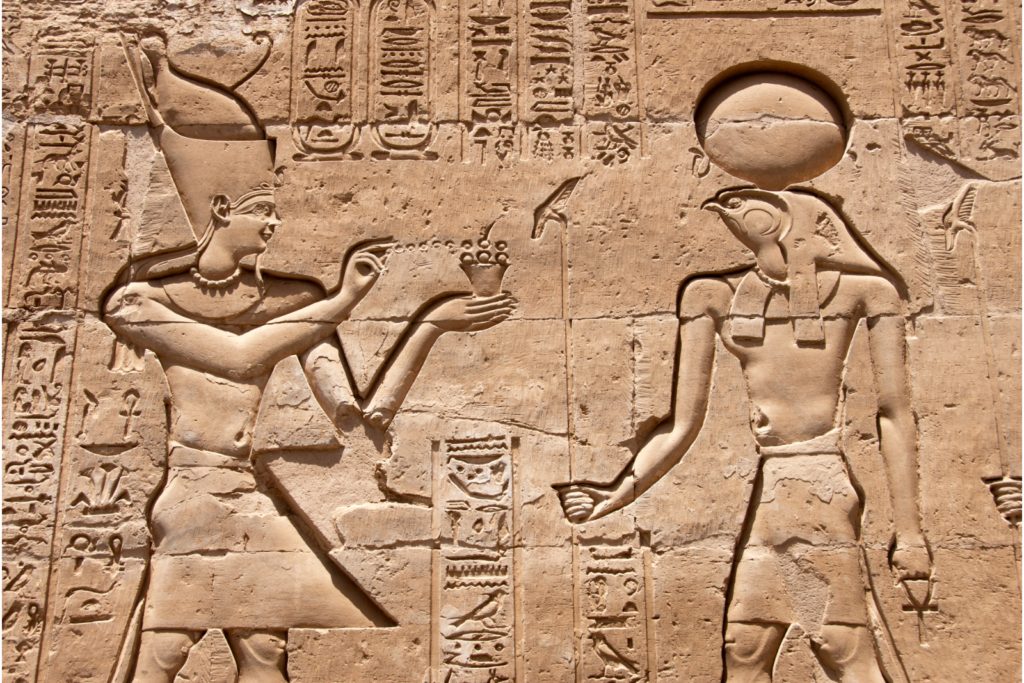
- Inner walls: rows of ritual scenes in which the king offers incense, wine, bread or a figure of Ma’at to a god, who replies with gifts of life and a long reign. The columns of hieroglyphs beside each figure are their speeches.
- Foundation scenes: at Edfu and Dendera the king and the goddess Seshat stretch a cord to lay out the temple, recording its founding.
- Ceilings and bases: ceilings show the sky, with stars and outstretched vultures; along the base, processions of Nile and regional gods bring offerings.
Look out for Roman emperors in pharaoh’s dress at Dendera, Esna and Kom Ombo: their names in the cartouches show that the old rituals continued under Rome.
What is the difference between a cult temple and a mortuary temple?
Cult temples housed a god; memorial or “mortuary” temples maintained the cult of a dead king, alongside the gods. In the Old Kingdom these stood beside the pyramids; in the New Kingdom, when kings were buried in hidden tombs, they moved to the edge of the cultivation on the Theban west bank. The Egyptians called them “mansions of millions of years”.
The Temple of Hatshepsut, the Ramesseum and Medinet Habu, the memorial temple of Ramesses III, are the great examples. They follow the same plan as cult temples, with an added focus on the king and on Amun’s yearly visit during the Valley Festival.
Why are so many temple carvings damaged?
Mostly through later reuse: early Christians chiselled out divine faces and turned halls into churches, and villagers built houses in and on the temples. At Philae and Medinet Habu you can see carved crosses and Coptic inscriptions; the temple of Isis at Philae was among the last to function and was closed under Emperor Justinian in the 6th century.
Other damage is older. Akhenaten’s agents hacked out the name of Amun, and later kings recarved their predecessors’ names. Soot from fires blackened many ceilings, now being cleaned with striking results at Karnak, Esna and elsewhere. Paradoxically, sand saved some temples: Edfu was buried up to its roof until it was cleared in the 1860s, which is why it is so complete.
Where to see Egyptian temples at their best
See Edfu to understand the plan, Karnak for scale, and Dendera for the details.
- Edfu: the most complete temple in Egypt, with pylon, court, halls, sanctuary, boat shrine and enclosure wall intact; a standard Nile cruise stop.
- Karnak: 2,000 years of building, with ten pylons, the Great Hypostyle Hall and the sacred lake.
- Dendera: colour on the ceilings, crypts and roof chapels; a day trip north of Luxor.
- Luxor Temple: a clear, compact plan, beautiful at night.
- Kom Ombo and Philae: a double temple for two gods, and a temple moved stone by stone to a new island.
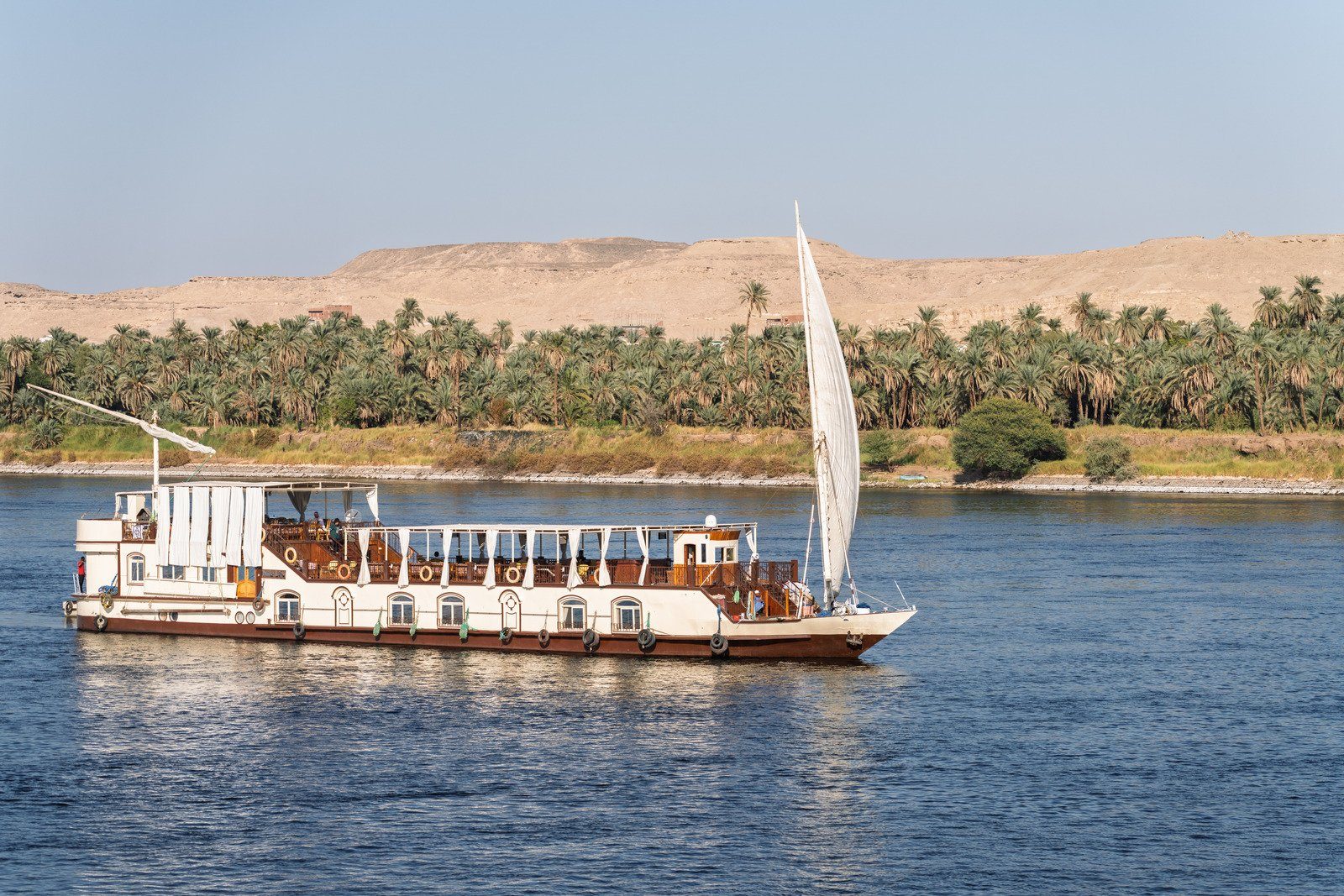
A dahabiya or small-ship Nile cruise reaches the quieter temples too, such as Esna and El Kab.
Frequently asked questions
Could ordinary Egyptians enter temples?
Not the inner parts. People prayed at the gates and outer shrines, and saw the god when its statue was carried in procession at festivals. Only priests in a state of ritual purity entered the halls and sanctuary.
What is a pylon in an Egyptian temple?
The massive gateway at the front of a temple, made of two tapering towers flanking a doorway. Its shape echoes the hieroglyph for the horizon, and grooves on its face held tall flagpoles.
What is a hypostyle hall?
A roofed hall filled with columns, usually just behind the open court. The columns represent plants of the primeval marsh. The most famous is Karnak's Great Hypostyle Hall, with 134 columns.
Which Egyptian temple is the best preserved?
Edfu, the Ptolemaic Temple of Horus, built between 237 and 57 BC. It is almost complete, roof included, and is the easiest temple in Egypt for understanding how the parts fit together.
Why do temples have obelisks?
Obelisks were solar symbols, usually set up in pairs in front of a pylon. See our guide to obelisks for how they were made and where they stand today.