Quick answer
Ra was the ancient Egyptian sun god, believed to have created the world and to sail across the sky by day and through the underworld by night. Usually shown as a falcon-headed man crowned with a sun disc, he merged with other gods as Ra-Horakhty and Amun-Ra. His cult centre was Heliopolis in Cairo, but he is best seen today at Abu Simbel and in the Valley of the Kings.
Who was Ra?
Ra (also written Re) was the sun and the power behind it: the creator who brought light and order, ruled the gods as their first king, and was reborn every dawn. His name simply means “sun”. Because the sun was the most obvious force in Egyptian life, Ra sat at the centre of state religion for most of ancient history. Kings called themselves “Son of Ra” from the Fourth Dynasty onward – the title first appears under Djedefre, Khufu’s son, around 2560 BC – and every later pharaoh carried a throne name built around Ra.
Ra was never a single fixed image. Egyptians described the sun as Khepri, the scarab beetle pushing the new sun over the horizon at dawn; as Ra at full strength at midday; and as Atum, an old man, in the evening. These are faces of one solar power rather than three separate gods, and scholars warn against reading them as a neat “trinity”.
How was Ra depicted?
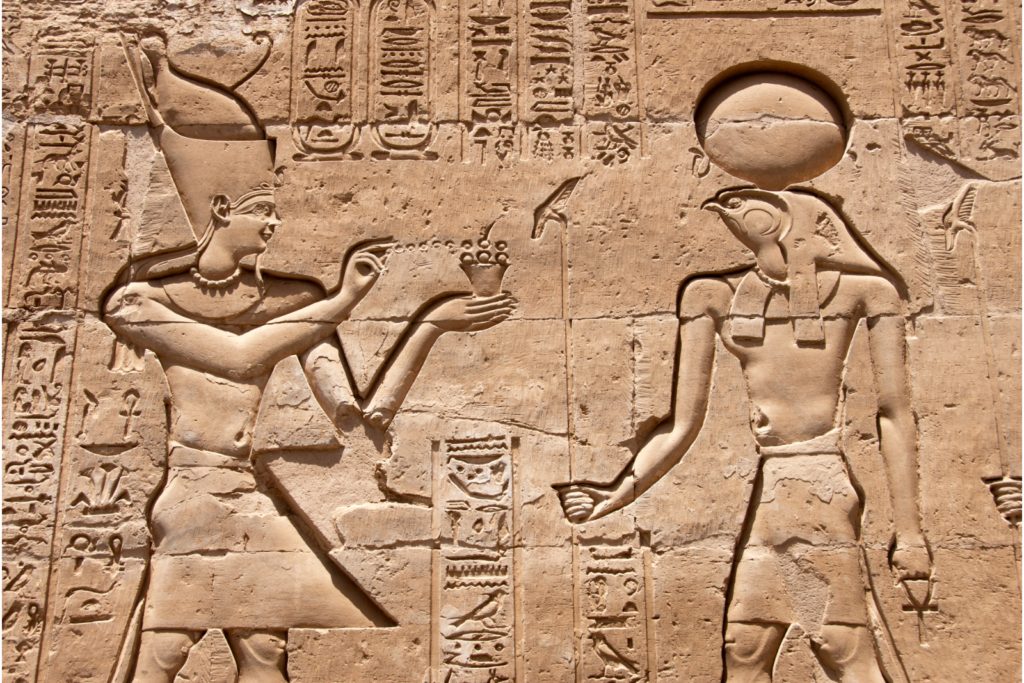
Ra is usually a man with a falcon’s head, topped by a sun disc encircled by a rearing cobra (the uraeus). In the night scenes painted in royal tombs he becomes ram-headed, the form the sun takes as it travels through the underworld. A plain red or gold disc can stand for him alone, as can the scarab and the obelisk, whose gilded tip caught the first rays of morning.
He fused easily with other gods. Ra-Horakhty, “Ra who is Horus of the Two Horizons”, combines him with Horus and is the falcon-headed sun god you see most on New Kingdom temple walls. Amun-Ra joined him to the Theban god Amun, giving the new national god the sun’s universal authority. Atum-Ra linked him to the creator of Heliopolis.
Ra’s journey through the day and the night
Each day Ra crossed the sky in a boat, and each night he sailed through the Duat, the underworld, to be reborn at sunrise. His boats carried a crew of gods. In the darkness the giant serpent Apep (Apophis) tried to swallow the sun and had to be defeated every night; in some versions Seth, standing in the prow, spears the serpent – a reminder that Seth was not always a villain.
This journey is the subject of the underworld books painted in the Valley of the Kings: the Amduat (“That which is in the underworld”), divided into the twelve hours of the night, the Book of Gates and the Book of Caves. As the sun passes, he briefly unites with Osiris, the dead god, and draws new life from him. The king hoped to join the sun’s boat and share in its rebirth each morning.
The myths of the Heavenly Cow and Ra’s secret name
Two stories dominate: Ra’s near-destruction of humanity, and Isis tricking him into revealing his hidden name. In the Book of the Heavenly Cow, whose oldest known copy is on one of Tutankhamun’s gilded shrines, an ageing Ra learns that people are plotting against him. He sends his Eye – the goddess Hathor, raging as the lioness Sekhmet – to punish them. When she cannot stop killing, Ra floods the fields with beer coloured red with ochre; she drinks it, thinking it blood, becomes drunk and forgets her fury. Weary of ruling, Ra then withdraws to the sky on the back of the celestial cow.
In the second story, known from Ramesside papyri (one is in Turin), Isis moulds a snake from earth and the old god’s own saliva. It bites him, and she agrees to cure the poison only if he tells her his secret name, the source of his power, which she then passes to her son Horus. Both myths express a very Egyptian idea: even the creator grows old, and order has to be won again and again.
Heliopolis and the sun temples
Ra’s great cult centre was Iunu, called Heliopolis (“sun city”) by the Greeks, now buried under the Cairo districts of Matariya and Ain Shams. Its temple was among the largest in Egypt and its priests were famed for learning. Heliopolis housed the benben, a sacred stone representing the first mound of creation, which probably inspired the pointed pyramidion on top of obelisks. The idea that it also inspired the pyramid shape is plausible but cannot be proven.
Fifth Dynasty kings (about 2494–2345 BC) built dedicated sun temples with a squat obelisk open to the sky. Texts name six, but only two have been securely located, near Abusir. The great cedar boat buried beside Khufu’s pyramid, now displayed at the Grand Egyptian Museum, is popularly called the “solar boat”; whether it was built for the sun god’s voyage or actually used in Khufu’s funeral is still debated.
Where to see Ra in Egypt today
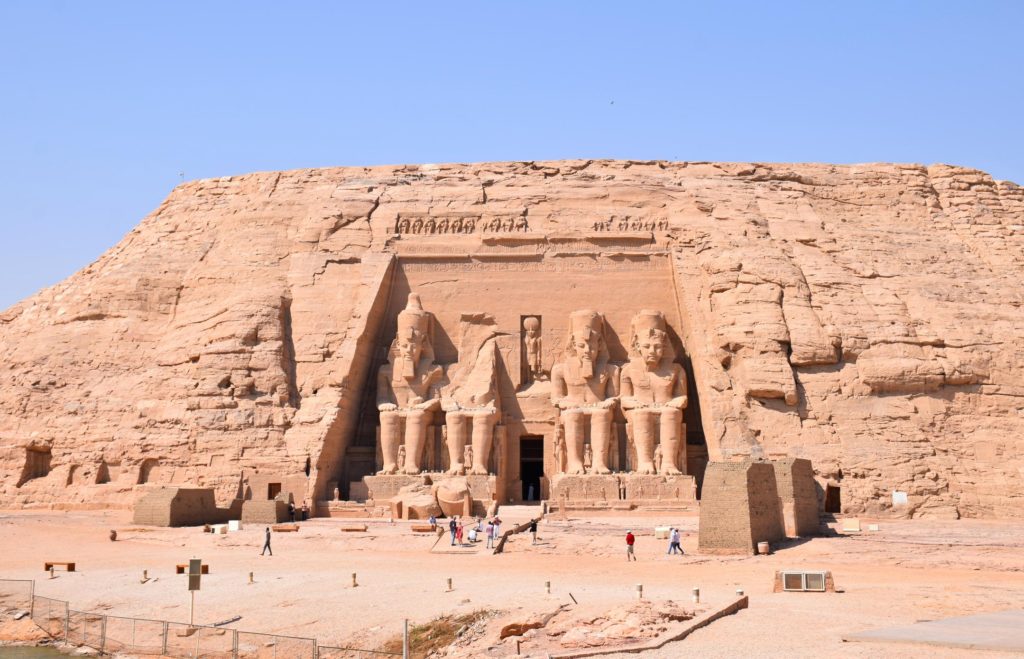
The best place is Abu Simbel, where Ra-Horakhty stands in a niche above the great temple’s entrance and the rising sun lights his statue in the sanctuary twice a year. Ramesses II’s temple honours Ra-Horakhty, Amun-Ra and Ptah alongside the deified king. On about 22 February and 22 October the dawn light reaches the seated statues at the back; it is often said that Ptah, linked with the underworld, alone stays in shadow. See our Abu Simbel Sun Festival guide for timing and crowds.
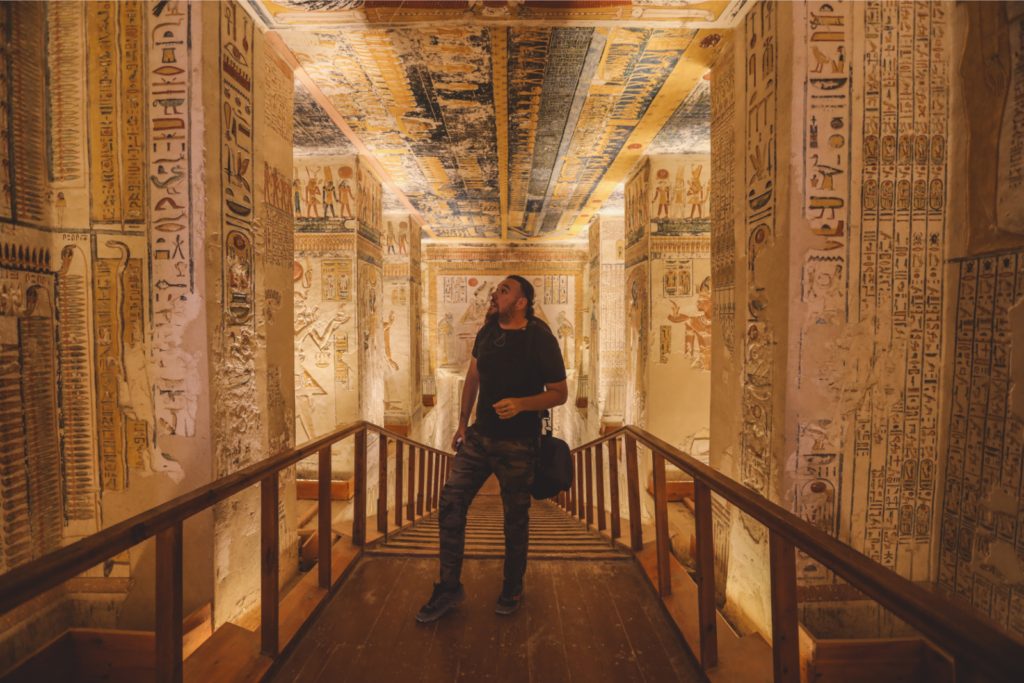
- Valley of the Kings, Luxor: the Litany of Ra and the Amduat line the royal tombs, and the tomb of Ramesses VI shows the sky goddess Nut swallowing the sun at night and giving birth to it at dawn across its ceiling.
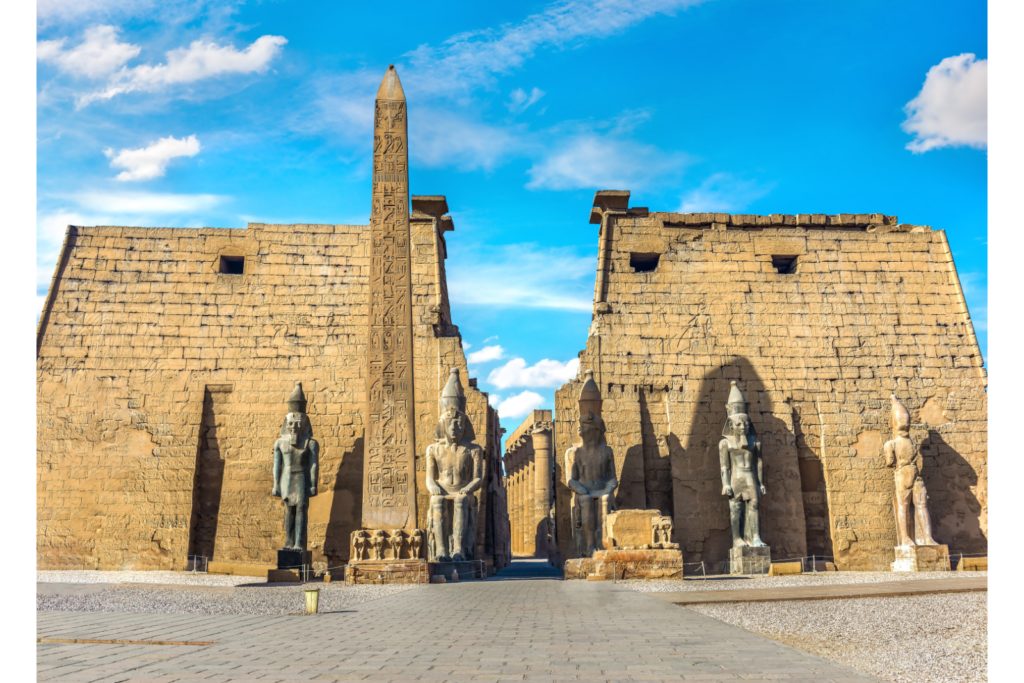
- Karnak, Luxor: the home of Amun-Ra, with obelisks of Thutmose I and Hatshepsut still standing.
- Matariya, Cairo: the obelisk of Senusret I, about 20 m tall and nearly 4,000 years old, still stands where it was erected at Heliopolis. Most of the city’s other obelisks were carried off, two ending up as “Cleopatra’s Needles” in London and New York; see our guide to obelisks.
Frequently asked questions
Is Ra the same as Amun?
No. Amun was the hidden god of Thebes; from the Middle Kingdom he was fused with Ra as Amun-Ra, combining Amun’s mystery with the sun’s visible power. Ra also continued to be worshipped in his own right.
What is the difference between Ra and Horus?
Both are falcon-headed. Ra wears a sun disc with a cobra; Horus usually wears the double crown of Upper and Lower Egypt. Ra-Horakhty, a fusion of the two, wears the sun disc. If in doubt, read the hieroglyphic label beside the figure.
What is the Eye of Ra?
The Eye of Ra is the sun god’s fierce, protective power, imagined as a goddess such as Hathor, Sekhmet or Wadjet. It is different from the healing Eye of Horus, though the two symbols are often confused.
Can you visit ancient Heliopolis?
Very little survives above ground. The obelisk of Senusret I stands in a small open-air area in Matariya, north-east Cairo, and excavations continue nearby. It is a short stop for enthusiasts rather than a major sight; check access before you go.
Did the Egyptians believe Ra was the only god?
No. Ra was supreme but one of many gods. The only attempt at worshipping a single sun god came under Akhenaten, who replaced Ra and the other gods with the Aten.