Quick answer
Edfu Temple is the Temple of Horus, the falcon god, built between 237 and 57 BC on the west bank of the Nile roughly halfway between Luxor and Aswan. It is the most complete temple in Egypt, with its roof, pylon, halls and sanctuary all intact, so it shows better than anywhere else what an Egyptian temple was actually like to walk through.
Why is Edfu Temple so well preserved?
Edfu survived almost intact because it was built late, in the Ptolemaic period, and then lay buried under sand and village houses for centuries, which protected it. Construction began on 23 August 237 BC under Ptolemy III and took around 180 years, finishing in 57 BC under Ptolemy XII, the father of Cleopatra VII. The walls even record the building dates and dimensions, which is why Egyptologists know its history so precisely.
After the temple fell out of use, drifting sand filled it almost to the top of the columns and a village grew on and around it. When the French archaeologist Auguste Mariette cleared it in the 1860s he found a temple with its roof, enclosure wall and most of its decoration in place. Some faces in the reliefs were deliberately damaged in later centuries, and soot from people living inside has darkened ceilings in places, but no other temple in Egypt gives such a complete picture.
What should you see at the Temple of Horus at Edfu?
The highlights are the great pylon, the granite falcon statues of Horus, the hypostyle halls, the sanctuary with its granite shrine and the reliefs of Horus defeating Seth. Because the plan is complete, walk it from front to back and notice how the floor rises, the ceilings drop and the light fades as you approach the sanctuary.
- The pylon: about 36 metres high, carved with Ptolemy XII smiting his enemies before Horus. It is the second-tallest pylon in Egypt after Karnak's first pylon.
- The Horus falcons: two black granite falcons guard the entrance to the courtyard and the hypostyle hall. The one by the hall door is the most photographed statue in the temple.
- The courtyard: lined by 32 columns, with reliefs of the Festival of the Beautiful Meeting, when the statue of Hathor sailed upriver from Dendera to visit Horus.
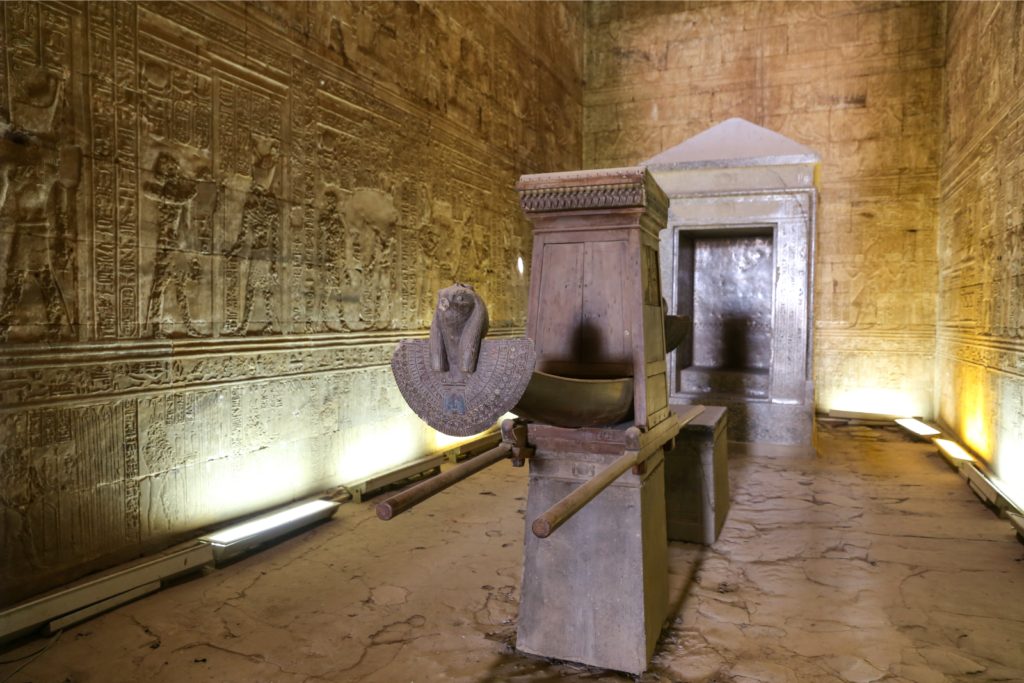
- The sanctuary: a polished granite naos (shrine) from the reign of Nectanebo II, older than the temple around it, with a modern replica of the sacred barque in front.
- The ambulatory: the corridor inside the enclosure wall, carved with the story of Horus spearing Seth, shown as a small hippopotamus. It is often empty even when the halls are busy.
- The Nilometer and the mammisi: the stepped Nilometer measured flood levels, and the birth house by the entrance celebrates the divine birth of Horus.
How long do you need at Edfu?
Allow about an hour and a half on site, or two hours including the transfer from the river. Cruise programmes usually give 1.5–2 hours in total, which is enough for a guided tour of the main axis, but it can feel rushed if you also want the ambulatory, the roof-level views of the pylon and the Nilometer. If you are travelling independently or by private car, two hours on site is comfortable.
Edfu combines naturally with Kom Ombo, about 65 km further south. On a drive between Luxor and Aswan the two temples fit easily into one day, with about 3.5 hours of driving in total.
When is the best time to visit Edfu and avoid the crowds?
Visit in the mid to late afternoon if you can; most cruise ships bring their passengers in the early morning, and the halls can be packed between about 7am and 10am. Large ships moor at Edfu in groups, and their passengers arrive almost at once, so the queues at the falcon statue and in the hypostyle hall are worst then.
Dahabiyas and private tours have more flexibility, and an afternoon visit also gives better light on the pylon. In summer the sun is fierce from late morning, so early or late is the only sensible choice. From October to April conditions are pleasant at any hour, though December and January bring the most visitors. See our best time to visit Egypt guide for month-by-month detail.
How do you get to Edfu Temple from the Nile?
Cruise passengers normally reach the temple by horse-drawn carriage (calèche) from the moorings, a ride of about 10–15 minutes through Edfu town. The carriage ride is traditionally included in cruise excursions, though drivers will usually ask for a tip.
The welfare of the carriage horses varies and has been criticised, so if you would rather not use them, ask your guide or cruise company about a minibus; many can arrange one. If you are travelling by road, Edfu is about 1.5–2 hours' drive from either Luxor or Aswan, and the temple sits on the edge of town with parking close to the entrance.
For tickets, prices change regularly, so check the official site egymonuments.gov.eg before you travel. On a cruise or guided tour, entry is normally included.
How does Edfu fit into a Nile cruise or dahabiya trip?
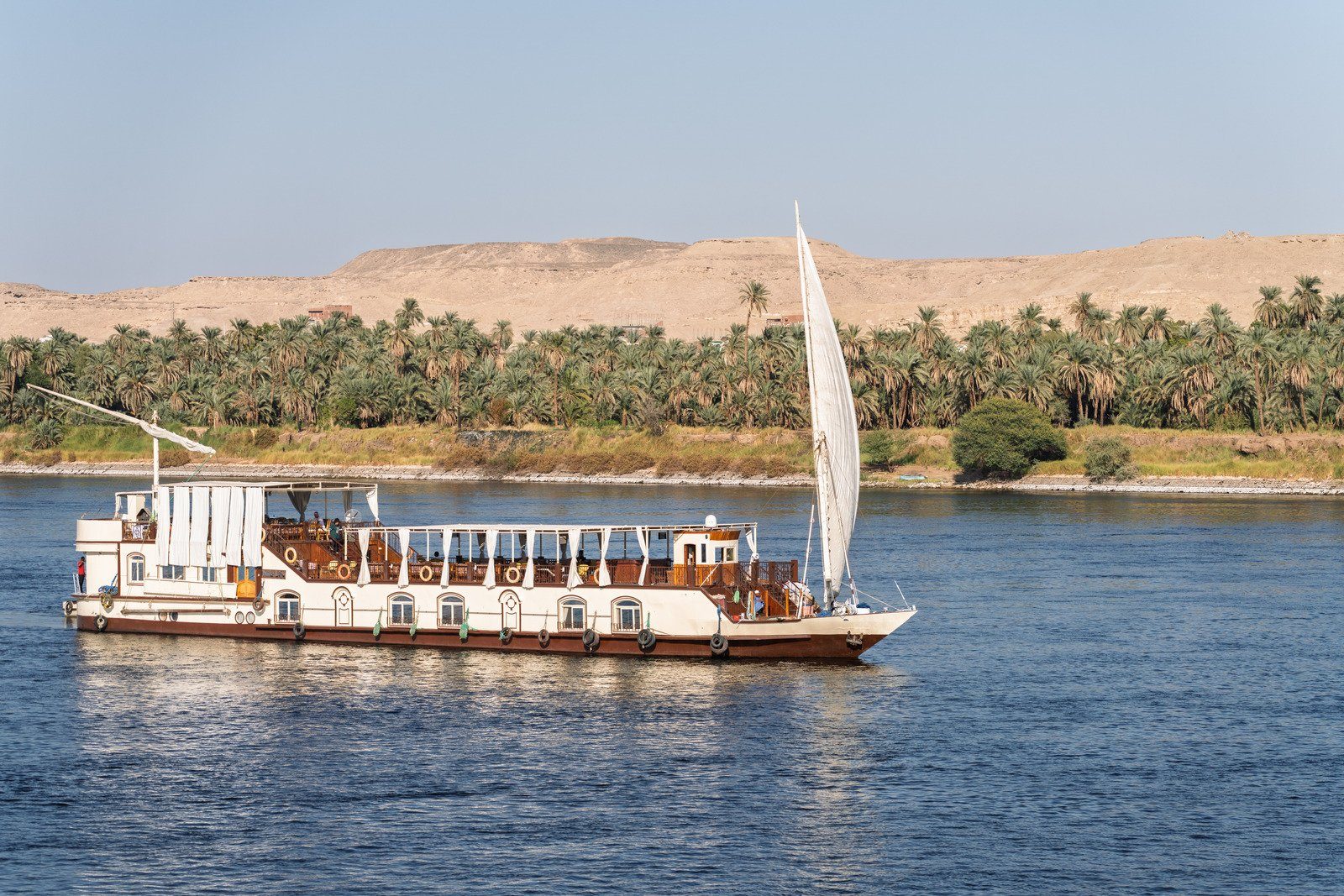
Edfu is a standard stop on every Luxor–Aswan cruise and on dahabiya routes from Esna, so if you sail the Nile you will almost certainly see it. On a southbound 4-night cruise it usually falls on the third morning, after passing through the Esna lock; on a northbound 3-night cruise it is typically visited on the final full day.
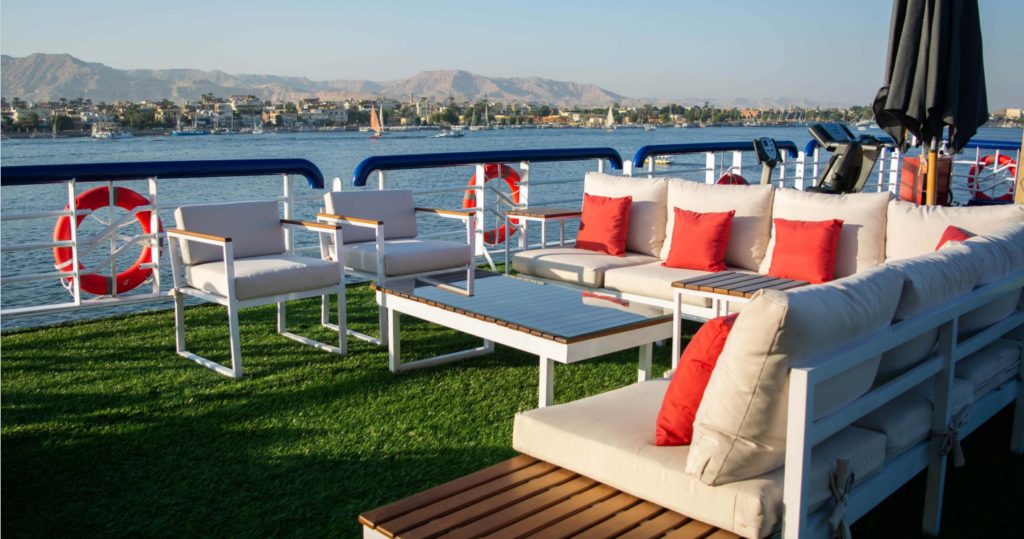
A dahabiya gives you the most freedom to time the visit around the big ships. Our dahabiya sailing trip plans Edfu to avoid the main groups where possible, and our Nile cruises guide explains how the standard schedules work.
What are the best practical tips for visiting Edfu?
Bring a torch or use your phone light for the darker inner chambers, wear comfortable shoes and keep small notes for the carriage driver and toilets. Some practical points:
- The approach from the ticket office passes a strip of souvenir stalls; a firm, friendly no is enough.
- The side chapels around the sanctuary are dim and often overlooked; the reliefs inside are among the finest in the temple.
- Photography for personal use is generally allowed without flash, but rules on tripods and professional cameras differ, so check at the time of your visit.
- Read up on the Horus and Seth myth beforehand, or ask your guide to tell it; it makes the ambulatory reliefs come alive.
Edfu Temple (Temple of Horus): FAQs
Is Edfu the best-preserved temple in Egypt?
Yes, it is generally regarded as the most complete ancient temple in Egypt, with its roof, pylon, courtyard, halls and sanctuary still standing.
Which god was worshipped at Edfu?
Horus, the falcon-headed god of kingship, together with his consort Hathor of Dendera and their son Harsomtus.
Is Edfu included on a Nile cruise?
Almost always. Edfu is one of the standard stops between Luxor and Aswan, along with Kom Ombo and, on many ships, Esna. Entry is usually included in the cruise excursion programme, but check your inclusions.
Do I have to take a horse carriage at Edfu?
No. Carriages are the traditional transfer from the moorings, but you can ask your guide or cruise company for a minibus or taxi instead.
How far is Edfu from Luxor and Aswan?
Edfu is about 115 km south of Luxor and about 110 km north of Aswan, roughly 1.5–2 hours by road from either.