Quick answer
Amun was the god of Thebes, modern Luxor, whose name means “the hidden one”. Merged with the sun god as Amun-Ra, he became king of the gods and the wealthiest deity in Egypt during the New Kingdom. Karnak, the largest temple complex of the ancient world, was his home, and his oracle at Siwa famously received Alexander the Great.
Who was Amun?
Amun was a god of invisible power – like the wind, felt but never seen – who rose from local deity of Thebes to supreme god of the Egyptian empire. He first appears among the eight primeval beings of Hermopolis, paired with Amaunet. His rise followed Theban politics: when Theban rulers reunited Egypt around 2000 BC, kings of the 12th Dynasty took the name Amenemhat, “Amun is foremost”. After Thebes expelled the Hyksos and founded the New Kingdom around 1550 BC, Amun was credited with Egypt’s victories, and his temple received the spoils.
Fused with the sun as Amun-Ra, he was called “king of the gods”. Ramesside hymns go further, describing all other gods as aspects of the hidden Amun. Some scholars see this as a step towards monotheism; others stress that the other gods were never abolished. Both readings are argued.
How Amun was depicted
Amun is usually a man wearing a flat-topped crown with two tall plumes, sometimes with blue skin suggesting lapis lazuli and the sky. His sacred animals were the ram with curled horns and the Nile goose. That is why the processional way in front of Karnak is lined with ram-headed sphinxes, each protecting a small figure of the king between its paws.
At Luxor Temple you will also meet Amun-Min, or Amun Kamutef (“bull of his mother”), an ithyphallic form celebrating his fertility and self-renewal. His family were Mut, a mother goddess shown in a vulture headdress or double crown, and the moon god Khonsu, a youth with a sidelock and lunar disc. Together they formed the Theban triad.
Amun’s wealth and the priests of Karnak
By the late New Kingdom, Amun’s temples controlled vast estates, herds and workforces, and his high priests became a political power in their own right. The Great Harris Papyrus, compiled under Ramesses IV, lists enormous donations by Ramesses III to Amun’s estates; scholars debate exactly what share of Egypt’s land this represents, but it was unrivalled. In the 21st Dynasty the High Priests of Amun effectively ruled southern Egypt from Thebes.
Later dynasties found a way to keep Thebes loyal: a royal princess, unmarried and holding the title God’s Wife of Amun, presided over the god’s estates. Kushite and then Saite kings in the 8th–6th centuries BC installed their own daughters in the post, which carried real wealth and authority.
Amun’s influence also provoked the greatest religious crisis of Egyptian history. Akhenaten closed his temples and had his name chiselled out across the country in favour of the Aten. Tutankhamun’s Restoration Stela, set up at Karnak, describes the temples abandoned and announces their revival. Hatshepsut, earlier, had claimed Amun as her actual father, shown in the divine birth reliefs at her temple.
The Opet Festival and the Valley Festival
Amun’s great annual celebration was Opet, when his statue travelled from Karnak to Luxor Temple to renew the king’s divine power. During the flood season, the gods’ statues rode in portable boat-shaped shrines on priests’ shoulders, or on river barges, accompanied by musicians, dancers and soldiers. Under Thutmose III the festival lasted 11 days; by Ramesses III’s reign it had grown to more than three weeks. The reliefs in Luxor Temple’s great colonnade, finished under Tutankhamun and Horemheb, show the whole procession.
The 2.7 km Avenue of Sphinxes linking the two temples was restored and reopened in 2021 with a televised re-creation of the procession. In the Beautiful Festival of the Valley, Amun crossed to the West Bank to visit the royal mortuary temples, and families picnicked at their ancestors’ tombs.
Amun beyond Thebes: Siwa and Nubia
Amun’s reach extended far beyond Luxor, to an oracle in the Western Desert and to temples deep in Nubia. In 331 BC Alexander the Great crossed the desert to consult the oracle of Amun at Siwa, and was greeted as the god’s son. Greeks knew the god as Zeus Ammon, and coins of Alexander’s successors show him with ram’s horns. Fossil ammonites are named after Ammon’s curled horns.
In Nubia, the mountain of Gebel Barkal in modern Sudan was revered as Amun’s southern home, and the Kushite kings who ruled Egypt as the 25th Dynasty were devoted to him. Ramesses II’s temple at Wadi el-Sebua, seen on Lake Nasser cruises, was dedicated to Amun-Ra and Ra-Horakhty.
Where to see Amun in Egypt today
Karnak Temple in Luxor was Amun’s home for some 2,000 years and is the essential visit; allow at least three hours. Its Great Hypostyle Hall has 134 columns, the central twelve about 21 m tall, decorated under Seti I and Ramesses II. Hatshepsut’s standing obelisk, nearly 30 m high, is the tallest ancient obelisk still standing in Egypt, and the granite barque shrine at the heart of the temple housed Amun’s sacred boat. Beside the sacred lake, a giant granite scarab dedicated by Amenhotep III draws visitors who circle it for luck – a modern custom with no ancient roots, though the scarab itself is genuine.
- Karnak Open-Air Museum: the White Chapel of Senusret I, one of the oldest buildings for Amun at Karnak, and Hatshepsut’s Red Chapel.
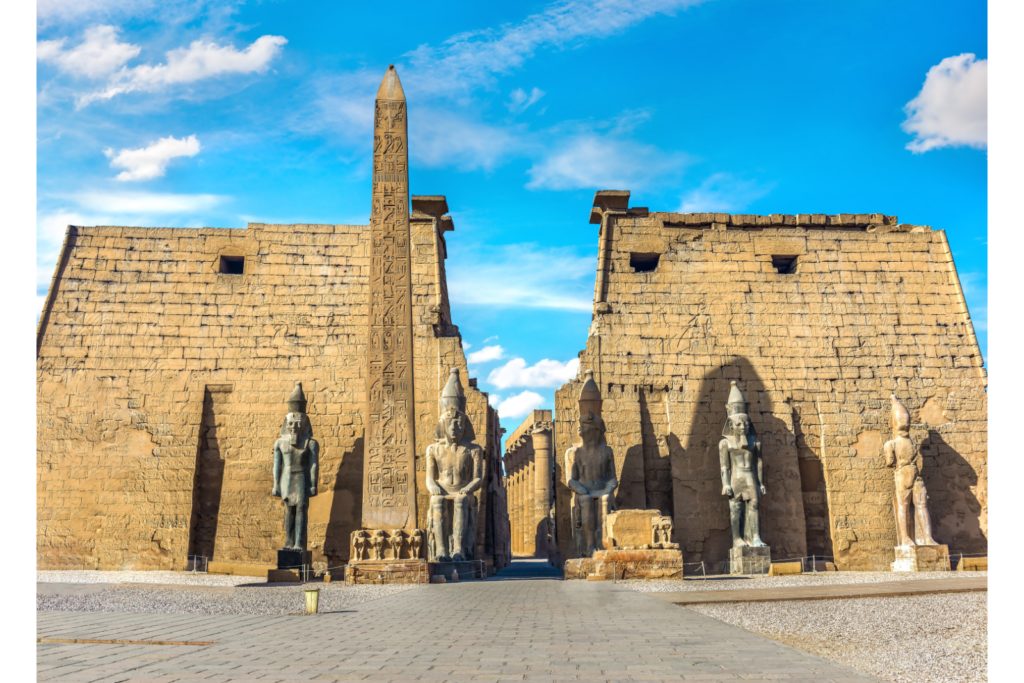
- Luxor Temple: Amun’s southern sanctuary and the destination of the Opet procession; beautiful after dark.
- Temple of the Oracle, Siwa: the hilltop ruins at Aghurmi where Alexander heard the oracle.
Frequently asked questions
Are Amun and Ra the same god?
They began as separate gods. From the Middle Kingdom they were combined as Amun-Ra, but Ra was also worshipped independently, especially at Heliopolis. See our guide to Ra.
Does the word amen come from Amun?
This is a popular claim, but linguists derive the Hebrew word amen from a Semitic root meaning firm or true. There is no accepted link with the Egyptian god’s name.
Why are there ram-headed sphinxes at Karnak?
The ram was Amun’s sacred animal. The ram-headed sphinxes in front of Karnak protect small statues of the king between their paws, placing him under the god’s care.
How long do you need at Karnak?
Three hours covers the main temple of Amun; add an hour for the Open-Air Museum. Go at opening time or in the late afternoon to avoid the midday heat and tour groups.
Who were Mut and Khonsu?
Amun’s wife and son. Mut had her own temple precinct south of Karnak’s main temple, and Khonsu’s well-preserved temple stands in the south-west corner of the Karnak complex.