Quick answer
Seth (also spelled Set) was the Egyptian god of the desert, storms, foreign lands and violent strength, best known for murdering his brother Osiris and fighting Horus for the throne. Yet for most of Egyptian history he was also a respected protector who defended the sun god's boat each night, and kings such as Seti I were named after him. Only in the first millennium BC was he widely demonised.
Who was Seth?
Seth was the god of everything beyond the ordered, irrigated Nile valley: the desert, thunderstorms, foreigners and uncontrolled force. He is one of the oldest Egyptian gods, with a cult at Nubt, a town near Naqada in Upper Egypt, already in prehistoric times. In the Heliopolitan family of gods he is a son of the earth god Geb and sky goddess Nut, and brother of Osiris, Isis and Nephthys.
The Egyptians did not see chaos as simply evil. The world needed Seth's strength, provided it was channelled. That is why one of the most common images of royal power, the sema-tawy, shows Horus and Seth together tying the plants of Upper and Lower Egypt around a windpipe-shaped sign meaning "unite": the two rival gods co-operate to bind the country together under the king. Note too that Seth's town Nubt, which the Greeks called Ombos, is not the same place as Kom Ombo, a frequent mix-up.
What animal is Seth?
Nobody knows, and most Egyptologists now think the "Seth animal" is a composite or imaginary creature rather than a real species. It has a long, down-curved snout, tall ears with flat, squared-off tips and a stiff, upright tail split at the end like an arrow. Suggestions over the past 150 years have included the aardvark, the anteater, the saluki hound, the jackal, the donkey, the okapi and the giraffe; none fits every feature. Seth can also appear in human form with this animal's head, and in specific myths he takes the shape of a red donkey, a hippopotamus, a pig or a crocodile, all creatures the Egyptians associated with danger. The colour red, the colour of the desert, was his.
How did Seth kill Osiris?
The murder of Osiris is Seth's defining act, but the famous version with the coffin and the 14 pieces is Greek, not Egyptian. Egyptian texts are strikingly reluctant to describe the killing directly, probably because writing it down risked making it happen again. The Pyramid Texts say only that Seth struck Osiris down or threw him to the ground at a place called Nedit, and other sources allude to drowning in the Nile.
The full narrative comes from Plutarch, a Greek writer of about AD 100. In his version Seth (whom he calls Typhon) has a beautiful chest made to Osiris's exact measurements, promises it to whoever fits it at a banquet, slams the lid on Osiris with the help of 72 conspirators and throws it into the Nile. Isis finds it at Byblos in Lebanon; Seth later discovers the body and cuts it into 14 pieces, which Isis gathers and reassembles. The dismemberment idea is genuinely Egyptian, since many temples claimed a relic of Osiris, but the number of pieces varies between sources, from 14 to 16 to 42 (one for each province). Treat Plutarch as a late, Hellenised retelling rather than the "original" myth.
What are the Contendings of Horus and Seth?
It is a long, comic and often crude story of the 80-year legal and physical battle between Seth and his nephew Horus for Osiris's throne, preserved on a papyrus of about 1150 BC. The manuscript, Papyrus Chester Beatty I, was written in the reign of Ramesses V and probably belonged to a family of scribes at Deir el-Medina.
The tribunal of gods dithers for decades. Seth argues he is the stronger; Horus that he is the rightful heir. The contests include a race in stone boats (Horus cheats by using a wooden boat plastered to look like stone), a bout in which both turn into hippopotamuses to see who can stay underwater longest, Seth tearing out Horus's eyes (restored by Hathor with gazelle milk in this version, by Thoth in others) and a lurid sexual episode involving lettuce, Seth's favourite food. Isis outwits Seth repeatedly. In the end Osiris threatens the tribunal from the underworld, Horus is crowned, and Seth is given a place beside the sun god, to roar as thunder in the sky. The older Pyramid Texts already know the core of the feud, including Horus tearing off Seth's testicles, so the rivalry is ancient even if this witty telling is New Kingdom.
Was Seth always the villain?
No: Seth's reputation rose and fell over 3,000 years, and for long stretches he was a royal patron.
| Period | How Seth was seen | Evidence |
|---|---|---|
| Early Dynastic (about 2700 BC) | Royal god alongside Horus | King Peribsen topped his name with the Seth animal instead of the Horus falcon; Khasekhemwy used both |
| Old and Middle Kingdoms | Murderer of Osiris, but also a strong protector | Pyramid Texts; the sema-tawy unity motif |
| Hyksos period (about 1650–1550 BC) | Chief god of the Hyksos capital Avaris | Identified with the Levantine storm god Baal |
| Ramesside era (about 1295–1070 BC) | Ancestral god of the ruling family | Seti I and Seti II named after him; Ramesses II's "400-Year Stela" celebrates his cult |
| Late Period onward | Increasingly demonised as god of foreigners and evil | Images erased; ritual 'killing' of Seth in temples such as Edfu |
Seth also had a heroic job in the afterlife. Funerary papyri of the New Kingdom and later show him standing at the prow of the sun god Ra's night boat, spearing the serpent Apophis, the true enemy of creation. In the oases of the Western Desert, such as Dakhla, his worship continued respectably even after the Nile valley had turned against him.
Where to see Seth in Egypt today
Because Seth's images were often defaced, the best places to find him are those where his struggle with Horus is the point of the decoration.
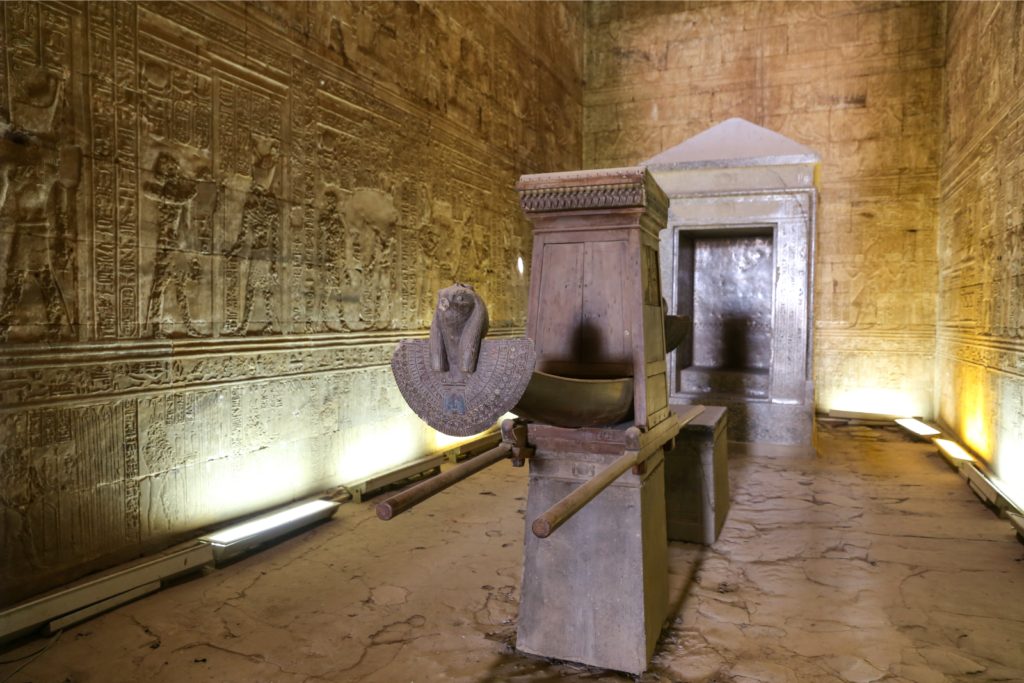
- Edfu Temple: on the inner face of the western enclosure wall, the "Triumph of Horus" reliefs show Horus harpooning Seth, shrunk to a tiny hippopotamus, in a sacred drama that was performed every year. Every Nile cruise stops here.
- Abydos Temple: in Seti I's temple to Osiris, the king's own name, which contains the Seth animal, is in many places written with a figure of Osiris instead, so as not to offend the god Seth had murdered.
- Egyptian Museum, Cairo: royal thrones and statue bases carry the sema-tawy with Horus and Seth, and a granite group from Medinet Habu shows Ramesses III being crowned between Horus and a damaged Seth.
- Tomb of Seti I: as at Abydos, look at how the king's name is written in this "Seth-named" king's tomb.
Frequently asked questions
Is Seth the same as Set?
Yes. Seth, Set and Sutekh are different modern renderings of the same Egyptian god. Seth is the spelling most Egyptologists use.
Why did Seth kill Osiris?
Egyptian sources rarely give a motive; the murder is simply Seth's nature as a force of disorder. Later accounts, especially Plutarch's, make it a jealous bid for Osiris's throne, and one tradition says Osiris had slept with Seth's wife Nephthys, who became the mother of Anubis.
Was Seth evil?
Not in the modern sense. He was violent and disruptive, but he was also a protector of the sun god and a patron of kings, including Seti I. He was only widely treated as evil from around the 1st millennium BC.
What animal represents Seth?
Seth is shown as the 'Seth animal', a creature with a curved snout, flat-topped ears and an upright forked tail that does not match any known animal. He was also linked to donkeys, hippopotamuses, pigs and crocodiles.
Who won the fight between Horus and Seth?
Horus. After 80 years of contests, the tribunal of gods awarded him the throne of Osiris, and Seth was compensated with a role beside the sun god as the voice of thunder.