Quick answer
Thoth was the Egyptian god of writing, knowledge, the moon and the reckoning of time, shown as an ibis-headed man or a baboon. Scribe of the gods, he recorded the verdict when the dead were judged and brokered peace between rival gods. His cult centre was Hermopolis in Middle Egypt, where catacombs at nearby Tuna el-Gebel hold millions of mummified ibises.
Who was Thoth?
Thoth was the gods’ scribe, accountant and messenger: the inventor of writing, keeper of knowledge and measurer of time. Egyptians called hieroglyphs “the god’s words” and credited Thoth with creating them, so he was patron of scribes, officials and physicians. As a moon god he governed the calendar, and the first month of the Egyptian year was named after him. The name survives today: Tout is the first month of the Coptic calendar still used by Egypt’s Christians and, traditionally, its farmers.
He served as Ra’s deputy and as a peacemaker among the gods. He was closely linked with Ma’at, the principle of truth and order, and in some traditions Seshat, goddess of writing and measurement, was his female counterpart. For more on the writing system he was said to have invented, see our guide to Egyptian hieroglyphs.
Ibis and baboon: how Thoth was shown
Thoth appears as a man with the head of an ibis, its long beak curving down, or as a seated baboon, often topped by a crescent and full moon. The sacred ibis, white with a black head and neck, once waded in the Nile marshes but no longer breeds wild in Egypt. Hamadryas baboons were famous for chattering at sunrise, which Egyptians read as greeting the sun, so baboons often appear with raised paws adoring Ra.
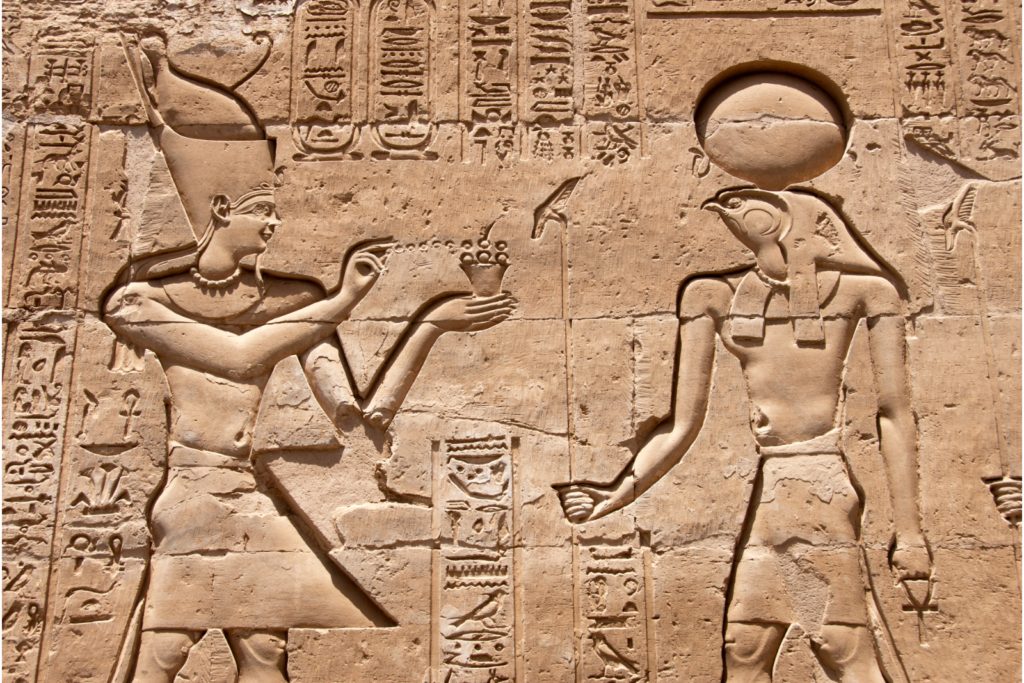
In temple reliefs, Thoth often holds a scribe’s palette and reed pen, writing the king’s years on a palm rib. He also appears with Horus pouring streams of ankh signs over the king in purification scenes, sometimes misleadingly called the “baptism of pharaoh”. Small statues of a baboon sitting behind a scribe show the god watching over writers at work. Thousands of small ibis and baboon amulets, in faience and bronze, were made for ordinary worshippers in the Late Period.
Thoth in myth
In myth Thoth is the problem-solver: he heals, records, negotiates and keeps the cosmic accounts. In the Pyramid Texts and later spells he restores the Eye of Horus after Seth damages it, and in the Contendings of Horus and Seth he acts as secretary of the divine tribunal. In the myth of the Distant Goddess, some versions have Thoth, as a baboon, persuade the angry Eye of Ra to come home from Nubia.
In the judgement of the dead, Thoth stands by the scales and writes down the verdict, as shown in spell 125 of the Book of the Dead. Plutarch adds a Greek-flavoured story: when Ra forbade the sky goddess Nut to give birth on any day of the year, Thoth won a share of the moon’s light at a board game, creating five extra days on which Osiris, Isis, Seth, Nephthys and Horus the Elder were born. These five days completed the 365-day calendar.
Hermopolis and the sacred ibises of Tuna el-Gebel
Thoth’s city was Khemenu, “Eight-town”, named after the eight primeval gods of creation; the Greeks called it Hermopolis Magna, and today it is el-Ashmunein in Minya province. Little of the great temple stands, but two colossal quartzite baboons dedicated by Amenhotep III, each more than four metres tall, have been re-erected on the site, along with granite columns of a 5th-century church.
On the desert edge to the west lies its necropolis, Tuna el-Gebel. Here underground galleries hold the mummies of sacred ibises and baboons offered from the Late Period through Roman times – estimates run into millions of birds. Nearby, the tomb of Petosiris, a high priest of Thoth around 300 BC, blends Egyptian and Greek art in fascinating ways. Read more in our guide to Tuna el-Gebel and Hermopolis.
Thoth, Hermes Trismegistus and the Book of Thoth
The Greeks identified Thoth with their messenger god Hermes, and that link gave rise to centuries of legends that have little to do with ancient Egypt. From Egyptian epithets calling Thoth “great, great”, the Greeks coined Hermes Trismegistus, “thrice-great Hermes”, the supposed author of the Hermetica. These Greek philosophical and magical writings date mainly from about the 1st to 3rd centuries AD. Renaissance scholars believed them older than Moses until Isaac Casaubon showed in 1614 that they were late.
The “Book of Thoth” has a real ancient source of sorts: a demotic story of the Ptolemaic period in which Prince Setne Khamwas steals a magic book written by Thoth, hidden in nested boxes at the bottom of the Nile, and suffers for it. It is fiction, not a lost text. Later inventions – tarot cards as Egyptian wisdom (an 18th-century French idea) and the “Emerald Tablets of Thoth”, published in the 20th century – have no ancient Egyptian basis.
Where to see Thoth in Egypt today
To see Thoth’s own sanctuary, travel to Middle Egypt: el-Ashmunein and Tuna el-Gebel lie near Mallawi, south of Minya, and make a full day from a Minya base. The ibis galleries, the tomb of Petosiris and one of Akhenaten’s boundary stelae can be combined with Tell el-Amarna. This region sees few visitors; arrangements for foreigners can change, so plan with a specialist and check Smartraveller before you go.
Elsewhere, Thoth is everywhere once you know the beak: in the hypostyle hall at Edfu, the chapels of Seti I’s temple at Abydos and the judgement scenes of the royal tombs. The temple of Dakka, rebuilt beside Wadi el-Sebua on Lake Nasser, was dedicated to Thoth of Pnubs. For his role in the stars and calendar, see Egyptian mathematics and astronomy.
Frequently asked questions
Why does Thoth have the head of an ibis?
The ibis was Thoth’s sacred bird, possibly because its curved beak resembles a crescent moon or a scribe’s pen, though the Egyptians never explained the link themselves. The baboon was his other sacred animal.
Is Thoth the same as Hermes?
Greeks in Egypt equated them because both were messengers, guides of souls and patrons of learning. The combined figure Hermes Trismegistus is a Graeco-Roman creation rather than an Egyptian god.
Is the Book of Thoth real?
No ancient Book of Thoth has survived, and the famous one is from a Ptolemaic-era story. Some real Egyptian texts were credited to Thoth, but modern books sold under that title are not ancient.
Can you visit Hermopolis and Tuna el-Gebel?
Yes, as a day trip from Minya, and the sites are open at the time of writing. Middle Egypt receives few tourists and travel conditions can change, so check Smartraveller and book through a specialist.
What was Thoth the god of?
Writing, knowledge, the moon, time-keeping, mathematics, magic and justice. He was the scribe and messenger of the gods and recorded the verdict on every soul.