Quick answer
The best-known ancient Egyptian symbols are the ankh (life), the scarab (rebirth and the rising sun), the Eye of Horus (protection and healing), the djed pillar (stability) and the tyet knot of Isis. They were not decoration: each was also a hieroglyph and a working amulet, believed to give its owner the quality it stood for, in this life and the next.
Why did symbols matter so much in ancient Egypt?
For the Egyptians a symbol was not a picture of an idea but a small piece of the thing itself: carving, painting or wearing an ankh was believed to bring life. Most of the famous symbols were also ordinary signs in the writing system, so the same shape that spelled the word “life” in an inscription could be cast in gold and hung around a neck. Our guide to hieroglyphs explains how the script works.
Their most important job was as amulets. Spells in the Book of the Dead specify which amulet to place where on a mummy, and what material to make it from. When Howard Carter unwrapped Tutankhamun in 1925 his team recorded well over a hundred objects within the bandages, many of them amulets laid in carefully planned positions.
Colour mattered too. Red carnelian and jasper suggested blood and life force, green feldspar and faience suggested growth and renewal, and lapis lazuli recalled the night sky. Ordinary people wore cheap faience versions of the same symbols the king wore in gold, which is why museums hold them in their tens of thousands.
Quick guide: what each symbol means
Ten symbols account for most of what you will see on temple walls and in museum cases.
| Symbol | Egyptian name | Meaning | Where to look |
|---|---|---|---|
| Ankh | ankh | Life | In gods’ hands on almost every temple wall |
| Scarab | kheper | Coming into being, rebirth | The giant scarab at Karnak; jewellery at the GEM |
| Eye of Horus | wedjat | Protection, healing | Amulets, jewellery, the sides of coffins |
| Djed pillar | djed | Stability, endurance | Abydos, shrine friezes |
| Isis knot | tyet | Protection of Isis | Paired with the djed in friezes |
| Was sceptre | was | Power, dominion | Held by gods; supports the sky at the base of walls |
| Shen ring | shen | Eternity, protection | Held in the claws of falcon and vulture gods |
| Crook and flail | heka and nekhakha | Kingship | Held by Osiris and by kings |
| Cobra and vulture | Wadjet and Nekhbet | Lower and Upper Egypt | The brow of royal crowns and masks |
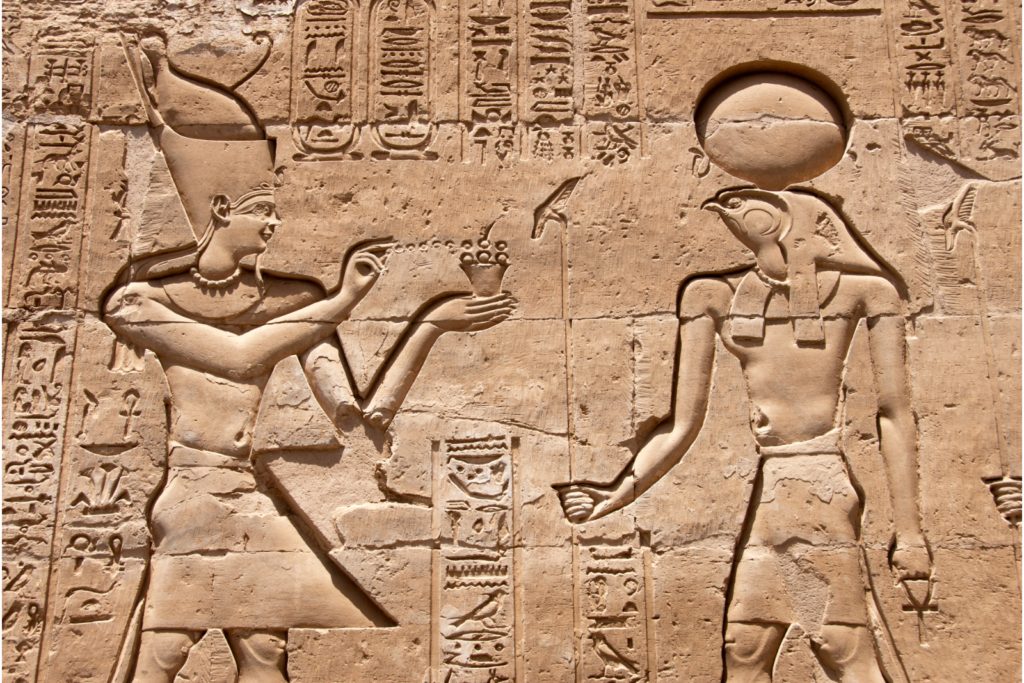
| Winged sun disc | Behdety | Protection of Horus | Over temple doorways, especially at Edfu |
What does the ankh mean?
The ankh is the hieroglyph for “life” and “to live”, and gods hold it out to the king’s nose to give him the breath of life. The loop-topped cross is one of the oldest Egyptian signs and appears from the very beginning of Egyptian history. What it originally depicted is uncertain; one long-standing theory is a sandal strap, because the Egyptian word for strap was pronounced the same way.
Once you know it, you see it everywhere. It forms part of names such as Tutankhamun, “living image of Amun”, and in Akhenaten’s reliefs the sun’s rays end in tiny hands offering ankhs to the royal family. Tutankhamun even owned a mirror case in the shape of an ankh, a pun on the word, which also meant mirror.
The symbol outlived the old religion. Egypt’s early Christians adopted it as a form of the cross, and at Philae you can find Christian crosses cut into walls beside ancient ankhs.
Why was the scarab beetle sacred?
The dung beetle rolls a ball of dung across the ground and young beetles later emerge from it, so the Egyptians saw it as a creature that made itself, and linked it to the sun rising each morning. Its name, kheper, also meant “to come into being”, and the god of the morning sun, Khepri, was shown as a scarab pushing the sun disc over the horizon.
Scarabs were made in vast numbers as stamp seals and amulets, with an inscription or a royal name cut into the flat base. Amenhotep III issued large commemorative scarabs, a kind of royal press release, announcing his marriage to Queen Tiye and boasting of the lions he had killed. The most important was the heart scarab, laid over the heart of a mummy and inscribed with a spell asking the heart not to testify against its owner at the final judgement.
At Karnak Temple a giant granite scarab dedicated by Amenhotep III stands beside the sacred lake; guides will tell you to walk around it for luck, usually seven times. One of Tutankhamun’s pectorals has a central winged scarab carved from yellow-green Libyan desert glass, formed naturally in the Western Desert millions of years ago.
What is the Eye of Horus?
The Eye of Horus, or wedjat (“the whole one”), stands for protection and healing, because in myth the eye that Seth tore from Horus was restored to health. In most versions it is Thoth who heals it, and Horus then offers the eye to his murdered father Osiris to revive him. The markings below the eye copy the facial stripe of a falcon, Horus’s sacred bird; our Horus guide tells the full story.
It was one of the most popular amulets in Egypt for well over two thousand years. Middle Kingdom coffins were painted with a pair of eyes on the side facing east, so the dead person could look out towards the rising sun.
You will often read that the parts of the eye were used to write fractions from one half to one sixty-fourth. The fraction signs are real, but many Egyptologists now doubt they were ever connected to the eye, so treat this as a popular theory. The Eye of Ra is a related but separate idea: the sun god’s fierce eye, personified as a lioness goddess sent to punish humanity.
What do the djed pillar and the tyet knot stand for?
The djed, a pillar with four crossbars, means stability and was read as the backbone of Osiris; the tyet, a knotted cloth, was the protective “knot of Isis”. The pair often alternate in long friezes, husband and wife guarding a shrine, as on the gilded shrines from Tutankhamun’s tomb.
Kings performed a ceremony called “raising the djed”, hauling the pillar upright with ropes to symbolise Osiris rising again and the kingdom standing firm. The clearest scenes of it are in the Osiris chapels of Seti I’s temple at Abydos, the god’s cult centre. The djed also appears in the sceptre of Ptah of Memphis, which combines djed, ankh and was in one staff: stability, life and power.
Tyet amulets were usually made of red stone such as jasper or carnelian, and a spell of the Book of the Dead calls on the “blood of Isis” to protect whoever wears one.
Which symbols belonged to the king?
Royal power had its own visual vocabulary: the crook and flail, the cobra and vulture on the brow, the plants of the Two Lands and the oval cartouche around the king’s name.
- Crook and flail: the crook was the hieroglyph in the word for “ruler”, a shepherd’s tool for a king who guarded his people. Tutankhamun’s own crook and flail survive.
- Cobra and vulture: Wadjet, the cobra of Lower Egypt, and Nekhbet, the vulture of Upper Egypt, whose cult centre was at El Kab. Together they rear from the brow of Tutankhamun’s gold mask.
- Papyrus and lotus: the plants of the north and south, knotted together around the sign for “unite” on the sides of royal thrones to show the union of the Two Lands.
- Shen and cartouche: the shen ring, a loop of rope meaning eternity, was stretched into the oval cartouche that encloses royal names; see our cartouches guide.
- Winged sun disc: a form of Horus of Edfu, spread across lintels to protect every temple doorway beneath it.
Where to see ancient Egyptian symbols in Egypt today
Every temple is full of them, but a few places show particular symbols at their best.
- Karnak, Luxor: the giant scarab by the sacred lake, and gods offering ankhs on almost every wall.
- Abydos: the djed-raising scenes and some of the finest painted reliefs in Egypt, in Seti I’s temple.
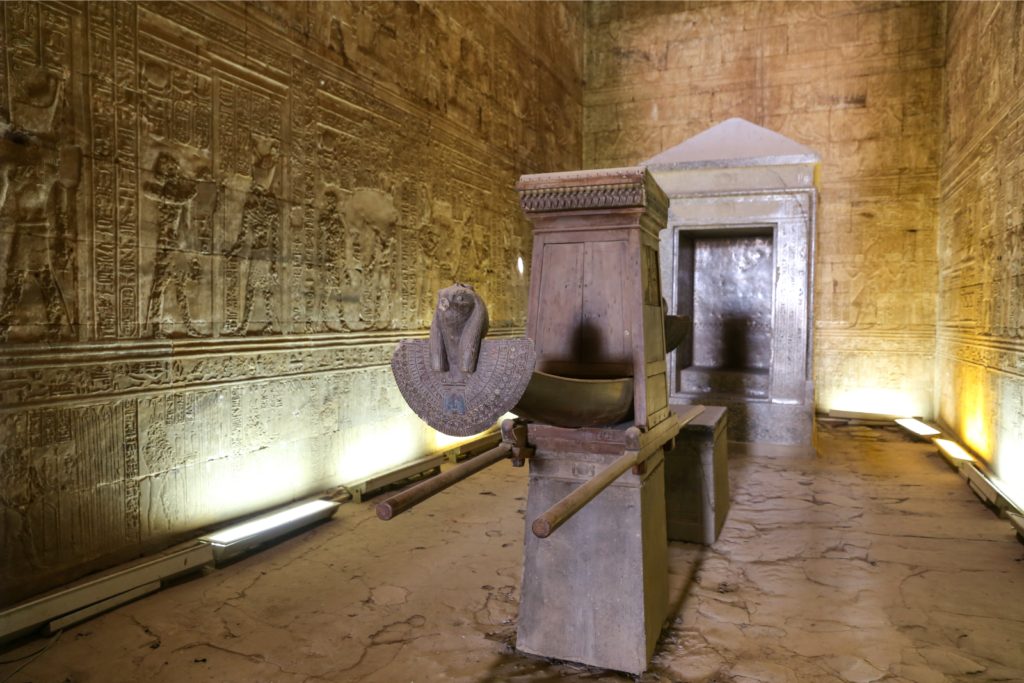
- Edfu: the winged sun disc over the gateways of the best-preserved temple in the country.
- Grand Egyptian Museum: Tutankhamun’s pectorals, amulets, crook and flail, and the cobra and vulture on his mask.
Silver ankhs, scarabs and Eye of Horus pendants are classic souvenirs, and the workshops around Khan el-Khalili make them to order; our Egyptian jewellery guide covers quality and hallmarks. Any “ancient” scarab offered for sale is a modern copy: trading in or exporting genuine antiquities is illegal in Egypt.
Frequently asked questions
What is the most important ancient Egyptian symbol?
The ankh, the sign of life, is the most widespread. Gods hold it on almost every temple wall, and it forms part of royal and private names. The scarab and the Eye of Horus were the most popular amulets.
What is the difference between the Eye of Horus and the Eye of Ra?
The Eye of Horus (wedjat) is the healed eye of the falcon god and stands for protection and wholeness. The Eye of Ra is the sun god’s fierce, sometimes destructive power, imagined as a lioness goddess such as Sekhmet. Modern jewellery often uses the same design for both.
Is it disrespectful to wear an ankh or Eye of Horus?
No. They are sold openly in Egypt as jewellery and souvenirs, and Egyptians themselves wear them. Like any symbol, simply wear it with an understanding of what it meant.
Can I buy a real ancient scarab in Egypt?
No. Trading in and exporting genuine antiquities is illegal, and anything sold as ancient in a market is a modern copy. Buy scarabs as honest reproductions, ideally from a reputable shop that gives a receipt.
Where can I see Egyptian symbols on a Nile cruise?
All the standard cruise stops are full of them: the scarab and ankhs at Karnak, the winged sun disc at Edfu, Horus and Sobek reliefs at Kom Ombo, and ancient and Christian symbols side by side at Philae.