Quick answer
A cartouche is the oval loop, tied with a bar at one end, that encloses a pharaoh’s name in hieroglyphs. It represents a rope encircling everything the sun shines on, and from around 2600 BC it held two of the king’s five official names: the throne name and the birth name. Today a gold or silver cartouche spelling your own name is one of Egypt’s most popular made-to-order souvenirs.
What is a cartouche?
A cartouche is a stretched version of the shen ring, a loop of rope tied at the base, drawn around a royal name to show the king ruled everything the sun encircles and to protect the name for eternity. The Egyptians called it shenu. The word we use is French: soldiers and scholars on Napoleon’s expedition of 1798–1801 thought the oval looked like the paper cartridges of their muskets.
Look closely at a well-carved example and you can see the twisted strands of the rope and the knot at the bottom (or at one side, when the inscription runs horizontally). The shape became so tied to kingship that a few objects were made in its outline, including the burial chamber and sarcophagus of Thutmose III in the Valley of the Kings, and a cartouche-shaped box from Tutankhamun’s tomb.
The cartouche came into regular use around the start of the Fourth Dynasty, about 2600 BC. Sneferu is usually named as the first king to enclose his name in one consistently. Before that, a king’s main name was written in a serekh, a rectangle representing a palace façade with a falcon on top.
Which of the pharaoh’s names went in a cartouche?
By the Middle Kingdom every pharaoh had five formal names, and only the last two, the throne name and the birth name, were written in cartouches. The throne name was taken at coronation and follows the title “King of Upper and Lower Egypt”; the birth name follows “Son of Ra”. Ramesses II is a good example, since his names are carved all over Egypt.
| Name | Written in | Ramesses II’s version |
|---|---|---|
| Horus name | Serekh | Kanakht Merymaat, “strong bull, beloved of Maat” |
| Two Ladies name | No frame | Mekkemet Wafkhasut, “protector of Egypt who subdues foreign lands” |
| Golden Horus name | No frame | Userrenput Aanakhtu, “rich in years, great in victories” |
| Throne name | Cartouche | Usermaatre Setepenre, “the justice of Ra is strong, chosen of Ra” |
| Birth name | Cartouche | Ramesses Meryamun, “Ra bore him, beloved of Amun” |
The throne name is the one contemporaries used most: foreign kings in the Amarna letters wrote to Akhenaten’s father as Nimmureya, a version of Nebmaatre. Two cartouches side by side are almost always the throne and birth names of one king. In the New Kingdom, royal wives such as Nefertari also had their names written in cartouches, and Akhenaten even placed the names of his god, the Aten, in a pair of them.
How do you read a cartouche?
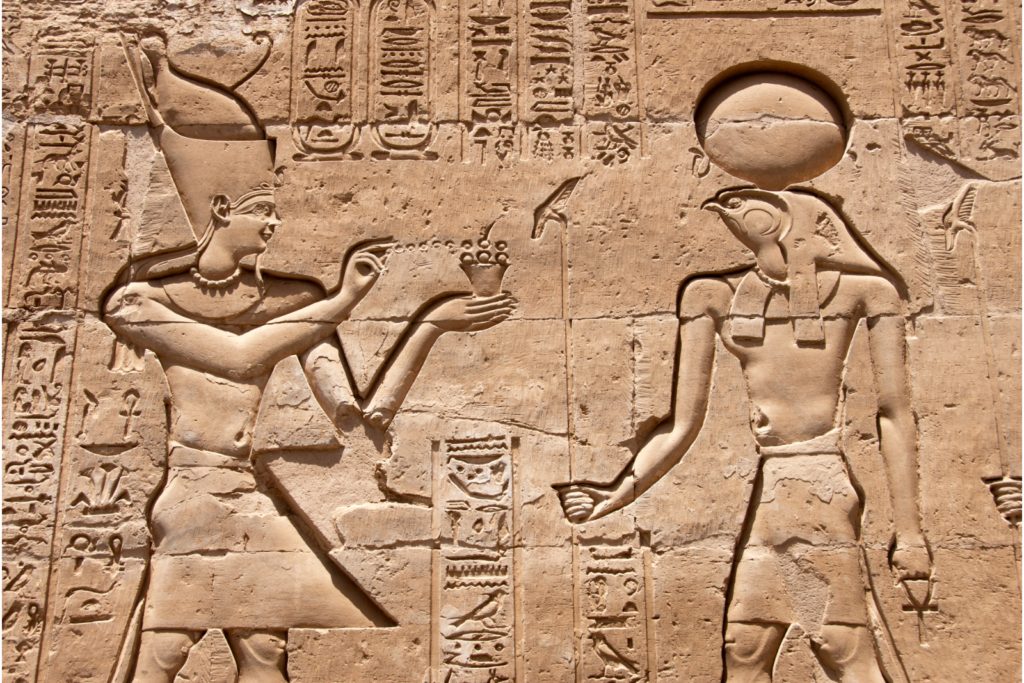
Read towards the faces: hieroglyphs of people, birds and animals look towards the start of the text, and vertical cartouches are read from top to bottom. Then watch for one trick. Out of respect, the name of a god was written first even when it was spoken later, a habit called honorific transposition.
Tutankhamun’s birth name, for example, begins with the signs for Amun, though it was pronounced Tut-ankh-amun. His throne name, Nebkheperure, is written with the sun disc of Ra at the top, then a scarab beetle with three plural strokes (kheperu, “forms”), and a basket at the bottom (neb, “lord”), yet it was read Neb-kheperu-Ra, “lord of the forms of Ra”. Only three signs, and once you know them you will spot them on dozens of objects at the Grand Egyptian Museum.
Many birth names also carry an epithet inside the cartouche, such as Tutankhamun’s Heqaiunushema, “ruler of southern Heliopolis”, or Ramesses’ Meryamun, “beloved of Amun”. A good guide will point out a few on site; our hieroglyphs guide explains the sound signs.
How did cartouches help decipher hieroglyphs?
Because scholars knew cartouches held royal names, they could match them to names known from Greek texts, and that was the key that let Jean-François Champollion read hieroglyphs in 1822. The name Ptolemy in a cartouche on the Rosetta Stone and Cleopatra on an obelisk from Philae shared the signs for p, t, o and l, which proved some hieroglyphs stood for sounds.
Champollion then read the cartouches of Ramesses and Thutmose in copies of temple inscriptions and realised the system mixed sound signs with picture signs: a breakthrough that pushed Egyptian names back far beyond the Greek period.
Why were some cartouches erased or recarved?
Because a name was thought to keep its owner alive, removing a cartouche was a way to erase a person from history, and adding your own was a cheap way to claim a monument.
- Hatshepsut: late in the reign of Thutmose III her cartouches were hacked out or recut with the names of male kings; see our Hatshepsut guide.
- The Amarna kings: the names of Akhenaten and his successors were struck out after the return to the old gods.
- Ramesses II: the great usurper, who put his cartouches on statues of earlier kings and had his own cut unusually deep so nobody could do the same to him.
- Roman emperors: at Dendera, Esna and Kom Ombo you can find emperors’ names in cartouches, some simply spelling the Greek titles Autokrator and Kaisaros. A few late temples even have cartouches left blank, perhaps because the carvers were unsure who was on the throne.
How do you order a custom cartouche in Egypt?
Jewellers in Cairo, Luxor and Aswan will spell your name in hieroglyphs on a gold or silver pendant, usually within one to three days, and many will deliver it to your hotel or ship. The cluster of workshops around Khan el-Khalili is the traditional place to order one.
- Check the spelling. Jewellers use a modern “alphabet” of single-sound hieroglyphs, so English spelling has to be turned into sounds. Ask to see the signs drawn out before they cut.
- Choose the metal. Sterling silver (925) is the budget choice; 18-carat gold is the standard for gold. Egyptian gold is sold by weight, so ask for the weight in grams and the day’s price per gram.
- Look for hallmarks. Genuine pieces carry an assay stamp; ask for a receipt that states metal, purity and weight.
- Consider extras. A name on each side, a birth date, or a small ankh or scarab added at the top.
- Know typical costs. Indicatively, a small silver cartouche costs tens of Australian dollars and a gold one several hundred, depending on size and the gold price; agree the total before work starts.
Be wary of the jewellery stop built into some tours, where prices are set for commission. Our guides to Egyptian jewellery and haggling cover fair prices.
Where to see cartouches in Egypt today
You will see thousands, but a few stand out. Ramesses II’s deep-cut cartouches on the columns of the Great Hypostyle Hall at Karnak are the size of a person. In the Valley of the Kings, look for the cartouche-shaped burial chamber of Thutmose III, when open. At the Grand Egyptian Museum, Tutankhamun’s cartouches appear on everything from his throne to his chariots, and at Philae and Dendera you can trace the names of Ptolemies and Roman emperors written in the old royal style.
Frequently asked questions
What does a cartouche symbolise?
A loop of rope encircling everything the sun shines on. Placing a king’s name inside it declared that he ruled the whole of creation and protected the name for eternity.
Did ordinary Egyptians have cartouches?
No. Cartouches were reserved for kings, and from the New Kingdom also for queens and some royal family members. Ordinary people’s names were written without a frame.
How long does it take to make a cartouche necklace in Egypt?
Usually one to three days, sometimes the same day for silver at a quiet time. Order early in your trip, ideally in Cairo or Luxor, so it can be finished before you move on.
Is my name spelled correctly in hieroglyphs on a cartouche?
It is a modern approximation. The ancient Egyptians had no letters for some English sounds and rarely wrote vowels, so jewellers use a simplified sound chart. Check the signs before they are cut.
How many cartouches did a pharaoh have?
Two: one for the throne name and one for the birth name. The other three of the five royal names were written without a cartouche.