Quick answer
The Book of the Dead is the modern name for a collection of nearly 200 ancient Egyptian spells, written on papyrus and placed in burials from around 1550 BC into the Ptolemaic period to help the dead pass safely through the underworld. Its Egyptian title was 'Spells for Going Forth by Day', and no two copies are the same: each owner had a different selection.
What is the Book of the Dead?
It is not one book but a toolkit: a large repertoire of spells from which each owner, or the workshop that made the copy, chose a selection to be buried with them. The name was popularised by the German Egyptologist Richard Lepsius, who in 1842 published a long Ptolemaic papyrus in Turin and numbered its 165 spells; the numbering, extended to about 190, is still used.
Copies were written in cursive hieroglyphs or hieratic, in black ink with headings and key instructions in red, and illustrated with painted scenes called vignettes. Many were produced in advance by workshops with spaces left for the buyer’s name, and some papyri still have those spaces empty. It was never a scripture to be read by the living, and despite what horror films suggest, it contains no spells for raising the dead or cursing tomb robbers.
Where did the Book of the Dead come from?
It grew out of 1,000 years of earlier funerary texts, first carved for kings and then adopted by the wealthy.
- Pyramid Texts (from about 2350 BC): carved inside the burial chambers of late Old Kingdom pyramids, beginning with that of Unas at Saqqara; for kings and later queens only.
- Coffin Texts (Middle Kingdom): new and adapted spells painted inside the wooden coffins of officials and their families.
- Book of the Dead (from about 1550 BC): the next stage, written first on linen shrouds and then on papyrus rolls placed in the coffin or tomb.
Around the 26th Dynasty, from 664 BC, the order of spells became more standardised. In the Ptolemaic and Roman periods shorter texts such as the Books of Breathing gradually took its place.
What do the spells actually say?
They are practical: spells to protect the body, pass guarded gates, avoid dangers, transform into other beings and enjoy a comfortable afterlife. A few of the best known:
- Spell 6: makes a shabti figurine answer for its owner and do any farm work demanded in the afterlife.
- Spell 17: a long statement about the creator god, with explanatory notes added by ancient editors, often illustrated with the owner playing the board game senet.
- Spell 30B: commands the dead person’s heart not to testify against them at the judgement; it was carved on heart scarabs placed over the chest of the mummy.
- Spells 76–88: let the dead take the form of a falcon, a swallow, a lotus, a snake and other beings.
- Spell 110: describes the Field of Reeds, an idealised Egypt of canals and rich harvests.
- Spells 144–147: list the gates of the underworld and the names of their gatekeepers, which the dead had to know to pass.
- Spell 175: a striking dialogue in which the creator god Atum tells Osiris that one day he will destroy everything he has made and return the world to the primeval waters.
What is spell 125 and the weighing of the heart?
Spell 125 is the judgement of the dead: the person declares their innocence before the gods, and their heart is weighed against the feather of truth. It takes place in the Hall of the Two Truths, in front of Osiris and 42 divine judges.
The dead person addresses each judge by name and denies a specific wrong, a passage often called the negative confession: “I have not stolen”, “I have not killed”, “I have not made anyone weep”, “I have not held back water in its season”, “I have not added to the weight of the balance”. It is a valuable record of what Egyptians considered wrongdoing, from violence to cheating at the market and blocking irrigation.
The famous illustration shows Anubis adjusting the scales, Thoth recording the result and the monster Ammit, part crocodile, part lion, part hippopotamus, waiting to devour a heart weighed down by wrongdoing. Owners of the papyri always pass; the vignette made sure of it. The feather belongs to Ma’at, goddess of truth and order, and our guide to the ancient Egyptian afterlife explains what came next.
Who owned a Book of the Dead?
Mostly wealthy officials, priests, scribes and their wives; kings used different texts. A papyrus with fine painted vignettes was a luxury, commissioned or chosen from a workshop; cheaper copies had fewer spells and simpler drawings, and many Egyptians had none at all.
Royal tombs in the Valley of the Kings mostly drew on other compositions, such as the Amduat and the Book of Gates, which follow the sun god through the 12 hours of the night. A few Book of the Dead spells do appear in royal and queenly tombs, and in the 21st Dynasty the priestly families of Thebes were buried with especially rich collections of papyri.
Which are the most famous copies?
The most famous papyri are in the British Museum, but Egypt’s museums and tombs hold fine examples too.
- Papyrus of Ani (about 1250 BC): about 24 metres long, from Thebes, with the best-known weighing-of-the-heart scene; acquired by the British Museum in 1888.
- Papyrus of Hunefer (about 1300 BC): also in the British Museum, with exceptionally clear vignettes of the judgement and the Opening of the Mouth ceremony.
- Greenfield Papyrus (21st Dynasty): made for a priestess named Nesitanebisheru, and at around 37 metres one of the longest known.
- Turin Papyrus of Iufankh: the Ptolemaic copy Lepsius used to number the spells.
The papyrus paintings sold in Egyptian shops are usually modern copies of Ani and Hunefer scenes; our guide to buying papyrus explains how to tell real papyrus from banana leaf.
Where to see the Book of the Dead in Egypt today
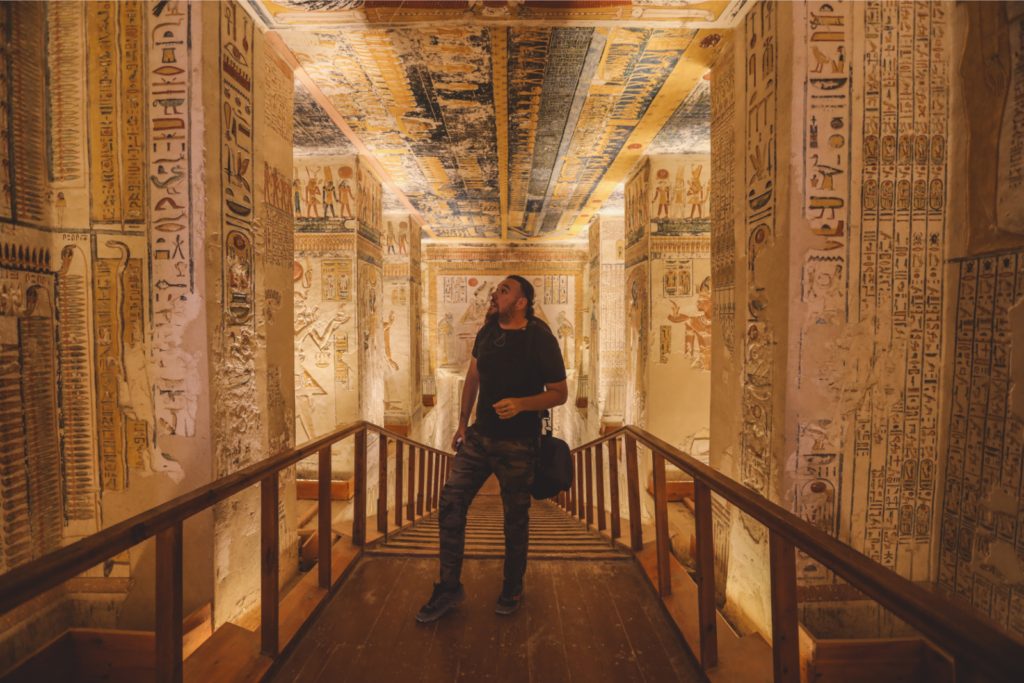
Look for Book of the Dead scenes painted on tomb walls in Luxor, and for original papyri in Cairo’s museums.
- Deir el-Medina: the tomb of the craftsman Sennedjem shows him and his wife harvesting in the Field of Reeds, straight out of spell 110, in some of the brightest colours in Egypt.
- The tomb of Nefertari: in the Valley of the Queens, with scenes from spell 17, including the queen playing senet, and the gates and guardians of spells 144–146. It needs a separate, expensive ticket at the time of writing.
- The Egyptian Museum, Tahrir: has displayed Book of the Dead papyri from Theban burials, such as those of Yuya and Maiherpri; with objects moving between Cairo museums, ask what is on show.
- The Tombs of the Nobles, Luxor: several include judgement scenes and funeral processions.
Frequently asked questions
Is the Book of the Dead a real book?
It is a real ancient text, but not a single book. It is a collection of about 190 spells, and every surviving copy has a different selection, written on a papyrus roll for one particular person.
What was the Book of the Dead called in ancient Egypt?
Its title translates as 'Spells for Going Forth by Day' (also rendered 'Coming Forth by Day'), reflecting the hope that the dead could leave the tomb and move freely in daylight.
Can you read the Book of the Dead in English?
Yes. Several translations are available, including scholarly editions of the full corpus and illustrated editions of the Papyrus of Ani. Older translations from the 1890s are still widely reprinted but are outdated in places.
Is the Book of the Dead dangerous or cursed?
No. It was a protective guide for the deceased. The cursed book in films such as The Mummy is fiction, and there are no spells in it for raising the dead.
Where is the original Book of the Dead?
There is no single original. Hundreds of copies survive, in museums including the British Museum, the Egyptian Museum in Turin and museums in Cairo.