Quick answer
Egyptian hieroglyphs were a script of roughly 700 to 1,000 picture-signs in classical use that recorded the Egyptian language for about 3,600 years, from around 3200 BC to AD 394. Most signs stand for sounds, not ideas, and they are combined with word signs and silent 'determinatives' that clarify meaning. Temples such as Edfu, Karnak and Philae are covered in them.
What are Egyptian hieroglyphs?
Hieroglyphs are the monumental script of ancient Egypt: pictures of real things, from owls to loaves of bread, used mainly to write the sounds of the Egyptian language. The Egyptians called them medu netjer, “the god’s words”, and believed the script was a gift of Thoth, god of writing. Our word comes from the Greek for “sacred carvings”, because by the time Greek visitors saw them they were used mostly on temple walls.
The earliest known examples are small bone and ivory labels from a royal tomb at Abydos, dated to around 3200 BC, which makes Egyptian writing about as old as the cuneiform of Mesopotamia. Hieroglyphs then stayed in use for more than 3,500 years. Only a small minority of Egyptians could read them; scribes trained for years, and literacy is usually estimated at a few per cent of the population at most.
How do hieroglyphs work?
Hieroglyphs mix three kinds of sign: sound signs, word signs and silent “determinatives” that tell you what category of word you are reading. It is neither an alphabet nor pure picture-writing, which is why it defeated European scholars for centuries.
- Sound signs (phonograms): about 24 signs stand for a single consonant, the so-called hieroglyphic alphabet. The owl is m, the water ripple n, the mouth r, the horned viper f and the quail chick w. Many more signs stand for two or three consonants at once.
- Word signs (logograms): a single picture for a whole word, such as the sun disc for ra, “sun”, or a house plan for per, “house”, usually marked with a short stroke.
- Determinatives: unspoken signs at the end of a word. A seated man marks a man’s name, walking legs mark verbs of motion, and a tied papyrus roll marks abstract ideas.
Vowels were not written. That is why spellings vary between books (Amun, Amen or Amon) and why Egyptologists insert an “e” between consonants simply to make words pronounceable. Our best guide to the vowels is Coptic, the last stage of the language.
Which way do you read hieroglyphs?
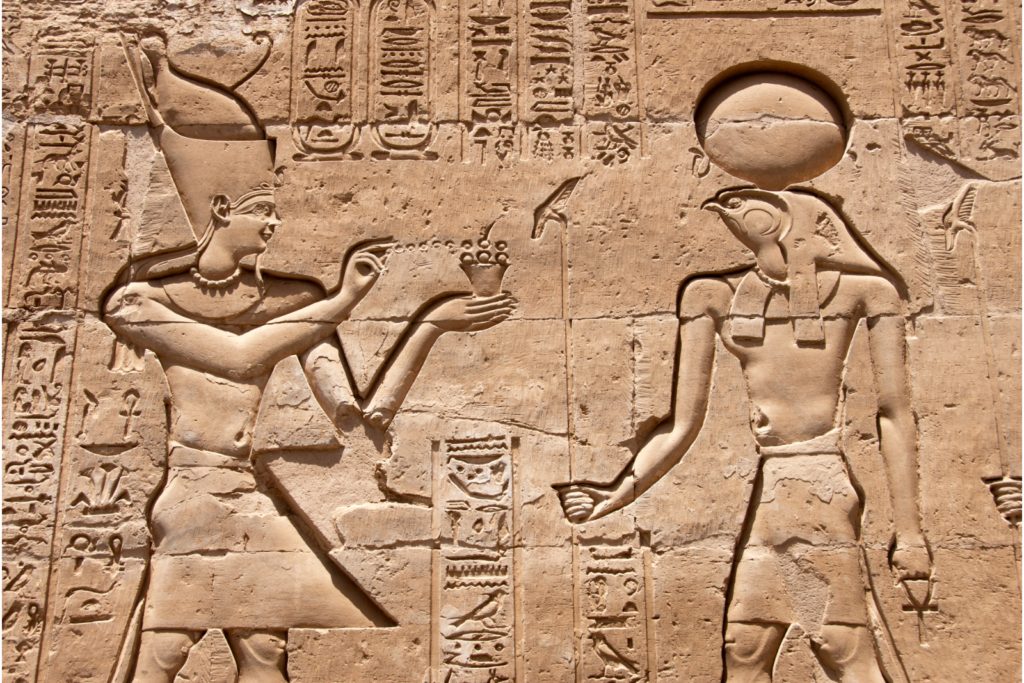
Read towards the faces: if the birds and people look to the right, start on the right and read leftwards. Right to left was the normal direction, but hieroglyphs could also run left to right or in vertical columns read from the top down, and scribes freely chose whichever suited the space.
On temple doorways the inscriptions on each side often face the opening, so the text is symmetrical and each half reads towards the centre. Signs were also grouped into neat rectangles rather than strung out in a line, so a short sign may sit under a tall one.
One more rule trips up beginners: out of respect, a god’s name was written first even when it was spoken later. Tutankhamun’s name begins with the signs for Amun, although it was pronounced roughly “Tut-ankh-amun”. Royal names are enclosed in an oval loop, the cartouche, and learning to spot the cartouches of a handful of famous kings is the quickest way to start reading temple walls.
Hieratic, demotic and Coptic: the other Egyptian scripts
Hieroglyphs were the formal script; everyday writing used faster, joined-up versions of the same system. Ink and papyrus favoured speed, and the Egyptians developed a family of scripts over 3,000 years.
- Hieratic: a cursive form of hieroglyphs, almost as old as the script itself, written with a reed brush on papyrus and on ostraca (flakes of limestone and pottery). Letters, accounts and literature were written in hieratic.
- Demotic: a still more abbreviated script that appeared around 650 BC and became the everyday writing of the Late and Ptolemaic periods. It is the middle text on the Rosetta Stone.
- Coptic: the Egyptian language written in the Greek alphabet plus a few extra letters taken from demotic, adopted as Egypt became Christian in the first centuries AD. It survives today in the liturgy of the Coptic Orthodox Church.
The language itself changed too. Students of hieroglyphs usually start with Middle Egyptian, the classical form of around 2000 BC, which was still being carved on temples 2,000 years later, much as Latin was used in Europe long after Romans stopped speaking it.
How were hieroglyphs forgotten, and how were they read again?
Knowledge of hieroglyphs died with the last temple priests in the late 4th century AD and was recovered only in 1822. The last dated hieroglyphic inscription was carved at Philae on 24 August AD 394, soon after Emperor Theodosius I banned pagan cults across the Roman Empire. Demotic graffiti continued at Philae into the 450s.
For the next 1,400 years scholars assumed the signs were mystical symbols rather than a way of writing words. A 5th-century Greek book, the Hieroglyphica of Horapollo, offered symbolic explanations that were partly correct but sent Renaissance scholars in the wrong direction. The breakthrough came after French soldiers found the Rosetta Stone in 1799: comparing its Greek with the Egyptian texts, Thomas Young made the first real progress, and Jean-François Champollion, who also knew Coptic, showed in 1822 that most signs stood for sounds.
How were hieroglyphs carved and painted?
Most hieroglyphs you see were carved in relief and then painted, and the style changed with the setting. On outer walls, carvers usually used sunk relief, cutting the signs into the stone so strong sunlight threw deep shadows; inside, they often used raised relief, cutting away the background, which reads better in soft, low light.
Look closely and you will find birds with individually feathered wings and colours that still survive on protected ceilings. Some scribes treated signs as potentially alive: in certain burial chambers, dangerous creatures such as snakes and scorpions were drawn cut in two or without tails so they could not harm the dead. In the Ptolemaic temples of Edfu, Dendera and Kom Ombo, priests invented hundreds of new signs and played with puns, making these late texts the hardest of all to read, even for specialists.
Where to see hieroglyphs in Egypt today
Every temple and decorated tomb in Egypt is covered in hieroglyphs, but a few places show the script at its finest or most significant.
- The White Chapel of Senusret I, Karnak: in the Karnak Open-Air Museum, this small Middle Kingdom chapel carries some of the most elegant hieroglyphs ever carved, crisp enough to study sign by sign.
- The Pyramid of Unas, Saqqara: its burial chamber holds the Pyramid Texts, the oldest religious writings in Egypt, in columns of blue-filled signs. Interior access has varied, so check before you go; see our Saqqara guide.
- Edfu Temple: the best-preserved temple in Egypt, with dense Ptolemaic texts on almost every surface. Our Edfu Temple guide covers visiting.
- Philae: the island temple of Isis where the last dated hieroglyphs were carved; ask your guide to point out the late inscriptions. See our Philae Temple guide.
- The Valley of the Kings: painted royal tombs with long columns of afterlife texts in vivid colour.
Tip: carry a short sign list on your phone and practise on cartouches; by the end of a Nile cruise most travellers can recognise Ramesses II at a glance.
Frequently asked questions
Can anyone still read hieroglyphs today?
Yes. Thousands of Egyptologists and students worldwide read Middle Egyptian, and good Egyptian guides can read cartouches and standard temple formulas on site. Late Ptolemaic inscriptions remain difficult even for experts.
Is there a hieroglyphic alphabet?
Partly. About 24 signs each represent a single consonant and are often presented as an 'alphabet', but the Egyptians never wrote using those signs alone. Real texts mix them with signs for two or three consonants, word signs and determinatives.
Did the Egyptians write vowels?
No. Hieroglyphs recorded consonants only, so the exact pronunciation of most words is unknown. Egyptologists add an 'e' to make words sayable, and reconstruct some vowels from Coptic and from Greek transcriptions.
How many hieroglyphs were there?
In classical Middle Egyptian about 700 to 1,000 signs were in regular use. Priests in the Ptolemaic period created many new ones, taking the total to several thousand.
Can I get my name written in hieroglyphs?
Yes, it is a popular souvenir, usually as a silver or gold cartouche pendant. Because English sounds and vowels do not map neatly onto Egyptian signs, any spelling of a modern name is an approximation.