Quick answer
Ramesses II, often called Ramesses the Great, ruled Egypt for about 66 years, around 1279–1213 BC, the second-longest reign in Egyptian history. He fought the Hittites at Kadesh, later signed one of the earliest surviving peace treaties with them, fathered more than 100 children and built or inscribed more monuments than any other pharaoh, from Abu Simbel to the Ramesseum.
Who was Ramesses II?
Ramesses II was the third king of the 19th Dynasty, a soldier-king’s grandson who reigned for about two-thirds of a century and made sure no Egyptian could forget his name. His grandfather, Ramesses I, was an army officer from the eastern Delta who reached the throne late in life; his father, Seti I, restored Egypt’s power in the Levant. Ramesses was made prince regent as a teenager and fought on his father’s campaigns before succeeding him at about 25, around 1279 BC.
Later Egyptians remembered him as the model pharaoh: nine later kings took his name, and the Greeks knew him as Ozymandias, from his throne name User-maat-Ra. Monuments bearing his cartouches survive from the Delta to Sudan, although a good share are older statues and temples he re-inscribed, a common royal habit that he practised on an unusual scale.
What happened in Ramesses II’s reign?
The reign falls into a warlike first two decades, a long peace with the Hittites, and a final era of jubilees in which the ageing king outlived many of his heirs. Dates are approximate and follow the conventional chronology.
| Date (about) | Regnal year | Event |
|---|---|---|
| 1279 BC | 1 | Accession; work begins on the Ramesseum and on completing Seti I’s monuments |
| 1274 BC | 5 | Battle of Kadesh against the Hittite king Muwatalli II |
| 1259 BC | 21 | Peace treaty with the Hittite king Hattusili III |
| About 1255 BC | About 24 | The Abu Simbel temples are dedicated |
| 1249 BC | 30 | First Sed (jubilee) festival; at least 12 more followed |
| 1246 BC | 34 | Marriage to a Hittite princess, given the Egyptian name Maathorneferure |
| 1213 BC | 67 | Death; his 13th son, Merenptah, succeeds him |
At Kadesh, in modern Syria, Ramesses walked into an ambush and, by his own account, saved the day almost single-handed. In reality the battle was a draw and Kadesh stayed Hittite, but he had it carved as a triumph on at least five temples. Our Battle of Kadesh guide separates fact from propaganda. The treaty that followed survives in two versions, Egyptian hieroglyphs at Karnak and the Ramesseum and a Hittite clay tablet now in Istanbul, and is often described as the oldest surviving peace treaty; a replica hangs at the United Nations in New York.
What did Ramesses II build?
Ramesses II built a new capital, completed Egypt’s greatest temple hall and carved temples into Nubian cliffs, and his name is the one you will read most often on a trip up the Nile.
- Pi-Ramesses: a new royal city near modern Qantir in the eastern Delta, close to the Asian frontier. Little stands today, because later kings carted its stone to Tanis.
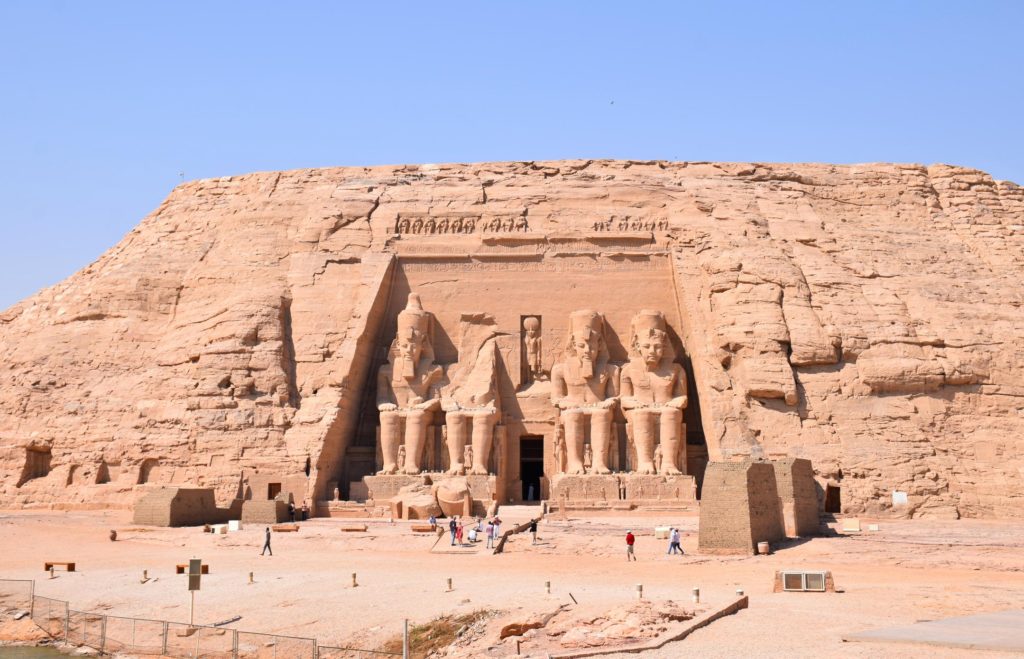
- Abu Simbel: two rock-cut temples near the Sudanese border, one with four 20-metre seated colossi of the king and one for Nefertari and the goddess Hathor. They were cut apart and raised above Lake Nasser in the 1960s, a story told in Saving Abu Simbel.
- The Ramesseum: his mortuary temple on Luxor’s West Bank, home of the shattered colossus behind Shelley’s poem.
- Karnak and Luxor Temple: he finished decorating the Great Hypostyle Hall begun under his father, and added the first pylon, the great court and the colossi at Luxor Temple, where one of a pair of obelisks still stands; its twin has been in the Place de la Concorde in Paris since 1836.
- Abydos: he completed Seti I’s temple and built a smaller one of his own nearby.
How many wives and children did Ramesses II have?
Ramesses had at least eight Great Royal Wives and many lesser wives, and temple lists name around 50 sons and a similar number of daughters, so more than 100 children is a fair estimate. The best known is Nefertari, his favourite in the early years, honoured with the smaller Abu Simbel temple and the finest painted tomb in the Valley of the Queens. Isetnofret, his other early queen, was the mother of his successor Merenptah and of Prince Khaemwaset, a high priest of Ptah at Memphis who restored Old Kingdom pyramids and labelled them with inscriptions, earning him the nickname “the first Egyptologist”.
Later he married several of his own daughters, including Bintanath and Meritamen, which for a pharaoh was primarily a ceremonial role, and two Hittite princesses to seal the peace. Because he lived so long, his first 12 sons died before him. Many of the princes were buried in KV5 in the Valley of the Kings, an enormous tomb with well over 100 chambers re-explored since 1995 by the American Egyptologist Kent Weeks. It is not open to visitors.
How did Ramesses II die, and what happened to his mummy?
He died of old age in his early 90s, around 1213 BC, and his mummy shows a frail man with severe arthritis, hardened arteries and painful dental abscesses. He was buried in tomb KV7 in the Valley of the Kings, but robbers looted it and priests later moved the body to safety. It was found in 1881 among the royal mummies hidden in the Deir el-Bahari cache near Hatshepsut’s temple.
In 1976 the mummy was flown to Paris for treatment against a fungal infection and was received with military honours; it is widely reported that he was issued an Egyptian passport for the trip. In April 2021 he travelled again, in the Pharaohs’ Golden Parade from Tahrir Square to the National Museum of Egyptian Civilization. Despite popular films, there is no evidence that he was the pharaoh of the biblical Exodus, and most scholars treat that identification as unproven.
Where to see Ramesses II in Egypt today
You will meet Ramesses II at almost every major site on a classic Egypt itinerary, but five places show him at his most impressive.
- Abu Simbel: the Great Temple and the Temple of Nefertari, with the sun reaching the sanctuary around 22 February and 22 October during the sun festival.
- The Ramesseum and Luxor Temple: the fallen Ozymandias colossus, Kadesh reliefs, and his pylon, colossi and obelisk at Luxor.
- Grand Egyptian Museum: the 11-metre granite colossus that greets you in the atrium, once a landmark of Cairo’s Ramses Square.
- Memphis: the 10-metre limestone colossus lying in its pavilion at Mit Rahina.
- National Museum of Egyptian Civilization: the king himself, in the Royal Mummies Hall.
On a Lake Nasser cruise you can add his temples at Wadi el-Sebua and Derr. Tomb KV7 has been under long-term restoration; check with your guide whether any part is open when you visit.
Frequently asked questions
How long did Ramesses II rule?
About 66 years, from around 1279 to 1213 BC. Only Pepi II of the 6th Dynasty is credited with a longer reign, and his length is uncertain.
Is Ramesses II the pharaoh of the Exodus?
There is no Egyptian evidence for the Exodus, and the Bible does not name the pharaoh. Ramesses II is a popular candidate because of the city of Pi-Ramesses, but most historians consider the identification unproven.
Who was Ramesses II’s favourite wife?
Nefertari, judging by the honours he gave her: her own temple at Abu Simbel and a superbly painted tomb, QV66, in the Valley of the Queens.
Can you see the mummy of Ramesses II?
Yes, in the Royal Mummies Hall of the National Museum of Egyptian Civilization in Fustat, Cairo, where his reddish hair and hooked nose are still clearly visible.
Why is Ramesses II called Ozymandias?
Ozymandias is the Greek rendering of User-maat-Ra, part of his throne name. Shelley’s 1818 sonnet was inspired by descriptions of the fallen colossus at the Ramesseum.