Quick answer
The Battle of Kadesh was fought in 1274 BC on the Orontes River in modern Syria between Ramesses II of Egypt and the Hittite king Muwatalli II. Ramesses walked into an ambush and fought his way out, but the battle ended in a stalemate and Kadesh stayed Hittite. He still had it carved as a great victory on his temples, and 15 years later Egypt and the Hittites signed one of the world’s earliest surviving peace treaties.
Why did Egypt and the Hittites fight at Kadesh?
Kadesh was the frontier fortress between two superpowers competing for the cities of Syria and Lebanon, and whoever held it controlled the route north. Egypt had dominated the region under Thutmose III, but during the Amarna period the Hittites of Anatolia (modern Turkey) took over Kadesh and the coastal kingdom of Amurru.
Ramesses II’s father, Seti I, briefly won Kadesh back. Early in his own reign Ramesses regained Amurru, and the Hittite king Muwatalli II prepared to respond. In the spring of his fifth year, Ramesses marched north from the Delta fortress of Pi-Ramesses with four divisions, named after the gods Amun, Ra, Ptah and Seth, each perhaps around 5,000 men, plus a separate force often called the Ne’arin coming up the coast.
What happened in the battle?
Misled by two captured nomads, Ramesses camped beside Kadesh with only one division while the hidden Hittite army struck the next division on the march, then hit the Egyptian camp. The Egyptian account gives the sequence.
- The false report: two Shasu nomads told Ramesses the Hittites were far away near Aleppo. Believing them, he hurried ahead with the Amun division and pitched camp north-west of Kadesh.
- The truth: two Hittite scouts, captured and beaten, revealed that Muwatalli’s army was hidden just behind the city.
- The ambush: Hittite chariots, said to number 2,500 in the first wave, crossed the Orontes and smashed into the Ra division as it marched, scattering it, then crashed into Ramesses’ camp.
- The counter-attack: Ramesses charged in his chariot and drove the attackers back towards the river, where Hittite chariots were trapped and their crews drowned. The Ne’arin arrived from the west in time to turn the fight.
- Stalemate: after fighting resumed, according to the Egyptian version, Muwatalli asked for peace; Ramesses withdrew south without taking Kadesh.
Egyptian chariots were light and fast, with a driver and an archer; Hittite chariots were heavier and the reliefs show crews of three. The chariot numbers come from Egyptian sources and may be inflated, but this was clearly the largest chariot battle known from the ancient world.
Who won the Battle of Kadesh?
Neither side won outright: Ramesses survived and claimed victory, but the Hittites kept Kadesh and soon took back Amurru, so they gained more from it. Hittite records found at their capital, Hattusa, describe Ramesses retreating and Hittite forces advancing south to Damascus afterwards.
The war dragged on for years in a series of smaller campaigns. Ramesses later fought in Syria and reached as far as Tunip and Dapur, but never permanently held Kadesh. The real turning point came with changes at the Hittite court, and the growing threat of Assyria to both powers.
For historians, Kadesh matters because it is the earliest battle whose tactics can be reconstructed in some detail, thanks to the unusually full Egyptian texts and pictures. Those sources are one-sided, so the Hittite tablets are an essential check: they treat the campaign as a success for Muwatalli, whose army held the field and whose kingdom kept its Syrian vassals.
How did Ramesses turn Kadesh into propaganda?
Ramesses had his version of the battle carved on at least five temples, in two texts and huge pictorial reliefs, making it the most publicised event in Egyptian history.
- The Poem: a literary account in which Ramesses, abandoned by his army, prays to Amun and fights alone “like Seth in his moment”. A papyrus copy shows it was read beyond temple walls.
- The Bulletin: a shorter report, captioning the reliefs.
- The reliefs: the Egyptian camp with shield walls, horses being fed and a lion beside the royal tent; the Hittite scouts being beaten; the chariot charge; and, famously, the Prince of Aleppo held upside down by his soldiers to empty the water from his lungs after being pulled from the Orontes.
The message was not that Egypt won a war, but that the king, with Amun’s help, saved Egypt single-handed when his army failed him. Read it as political theatre, as our Ramesses II guide explains.
What was the Egyptian–Hittite peace treaty?
Around 1259 BC, in Ramesses’ 21st year, Egypt and the Hittites signed a formal peace treaty, one of the earliest whose full text survives from both sides. The new Hittite king, Hattusili III, and Ramesses agreed to end hostilities, to help each other against attack, and to return fugitives, with a clause that returned refugees would not be punished.
The Egyptian version is carved on the walls of Karnak and the Ramesseum; the Hittite version, in Akkadian, the diplomatic language of the day, survives on clay tablets from Hattusa, now in museums in Istanbul and Berlin. A replica of one tablet hangs at the United Nations in New York. Thirteen years later Ramesses married a Hittite princess, and peace held for the rest of his long reign; our guide to the New Kingdom covers what came after.
Where to see the Battle of Kadesh in Egypt today
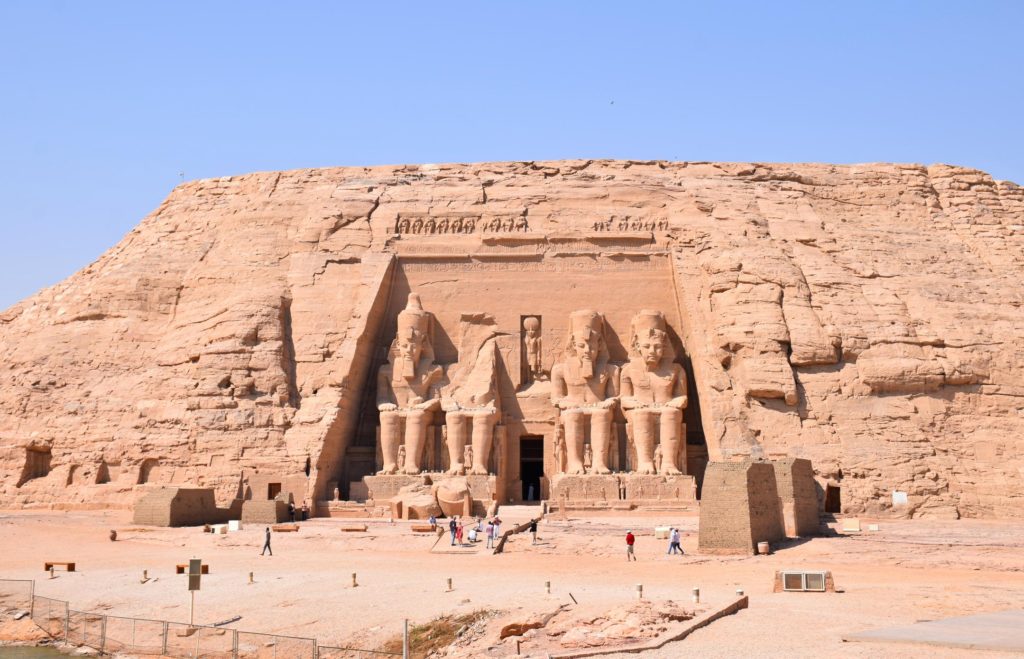
The most complete and accessible Kadesh reliefs are at Abu Simbel, but you can follow the battle on most temples Ramesses built.
- Abu Simbel: the north wall of the great hall in the Great Temple carries the full sequence, from the camp and the scouts to the charge, in sunk relief with traces of colour. Lighting inside is dim, so give your eyes a minute.
- Ramesseum: on the inner faces of the first and second pylons, including the drowning Hittites and the upside-down Prince of Aleppo. The treaty is also recorded here.
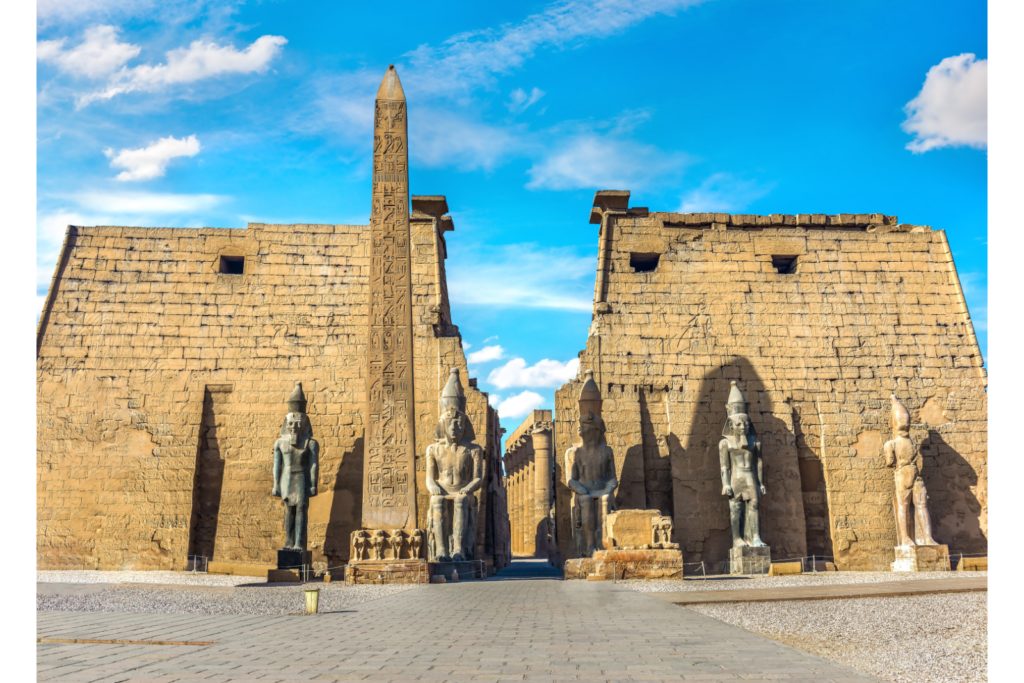
- Luxor Temple: on the outer face of the first pylon, behind the colossi, the camp and battle scenes stretch across both towers; they are worn, so the late afternoon light helps.
- Karnak: the treaty text is on a wall south of the great hypostyle hall, and Kadesh scenes appear on the outer walls.
- Abydos: the smaller temple of Ramesses II, near Seti I’s, has battle reliefs with well-preserved colour.
Frequently asked questions
When was the Battle of Kadesh?
In 1274 BC, in the fifth year of Ramesses II’s reign, according to the most widely used chronology. Some books give 1275 or 1286 BC under older dating systems.
Where was Kadesh?
On the Orontes River in western Syria, south-west of Homs. The site is the mound of Tell Nebi Mend, and it is not a place travellers can visit safely at present.
Did Ramesses II win the Battle of Kadesh?
He survived an ambush and drove the Hittites back, but did not take Kadesh, and the Hittites gained ground afterwards. Most historians call it a draw that Ramesses presented as a victory.
Where can I see the Kadesh reliefs?
Best at Abu Simbel, in the great hall of the Great Temple, and at the Ramesseum in Luxor. There are also versions at Luxor Temple, Karnak and Abydos.
Is the Kadesh treaty the oldest peace treaty?
It is one of the earliest whose text survives in versions from both parties, which is why it is often called the oldest peace treaty. Older agreements are known from Mesopotamia, but not in such complete form.