Quick answer
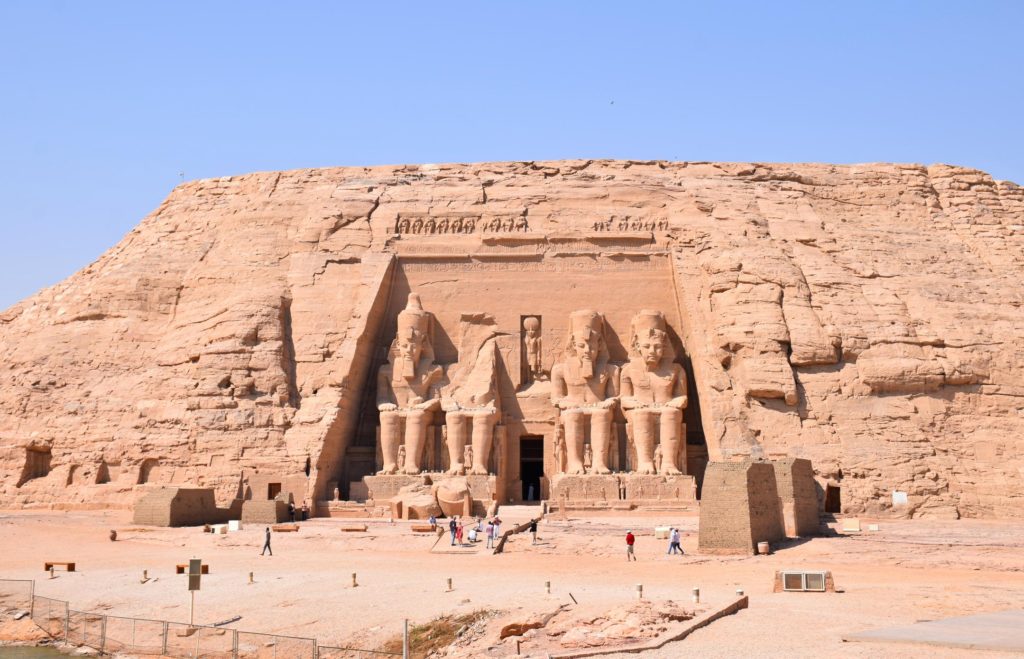
The Abu Simbel Sun Festival happens twice a year, around 22 February and 22 October, when the rising sun shines about 60 metres into the Great Temple and lights three of the four statues in its sanctuary for roughly 20 minutes. Thousands gather before dawn, so it needs a night-time start, early bookings and patience.
What actually happens at sunrise?
The first rays of the sun come straight over Lake Nasser, through the doorway of the Great Temple and down its central axis to the sanctuary, where they light three seated gods and leave the fourth in darkness. The beam travels about 60 metres through the rock: past the eight Osiride statues of Ramesses in the great hall, through a second pillared hall and a vestibule, to a small room at the very back.
There, four figures sit against the rear wall. From left to right they are Ptah, Amun-Ra, Ramesses II as a god, and Ra-Horakhty, the falcon-headed rising sun. The light falls on the last three, gilding the king between the two great solar gods, while Ptah, associated with the underworld, stays in shadow. The patch of light creeps across the statues and fades after about 20 minutes.
The effect is subtle rather than theatrical: a warm, gold rectangle in a dark stone room. What makes it powerful is knowing that Ramesses' architects planned it more than 3,200 years ago.
Why 22 February and 22 October?
Nobody knows for certain; the popular idea that the dates mark Ramesses II's birthday and coronation has no ancient text to support it. Other suggestions link them to the agricultural seasons or simply to the angle the builders could achieve from the cliff. The two dates sit roughly two months either side of the winter solstice, which is why there are two festivals a year.
The dates themselves have shifted. When the temple was cut up and rebuilt 65 metres higher and about 200 metres further back between 1964 and 1968, engineers reproduced its orientation closely but not perfectly, and the alignment now appears to fall about a day later than it did originally. That is one reason you may see 21 February and 21 October quoted in older sources. Saving Abu Simbel tells the story of the move, and our Ramesses II guide explains why the king put himself among the gods.
What is it like to be there?
Expect a crowd of thousands, a long, slow queue in the dark and only a few seconds inside the sanctuary, balanced by a genuinely festive atmosphere.
- The queue: the site opens in the small hours for the event. Visitors file through the Great Temple in a single line, and only a handful of people fit in the sanctuary doorway at once, so most see the light briefly as they pass.
- Screens: large screens outside usually relay the sanctuary live, so you can watch the full 20 minutes without being inside.
- Celebrations: Nubian drummers and dance troupes perform in front of the temples after sunrise, and the town of Abu Simbel holds music and stalls around the date. The programme varies year to year.
- Cold, then hot: February dawns in the desert can be close to 10°C; by 10am in October it is often well over 30°C.
How do you get there for the festival?
Staying the night before in Abu Simbel is the easiest option; the overnight road trip from Aswan is the most common.
| Option | How it works | Trade-off |
|---|---|---|
| Overnight in Abu Simbel | Sleep in the village, walk or drive minutes to the gate | Very few rooms; books out first |
| Road from Aswan | Leave around midnight to 1am, about 280 km through the desert | No sleep; police-managed traffic and delays |
| Fly from Aswan | Short flight when scheduled, about 45 minutes | Few seats and schedules vary; may not land before sunrise |
| Lake Nasser cruise | Some ships time their sailing to moor at Abu Simbel | Cabins limited; 3–4 nights' commitment |
A Lake Nasser cruise is the most comfortable way in, since you wake up a short walk from the temple. Our Abu Simbel Sun Festival tour is built around the date.
How do you plan and book it?
Lock in the night of the 21st first, whether a bed in Abu Simbel, a cabin or an Aswan hotel, then build the rest of the trip around it.
- Next dates: 22 February 2027 and 22 October 2027. Ramadan 2027 is expected to begin around 8 February, so the February festival falls within it; the alignment happens regardless, but check how celebrations are scheduled.
- Book 6–12 months out: Abu Simbel's few hotels, Aswan's better hotels and Lake Nasser ships fill first.
- Keep a spare day: plan the festival in the middle of your trip, not on the day before an international flight.
- Season: February has the kinder weather; October is warmer and marks the start of the season. Our February and October guides cover each month's weather and crowds.
- Tickets: festival entry arrangements and prices can differ from normal days; check egymonuments.gov.eg and confirm with your operator.
How do you make the most of the morning?
Decide in advance whether you want to queue for the sanctuary or watch from outside, and stay on after the crowd leaves.
- Bring a warm layer, a torch, water and a breakfast box; there is little to buy at 4am.
- Flash photography is not allowed inside; phones cope well with the light in the sanctuary, but you will have seconds, so have the camera ready.
- Most visitors leave by about 9am. Stay another hour to see both temples properly, including the Temple of Nefertari.
- Travelling with children or anyone who struggles with standing? The screens outside give a better view than the scrum inside.
Is the Sun Festival worth it?
Go if you love the idea of seeing an ancient alignment work and do not mind crowds; otherwise visit Abu Simbel on a normal day. On an ordinary morning you can stand in the sanctuary for as long as you like, and a dawn visit within a few days of the festival still brings low light into the front halls. Travellers who choose the festival rarely forget the drumming, the cold desert dark and the moment the light arrives; those who skip it rarely regret the extra sleep.
Abu Simbel Sun Festival: FAQs
When is the next Abu Simbel Sun Festival?
22 February 2027, then 22 October 2027, at sunrise. Confirm event timings closer to the date.
How long does the sunlight stay in the sanctuary?
About 20 minutes, moving across the statues of Amun-Ra, Ramesses II and Ra-Horakhty while Ptah stays dark.
Can you see the alignment on other days?
The full alignment reaching the sanctuary statues happens only around the two festival dates. On other mornings sunlight still reaches into the front halls soon after sunrise.
What time should you arrive for the Sun Festival?
Around 4–4.30am to queue. From Aswan by road that means leaving around midnight to 1am.
Is the Sun Festival suitable for children?
Older children who can cope with a night-time start can enjoy it; with younger ones, stay overnight in Abu Simbel and watch on the screens outside rather than queuing.
