Quick answer
Nefertari was the first and best-loved Great Royal Wife of Ramesses II, prominent from the start of his reign around 1279 BC until her death some 25 years later. He dedicated the smaller temple at Abu Simbel to her and the goddess Hathor, and her tomb in the Valley of the Queens holds some of the most beautiful paintings in Egypt.
Who was Nefertari?
Nefertari was the principal queen of Ramesses II, married to him before he became king and honoured above all his other wives during the first half of his 66-year reign. Her full name, Nefertari Meritmut, means “beautiful companion, beloved of the goddess Mut”. She held the titles Great Royal Wife, Lady of the Two Lands and God’s Wife, and appears beside the king at festivals, temple dedications and on the walls of his greatest monuments.
Her family is unknown. No document names her parents, and the suggestion that she was related to the pharaoh Ay rests on a single object, a knob bearing his name found in her tomb, which most scholars think proves very little. That a queen of uncertain origin was given such prominence makes her one of the most intriguing women of the New Kingdom.
Nefertari or Nefertiti? How to tell them apart
They are two different queens who lived about 70 years apart; the names look alike but their stories and monuments are quite separate.
| Nefertari | Nefertiti | |
|---|---|---|
| Husband | Ramesses II | Akhenaten |
| Era | Nineteenth Dynasty, about 1279–1255 BC | Eighteenth Dynasty, about 1350–1335 BC |
| Religion | Traditional gods, especially Hathor and Mut | The Aten, the sun disc |
| Famous image | The paintings of her tomb | The painted bust in Berlin |
| Where to see her in Egypt | Valley of the Queens, Abu Simbel | Tell el-Amarna, Egyptian museums |
What part did Nefertari play in diplomacy?
Nefertari wrote personally to the Hittite queen Puduhepa after Egypt and the Hittites made peace, one of the few letters from an Egyptian queen to survive. The treaty, sealed around 1259 BC in Ramesses II’s 21st year, ended decades of war that had included the Battle of Kadesh. Copies of letters between the two courts were found in the Hittite capital, Hattusa, in modern Türkiye.
In hers, Nefertari greets Puduhepa as “my sister”, assures her that all is well with her, and sends gifts of gold jewellery and fine coloured linen. The letter is short and formal, but it shows the queen acting in her own name on the international stage, much as Queen Tiye had done a century earlier.
Why did Ramesses II build her a temple at Abu Simbel?
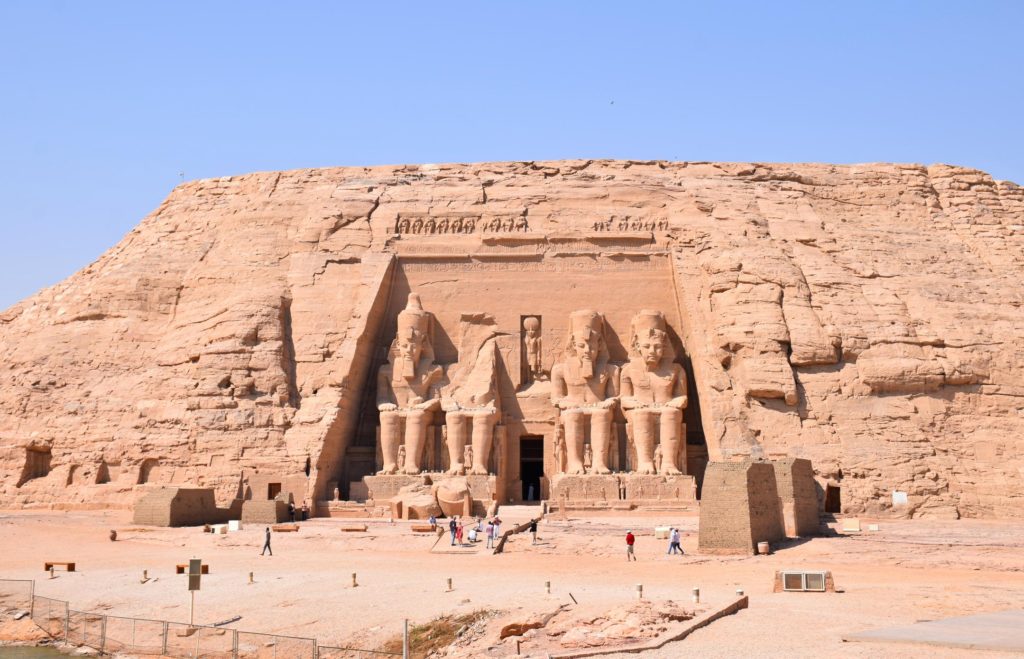
The smaller temple at Abu Simbel, dedicated to Hathor and to Nefertari, was the grandest monument any Egyptian king raised for his queen. Its rock-cut façade has six standing statues about 10 metres tall: four of Ramesses and two of Nefertari, and the queen is carved at the same height as the king, which is very rare in Egyptian art. The dedication text says Ramesses made it for the Great Royal Wife Nefertari, “for whose sake the very sun does shine”.
Inside, Nefertari is shown crowned by Isis and Hathor, shaking sistrums before the gods and wearing the cow horns and sun disc of Hathor herself. Our Temple of Nefertari guide covers what to look for room by room. The temple was moved with the great temple to higher ground in the 1960s rescue campaign.
Who were Nefertari’s children?
Egyptologists generally assign her at least four sons and two daughters, though none of her sons outlived their father to become king. The best known are:
- Amenherkhepeshef, Ramesses II’s eldest son and first crown prince, who died before his father.
- Prehirwenemef, shown riding in his chariot in the Kadesh reliefs.
- Meryatum, who became high priest of Ra at Heliopolis.
- Meritamen, a daughter who later became a Great Royal Wife of her father, a role queens’ daughters sometimes filled at court.
The throne eventually passed to Merenptah, the thirteenth son, whose mother was Ramesses’s other senior queen, Isetnofret.
When did Nefertari die, and was her mummy found?
Nefertari disappears from the record around year 24 of Ramesses II, about 1255 BC, soon after the opening of Abu Simbel, and is thought to have died then or a little later. At the dedication ceremonies in Nubia, one stela shows her daughter Meritamen taking part, which some scholars read as a sign that the queen was already unwell.
Her tomb, QV66, was robbed in antiquity. When the Italian Egyptologist Ernesto Schiaparelli opened it in 1904 he found fragments of a granite sarcophagus lid, sandals, shabti figures and a pair of mummified knees, all now in the Egyptian Museum of Turin. A study published in 2016 concluded that the knees most likely belonged to a woman of about 40 from this period and are probably hers, though without DNA that cannot be certain.
Where to see Nefertari in Egypt today
See her in two places above all: her tomb in Luxor’s Valley of the Queens and her temple at Abu Simbel, about 280 km south of Aswan. The tomb needs a premium ticket on top of the valley entry and visits are limited to about ten minutes; the valley page explains the paintings and how tickets work. Prices and access change, so check egymonuments.gov.eg before you go.
- Abu Simbel: usually reached by a 3-hour drive or a short flight from Aswan; both temples are seen on the same visit.
- Luxor Temple: in the Ramesses II court, small figures of Nefertari stand beside the legs of the king’s colossal statues.
- Karnak and the Ramesseum: she appears in reliefs and statues with the king, though rarely as the main subject.
Seeing the tomb and the temple on one trip is the best way to bring her story to life.
Frequently asked questions
Was Nefertari Ramesses II’s favourite wife?
All the evidence suggests so. No other queen received a temple like hers at Abu Simbel, and the tomb he provided for her is the finest in the Valley of the Queens.
Can you visit Nefertari’s tomb?
Yes, with a separate premium ticket, and visits are limited to around ten minutes to protect the paintings. The tomb occasionally closes for conservation, so confirm it is open before planning around it.
Are Nefertari and Nefertiti related?
There is no known relationship. Nefertiti was the wife of Akhenaten in the Eighteenth Dynasty; Nefertari married Ramesses II in the Nineteenth Dynasty, roughly 70 years later.
How old was Nefertari when she died?
Nobody knows exactly. If the knees found in her tomb are hers, she was probably around 40 to 60, which fits a queen who married young and died about 25 years into her husband’s reign.
What does the name Nefertari mean?
“Beautiful companion”. Her full name, Nefertari Meritmut, adds “beloved of Mut”, the mother goddess of Thebes.