Quick answer
Thutmose III ruled Egypt for almost 54 years, around 1479–1425 BC, the first two decades alongside his stepmother Hatshepsut. Once sole king he led around 17 campaigns into Canaan and Syria, won the Battle of Megiddo, crossed the Euphrates and turned Egypt into the leading power of the Near East, while building lavishly at Karnak.
How did Thutmose III come to the throne?
He became king as a small child around 1479 BC and spent the first 20 or so years of his reign as junior partner to his stepmother and aunt, Hatshepsut. His father, Thutmose II, had no son by his chief queen, so the throne passed to Thutmose III, the son of a lesser wife named Iset. Hatshepsut ruled as regent, and within about seven years had herself crowned as a full king.
Thutmose was not hidden away. He appears beside her in temple reliefs, including on the Red Chapel at Karnak, and he seems to have been trained as a soldier and given command of the army as he grew up. When Hatshepsut died around 1458 BC, he was perhaps in his mid-twenties and ready to act.
What happened at the Battle of Megiddo?
Megiddo, around 1457 BC, was Thutmose III’s first campaign as sole ruler and the first battle in history recorded in real detail, and he won it by taking a risk his generals advised against. A coalition of Canaanite and Syrian cities led by the king of Kadesh had gathered at the fortified city of Megiddo, in today’s northern Israel.
- The choice of route: three roads crossed the Carmel ridge to Megiddo. His officers urged one of the two wider routes; Thutmose chose the narrow Aruna pass, where the army had to march in single file.
- Surprise: the enemy had expected him on another road, and the Egyptians emerged unopposed in front of the city.
- The battle: the next morning the Egyptian charge broke the coalition, whose soldiers fled into Megiddo; according to the account, some had to be hauled over the walls by their clothes.
- The siege: Egyptian troops stopped to loot the enemy camp instead of storming the gates, and the city held out for about seven months before surrendering.
The account was written up from the army’s daybook, kept by the scribe Tjaneni, and carved as the Annals of Thutmose III on walls around the sanctuary at Karnak. Megiddo’s Hebrew name, Har Megiddo, is the origin of the word Armageddon.
How big was Thutmose III’s empire?
By the end of his campaigns Egypt controlled Canaan and much of coastal Syria and dominated Nubia as far as the Fourth Cataract, the widest reach Egypt ever had. He campaigned almost every summer for about 20 years, around 17 campaigns in all.
- Crossing the Euphrates: in his 33rd year he marched against Mitanni, the great power of northern Syria, with boats built near Byblos and carried overland on ox-carts. He crossed the river and set up a victory stela next to one left by his grandfather Thutmose I.
- Holding the territory: rather than occupying every city, he left local rulers in place and took their sons to Egypt to be educated at court, returning them later as loyal vassals.
- Tribute: gold, timber, horses, chariots and skilled workers flowed into Egypt. The tomb of his vizier Rekhmire, among the Tombs of the Nobles in Luxor, shows Syrians, Nubians and Aegeans bringing gifts.
The American Egyptologist James Henry Breasted called him the “Napoleon of Egypt”, a nickname that has stuck, though it says more about early 20th-century taste than ancient Egypt.
What did Thutmose III build?
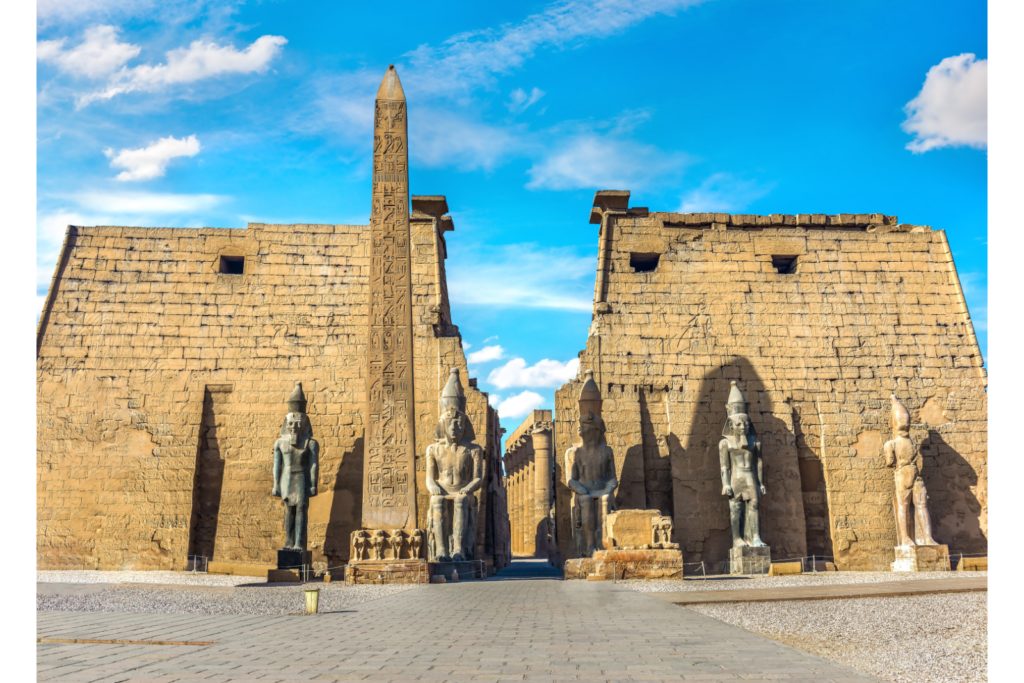
He poured the wealth of his empire into temples, above all Karnak, and his obelisks now stand in four of the world’s great cities. At Karnak he added the Akh-menu, a festival hall with columns shaped like tent poles, recalling a military camp. A small room off it, nicknamed the Botanical Garden, is carved with plants and animals he saw on campaign in Syria in his year 25. The Karnak King List, now in the Louvre, came from the Akh-menu too.
His obelisks have travelled further than any others:
| Obelisk | Where it stands now | Story |
|---|---|---|
| Cleopatra’s Needle | Victoria Embankment, London | Raised at Heliopolis, moved to Alexandria under Augustus, shipped to London 1878 |
| Cleopatra’s Needle | Central Park, New York | The pair to London’s, erected in New York 1881 |
| Obelisk of Theodosius | Former Hippodrome, Istanbul | Taken from Karnak; only the upper part survives; set up in AD 390 |
| Lateran Obelisk | Piazza San Giovanni in Laterano, Rome | Begun for Thutmose III, raised by his grandson Thutmose IV; the tallest standing ancient obelisk |
The nickname “Cleopatra’s Needle” is a misnomer; see our guides to obelisks and to Cleopatra.
Why did Thutmose III erase Hatshepsut?
He did it late in his reign, around his year 42, roughly two decades after she died, so it was probably about securing his own son’s succession rather than personal revenge. Her figures as king were chiselled away or recut with his name or his father’s and grandfather’s, while many of her images as queen were left. Around the same time he made his son Amenhotep II co-regent. The full story is told in our Hatshepsut guide.
How did Thutmose III die, and where is he buried?
He died in his 54th regnal year, around 1425 BC, and was buried in tomb KV34, cut high in a cleft of the cliffs at the far end of the Valley of the Kings. The date is preserved in the tomb biography of one of his officers, Amenemheb. Amenhotep II, his son by Queen Meritre-Hatshepsut, succeeded him. Among his other wives were three foreign women whose shared tomb, found in the Theban hills in 1916, held gold jewellery now in New York’s Metropolitan Museum.
KV34 is reached by a steep staircase up the cliff and then steep stairs down inside. Its oval burial chamber, shaped like a cartouche, is painted with the complete Amduat, the guide to the sun’s night journey, in simple stick-like figures on a pale background, as if an unrolled papyrus had been pasted on the walls. His mummy, badly damaged by ancient robbers, was found in the Deir el-Bahari cache in 1881.
Where to see Thutmose III in Egypt today
Karnak is the heart of his story, but you can follow him across the West Bank and as far as Lake Nasser.
- Karnak Temple: the Akh-menu and Botanical Garden, the Annals around the sanctuary, his Sixth and Seventh Pylons and the heraldic granite pillars carved with the lotus and papyrus of Upper and Lower Egypt.
- Valley of the Kings: tomb KV34, when open; at times it has been included on the standard ticket, but check on the day, and expect steep stairs.
- Luxor Museum: fine statues of the king found at Karnak are among its highlights.
- Tombs of the Nobles: Rekhmire’s tomb, with foreign tribute and scenes of daily work.
- Amada Temple: a small Nubian temple begun by Thutmose III and finished by Amenhotep II, seen on Lake Nasser cruises.
- National Museum of Egyptian Civilization: his mummy in the Royal Mummies Hall.
Frequently asked questions
Why is Thutmose III called the Napoleon of Egypt?
Because of his long run of successful campaigns, which extended Egypt’s control into Syria. The nickname was coined by the Egyptologist James Henry Breasted in the early 20th century.
What was the relationship between Thutmose III and Hatshepsut?
She was his stepmother and aunt, and his co-ruler for about 20 years. She was the senior king until her death around 1458 BC, after which he ruled alone.
How long did Thutmose III rule?
Almost 54 years, around 1479–1425 BC, including the years he shared with Hatshepsut. He ruled alone for about 33 years.
Are Cleopatra’s Needles really Cleopatra’s?
No. The obelisks in London and New York were made for Thutmose III about 1,400 years before Cleopatra; they were moved to Alexandria under Roman rule and acquired her name much later.
Can you visit the tomb of Thutmose III?
KV34 has often been open to visitors, but tombs rotate for conservation. It involves steep stairs both up to the entrance and down inside, so it suits reasonably fit travellers.