Quick answer
Amenhotep III ruled Egypt for about 38 years, around 1390–1352 BC, when the Eighteenth Dynasty was at the peak of its wealth and international power. Rather than fighting wars, he built on a colossal scale – Luxor Temple, the Colossi of Memnon and the largest mortuary temple in Thebes – and conducted diplomacy with the great kings of the Near East. He was the husband of Queen Tiye and the father of Akhenaten.
Who was Amenhotep III?
Amenhotep III was the ninth king of the Eighteenth Dynasty, a son of Thutmose IV who came to the throne as a boy around 1390 BC and ruled for some 38 years of peace and prosperity. His mother was Mutemwia, a secondary wife of Thutmose IV; to underline his legitimacy, reliefs in a room of Luxor Temple show the god Amun himself fathering the future king with her. He was probably no older than about 12 when he was crowned, though the exact age is uncertain.
His throne name, Nebmaatra, “Ra is lord of truth”, appears on more surviving statues than that of almost any other pharaoh. Historians sometimes call him “the Magnificent”, and with reason: he inherited an empire running from Syria to Sudan, built by warrior kings such as Thutmose III, and spent its tribute on monuments, festivals and luxury.
How rich and powerful was Egypt under Amenhotep III?
Egypt was the wealthiest state in the Near East, and its gold made Amenhotep III the most courted king of his age. We know this from the Amarna Letters, clay tablets in Akkadian cuneiform, the diplomatic language of the day, found in 1887 at Tell el-Amarna. Kings of Babylon, Mitanni (in northern Syria), Assyria and Arzawa wrote to him as “brother”, exchanging gifts and princesses and complaining when the Egyptian gold arrived short. One king of Mitanni wrote that in Egypt gold was as plentiful as dust.
Amenhotep married at least two Mitannian princesses and a Babylonian princess, but refused to send an Egyptian princess abroad in return, a sign of how firmly he held the upper hand. When he was old and ill, the king of Mitanni even sent a cult statue of the goddess Ishtar of Nineveh to Egypt, apparently to help heal him.
The commemorative scarabs: royal news in stone
Amenhotep III announced the highlights of his reign on large inscribed scarabs, sent out in many copies like a royal press release. More than 200 survive, grouped by subject:
- The marriage scarab (about year 2) names his Great Royal Wife Tiye and, unusually, her non-royal parents, Yuya and Tjuyu.
- The lion-hunt scarab claims the king killed 102 lions with his own arrows in his first ten years.
- The wild bull scarab describes a single hunt in which dozens of wild cattle were rounded up and shot.
- The Gilukhepa scarab (year 10) records the arrival of a Mitannian princess with 317 women in her retinue.
- The lake scarab (year 11) announces a pleasure lake dug for Tiye, said to have been finished in just 15 days.
What did Amenhotep III build?
He built more, and bigger, than any king before him, transforming Thebes (modern Luxor) into a city of monuments. His architect and right-hand man, Amenhotep son of Hapu, became so famous that he was later worshipped as a god, like Imhotep before him.
| Monument | What it was | What survives |
|---|---|---|
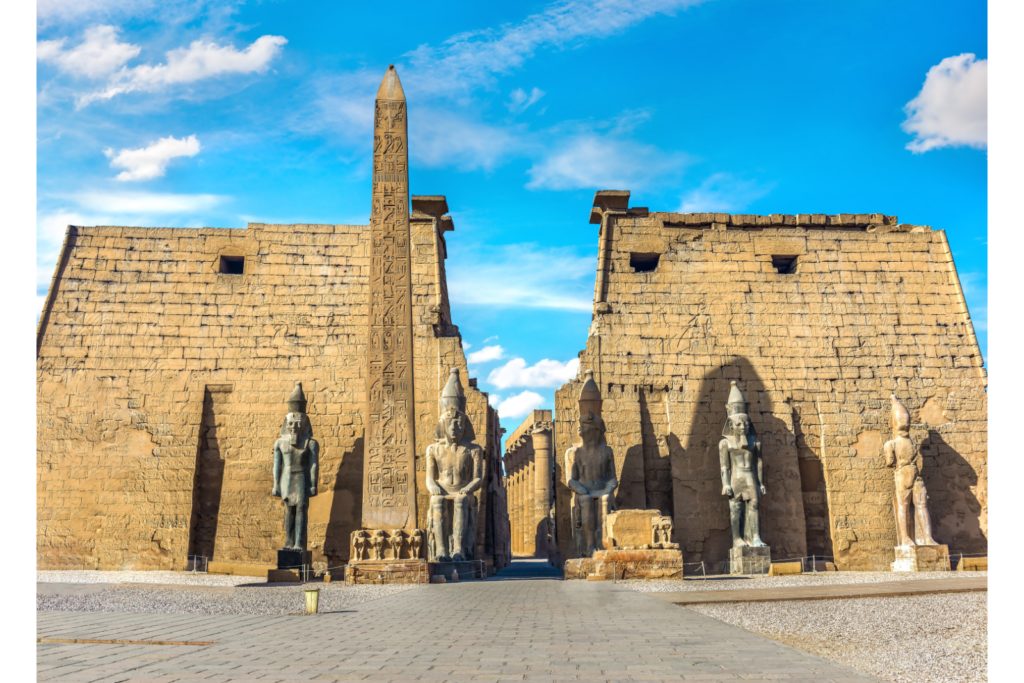
| Luxor Temple | The temple of Amun’s annual Opet festival | His great colonnade, sun court and inner rooms form the core of the temple |
| Mortuary temple at Kom el-Hettan | The largest temple on the West Bank | The Colossi of Memnon and re-erected statues from ongoing excavations |
| Precinct of Mut, Karnak | Temple of Amun’s consort | Hundreds of granite statues of the lion goddess Sekhmet, now scattered across the world’s museums |
| Malkata palace | Royal city on the West Bank with a vast harbour basin, Birket Habu | Low mud-brick ruins, rarely visited |
| Soleb, in today’s Sudan | Temple where the king was worshipped as a god | Columns and walls standing beside the Nile |
Did Amenhotep III make himself a god?
Yes, increasingly so: in the last decade of his reign he celebrated three Heb-Sed jubilees and presented himself as a living god identified with the sun. The jubilees, in years 30, 34 and 37, were held at Malkata with enormous feasts; thousands of wine and food jar labels from the palace record the supplies. In Nubia, at Soleb, he was worshipped as a form of the moon god, and one of his epithets was “the dazzling sun disc”, using the word Aten.
That last detail matters, because his son and successor, Amenhotep IV, would rename himself Akhenaten and make the Aten the only god of the state. Many historians see the seeds of the Amarna revolution in the solar theology of Amenhotep III’s court.
How did his reign end, and what is still debated?
Amenhotep III died around 1352 BC, probably in his late forties or around 50, and was buried in tomb WV22 in the remote Western Valley of the Kings. His mummy, found in 1898 among the royal mummies cached in the tomb of Amenhotep II, shows an overweight man with severe dental abscesses that must have caused him great pain, although the identification of some reburied royal mummies has been questioned. DNA work published in 2010 linked him to Tiye’s family and to Tutankhamun, his grandson.
The biggest debate is whether he shared the throne with his son. Some scholars argue for a co-regency with Akhenaten of up to 12 years, which would mean the Amarna revolution began while the old king still lived; others see no overlap at all, or only a short one. New evidence surfaces from time to time, and the question remains open.
Where to see Amenhotep III in Egypt today
Luxor is his city: start with the colonnade and sun court of Luxor Temple, then cross to the West Bank for the Colossi of Memnon, about 25 minutes by car from East Bank hotels.
- Luxor Museum: the star exhibit is a pink quartzite statue of the king standing on a sledge, found buried in the sun court of Luxor Temple in 1989 with other statues known as the Luxor Cache.
- Egyptian Museum, Tahrir: a colossal limestone group about 7 m high shows Amenhotep III and Tiye seated side by side with three of their daughters. Check that it is still on display when you visit, as objects continue to move between Cairo’s museums.
- National Museum of Egyptian Civilization: his mummy was moved here in the 2021 Pharaohs’ Golden Parade and, at the time of writing, lies in the Royal Mummies Hall.
- His tomb: WV22 has been under long-term conservation and is not normally open; see our Western Valley guide for what you can visit there.
Frequently asked questions
Who was the father of Amenhotep III?
Thutmose IV, who ruled for only about ten years. His mother was Mutemwia, a secondary wife.
Was Amenhotep III the father of Akhenaten?
Yes. Akhenaten, born Amenhotep, was his son by Queen Tiye. An elder son, Prince Thutmose, died before his father, which is how Amenhotep IV came to the throne.
Was Amenhotep III Tutankhamun’s grandfather?
Yes. DNA studies published in 2010 identified the mummy from tomb KV55, usually thought to be Akhenaten, as a son of Amenhotep III and Tiye and as the father of Tutankhamun.
Why are the Colossi of Memnon not called the Colossi of Amenhotep?
Greek and Roman visitors linked them to Memnon, a hero of the Trojan War, because one statue seemed to sing at dawn after an earthquake cracked it. The name stuck, though both statues show Amenhotep III.
Did Amenhotep III fight any wars?
Very few. Apart from a campaign in Nubia early in his reign, he kept Egypt’s empire through diplomacy, marriage alliances and gold rather than battle.