Quick answer
An obelisk is a tall, four-sided stone shaft, cut from a single block and tapering to a pyramid-shaped tip, raised in pairs at temple gateways as a symbol of the sun. Most were cut from Aswan granite. Rome alone has eight ancient Egyptian obelisks and only a handful still stand where they were raised in Egypt, but Karnak, Luxor Temple and Aswan's quarry show them in their original setting.
What is an obelisk and what did it mean?
An obelisk was a monument to the sun: a single shaft of stone whose pointed tip, the pyramidion, caught the first and last rays of the day. The Egyptians called it tekhen. The word obelisk comes from the Greek obeliskos, “little skewer”, a joking name from Greek visitors.
Obelisks were tied to the sun cult of Heliopolis and to the benben, the sacred stone on which the sun first rose at creation; the god most closely linked to them is Ra. Their tips were often sheathed in electrum, a gold-silver alloy, so they flashed in the sun. Kings set them up in pairs in front of temple pylons, carved with columns of royal titles and dedications to the gods. Fifth Dynasty kings built squat masonry obelisks as the centrepieces of their sun temples at Abu Gorab, near Abusir.
How were obelisks made and raised?
They were pounded out of the bedrock at Aswan, floated downriver on huge barges and then, by methods still debated, lowered upright onto their bases. The quarrying is clearly visible at the Unfinished Obelisk, where a 42-metre shaft cracked before it could be freed.
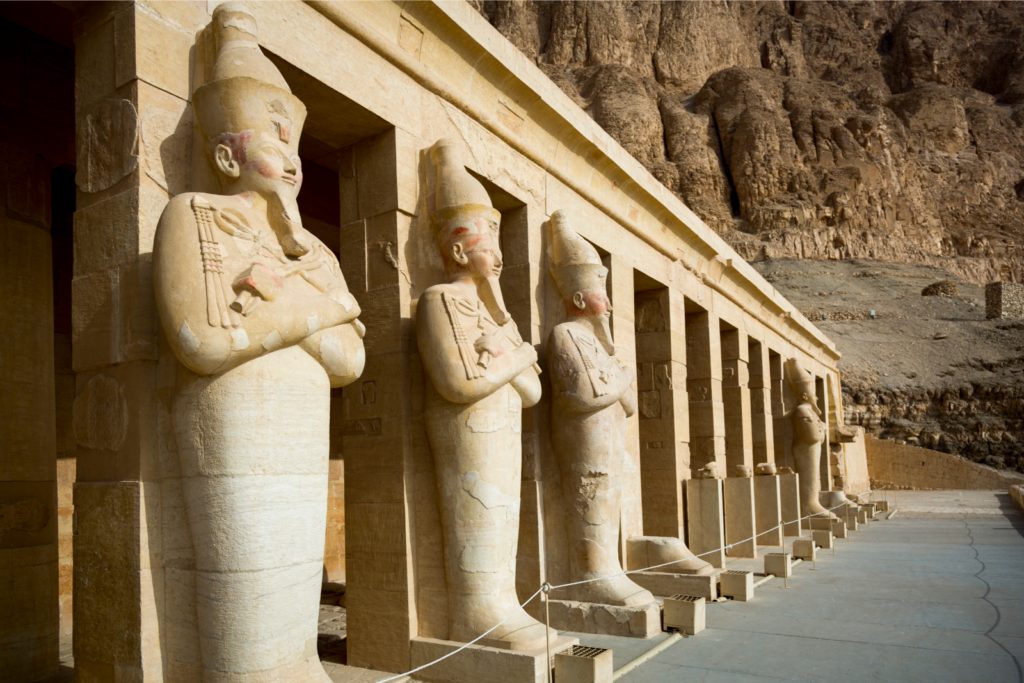
Transport is recorded in reliefs at the Temple of Hatshepsut, which show two obelisks lying end to end on a giant barge towed by a fleet of boats. Hatshepsut’s inscription at Karnak claims her obelisks were quarried in seven months.
Raising them is the real puzzle. The leading theory has the obelisk dragged up an earth ramp and tipped base-first into a funnel filled with sand; as the sand was removed, the shaft settled onto its base at an angle and was then hauled upright with ropes and levers. Modern experiments have raised smaller obelisks this way, but no ancient text describes the method. A satirical New Kingdom letter, Papyrus Anastasi I, even mocks a scribe who cannot calculate the ramp and manpower needed to move one.
Which obelisks still stand at Karnak and Luxor?
Three ancient obelisks still stand in Luxor: two at Karnak and one at Luxor Temple.
- Thutmose I, Karnak: about 20 metres, the older of the two, standing between the Third and Fourth Pylons.
- Hatshepsut, Karnak: almost 30 metres and weighing more than 300 tonnes, the tallest standing in Egypt. Thutmose III later walled it in, which hid it from view but also protected it. The upper part of its fallen twin lies near the Sacred Lake, where you can study the carving at eye level.
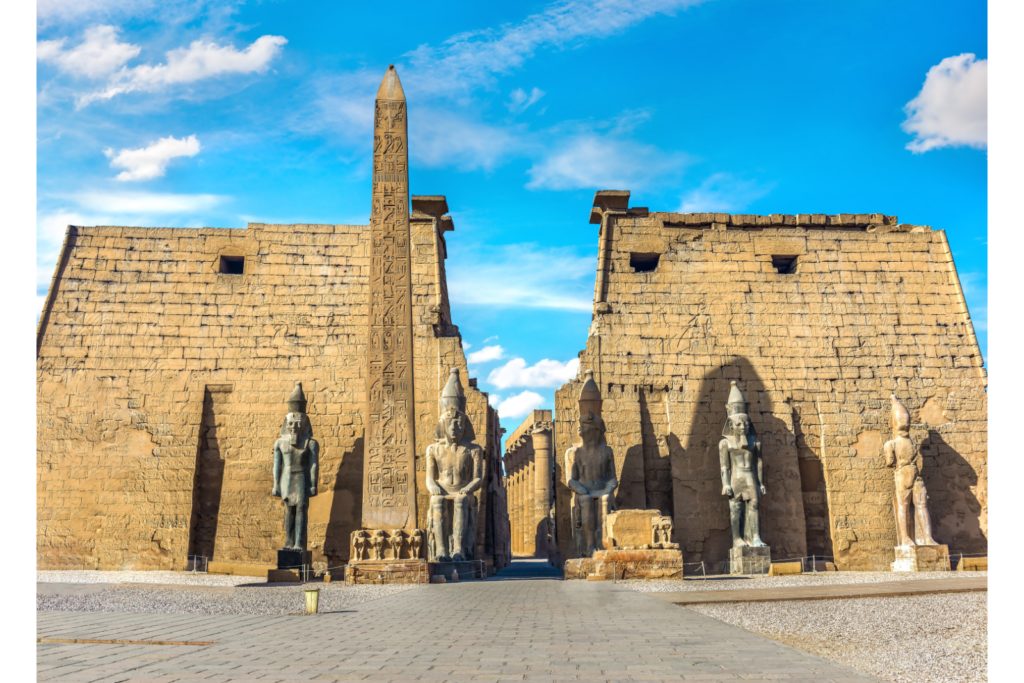
- Ramesses II, Luxor Temple: about 25 metres, in front of the pylon. Its partner, slightly shorter, has stood in the Place de la Concorde in Paris since 1836.
Why are so many Egyptian obelisks abroad?
Because conquerors and later rulers prized them as trophies: first the Romans, then 19th-century Europe, often as diplomatic gifts from Egypt’s rulers. Augustus shipped two to Rome after conquering Egypt, later emperors followed, and Renaissance popes re-erected the fallen ones as Christian landmarks.
| Obelisk | Original site and king | Where it stands now |
|---|---|---|
| Lateran Obelisk | Karnak; Thutmose III, completed by Thutmose IV | Rome, moved in AD 357; the tallest ancient obelisk, about 32 m |
| Obelisk of Theodosius | Karnak; Thutmose III | Istanbul, Hippodrome, since AD 390 (upper part only) |
| Luxor Obelisk | Luxor Temple; Ramesses II | Paris, Place de la Concorde, since 1836 |
| Cleopatra’s Needle | Heliopolis, then Alexandria; Thutmose III | London, Victoria Embankment, since 1878 |
| Cleopatra’s Needle | Heliopolis, then Alexandria; Thutmose III | New York, Central Park, since 1881 |
| Philae Obelisk | Philae; Ptolemy VIII | Kingston Lacy, Dorset, England |
The “Cleopatra’s Needles” have nothing to do with Cleopatra; they were simply moved to Alexandria by the Romans. London’s was nearly lost when its towing cylinder broke loose in a storm in the Bay of Biscay in 1877, and six sailors died trying to recover it. In return for the Paris obelisk, France gave Muhammad Ali a clock tower that stands in the courtyard of his mosque at the Citadel; by repute it has rarely kept good time.
Which obelisks can you see in Cairo?
Cairo has the oldest obelisk still standing where it was raised, plus two relocated giants of Ramesses II.
- Senusret I, Heliopolis (Al-Matariya): about 20 metres, set up around 1950 BC, the sole survivor of the great sun temple of Heliopolis. It stands in a small garden in a busy suburb, best combined with other sights in the north-east of Cairo.
- Tahrir Square: an obelisk of Ramesses II brought from the Delta site of Tanis and re-erected in the centre of the square in 2020, surrounded by ram-headed sphinxes from Karnak.
- Grand Egyptian Museum: the “hanging obelisk” of Ramesses II in the entrance plaza, raised on supports so you can walk underneath and see the cartouche carved on its base, normally hidden from view. Our GEM guide covers the museum.
Where to see obelisks in Egypt today
For obelisks in their original setting go to Luxor; for how they were made go to Aswan.
- Karnak: the obelisks of Thutmose I and Hatshepsut, and the fallen tip by the Sacred Lake.
- Luxor Temple: Ramesses II’s obelisk in front of the pylon, with the empty base of its Paris twin beside it; beautiful when lit after dark.
- Unfinished Obelisk, Aswan: the quarry, the pounding marks and the fatal crack.
- Temple of Hatshepsut: the barge relief showing the obelisks in transit, on the lower colonnade.
- Cairo: Heliopolis, Tahrir Square and the GEM, all reachable in a day.
Most Nile itineraries cover Karnak, Luxor Temple and the Unfinished Obelisk as standard, so you can see the whole life of an obelisk, from bedrock to temple gate, in a single trip.
Frequently asked questions
What is an obelisk?
A tall, four-sided monolith of stone that tapers to a small pyramid at the top. In ancient Egypt obelisks were sun symbols, usually set up in pairs at the entrances of temples.
How many ancient Egyptian obelisks are there?
Around 30 ancient Egyptian obelisks are usually counted as still standing worldwide, and more of them stand outside Egypt than inside. Rome alone has eight.
Where is the twin of the Luxor obelisk?
In the Place de la Concorde in Paris, where it was erected in 1836 after being given to France by Muhammad Ali. Its partner still stands in front of Luxor Temple.
Did Cleopatra have anything to do with Cleopatra's Needles?
No. The London and New York obelisks were made for Thutmose III around 1450 BC, more than 1,400 years before Cleopatra, and were moved to Alexandria by the Romans after her death.
How did the Egyptians raise obelisks?
No ancient text explains it. The leading theory is that they were lowered base-first into a sand-filled pit and then pulled upright with ropes and levers, but this remains a reconstruction.