Quick answer
Hatshepsut was an 18th Dynasty queen who first ruled as regent for her young stepson Thutmose III and then, around 1473 BC, was crowned pharaoh in her own right, reigning until about 1458 BC. Her reign was peaceful and prosperous, remembered for the trading expedition to Punt, the obelisks at Karnak and her terraced temple at Deir el-Bahari.
Was Hatshepsut the first female pharaoh?
She was not the first woman to rule Egypt, but she was the first to take the full titles of a king and hold them for some two decades, which makes her the most successful female pharaoh before Cleopatra. Earlier women had governed: Merneith in the 1st Dynasty probably acted as regent, and Sobekneferu ruled as king at the end of the 12th Dynasty for only about four years. Ahhotep and Ahmose-Nefertari, at the start of Hatshepsut’s own dynasty, wielded great power as queens.
Hatshepsut was born into the royal house, the daughter of Thutmose I and his principal wife Ahmose, and she never let anyone forget it. Her name means “foremost of noble women”. Her later inscriptions stress that her father had chosen her as heir, a claim most historians treat as political justification rather than fact.
How did Hatshepsut become king?
She rose in three steps: queen, regent, then crowned pharaoh, and she did it without displacing the boy king, who remained her co-ruler throughout.
- Queen: she married her half-brother Thutmose II and became Great Royal Wife and God’s Wife of Amun, a powerful priestly office. Their only known child was a daughter, Neferure. How long Thutmose II reigned is disputed, with estimates from about three to thirteen years.
- Regent: when Thutmose II died around 1479 BC, the heir was Thutmose III, his infant son by a minor wife called Iset. Hatshepsut governed on his behalf, as queens had done before.
- King: by about year 7 of the boy’s reign, around 1473 BC, she had been crowned as king with the throne name Maatkare. She counted her years from his accession, and official art shows the two kings side by side, with Hatshepsut usually in front.
Why she took this unprecedented step is unknown: personal ambition, a political crisis or pressure from her supporters have all been suggested. Her statues gradually change from a slender woman in a king’s headdress to a fully masculine king with a false beard, which is how her role required her to be shown. Inscriptions often still use feminine grammar for her.
What did Hatshepsut achieve?
Her reign was a time of peace, trade and building on a scale no ruler since the Middle Kingdom had matched.
- The expedition to Punt: in year 9 she sent ships down the Red Sea to Punt, probably on the coast of today’s Eritrea or Sudan, bringing back gold, ebony, animal skins, baboons and living myrrh trees. Her temple’s reliefs record it in vivid detail, and the pits where the trees were planted can still be seen in front of the temple.
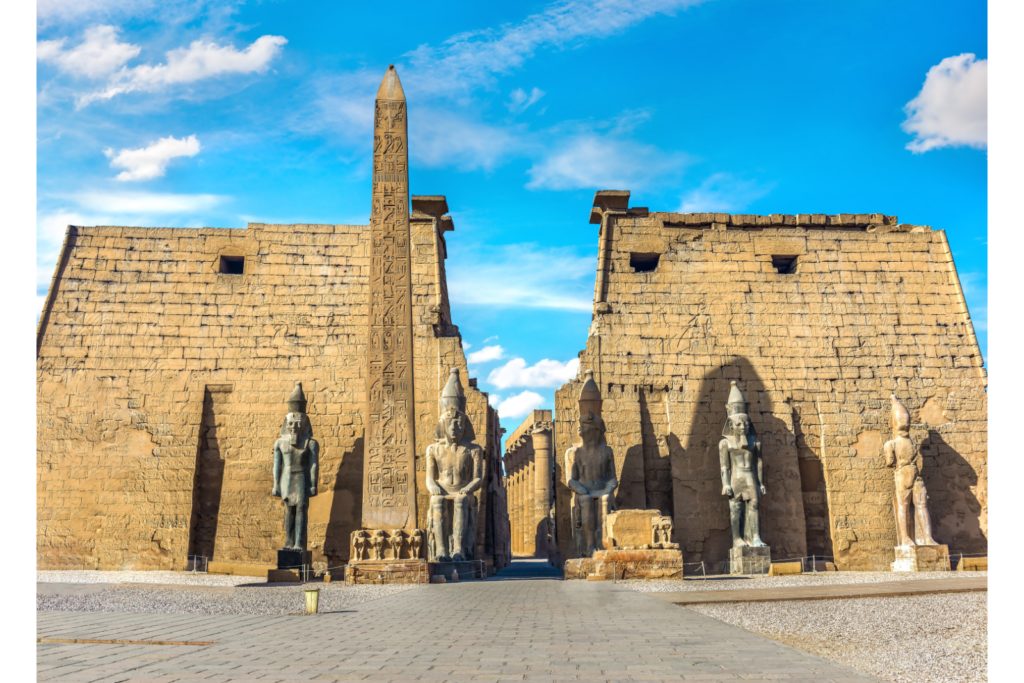
- Karnak: she raised two pairs of granite obelisks from Aswan. One still stands, about 29.5 metres tall, the tallest ancient obelisk standing in Egypt; its inscription claims the pair was quarried in seven months. She also built the Red Chapel and the Eighth Pylon.
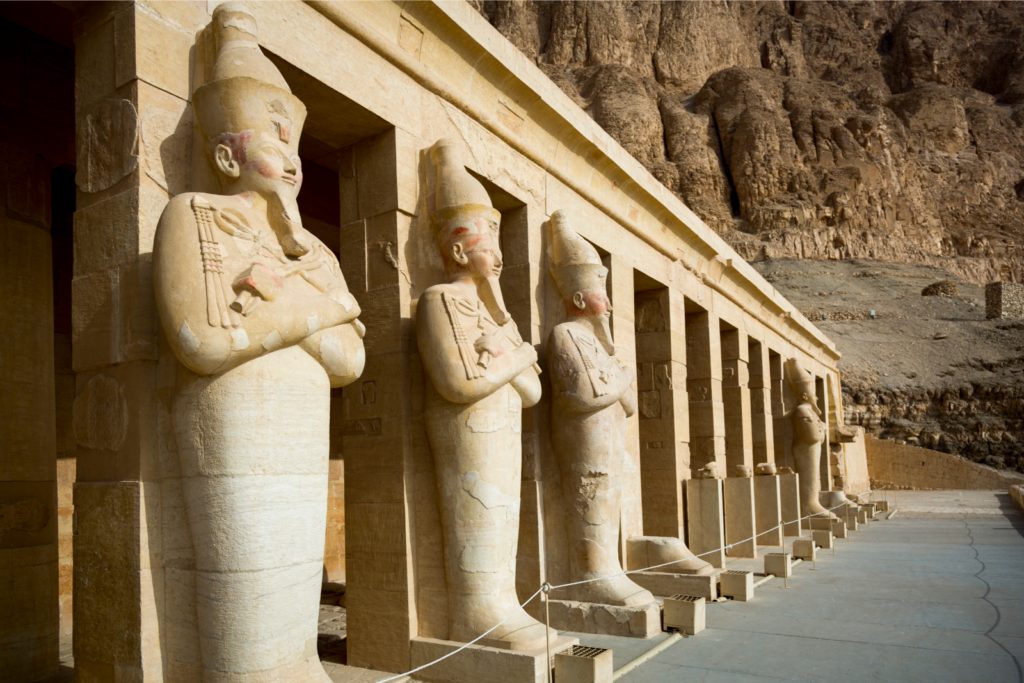
- Deir el-Bahari: her temple, Djeser-Djeseru, rises in three colonnaded terraces against the cliffs, a design without parallel in Egypt. The Temple of Hatshepsut guide covers what you see there.
- Restoration in Middle Egypt: at the Speos Artemidos, a rock temple near Beni Hasan, an inscription claims she repaired temples neglected since the Hyksos occupation, decades earlier.
Military activity was limited but not absent: there is evidence of at least one campaign in Nubia, where some think she took part herself.
Who was Senenmut?
Senenmut was the commoner who became Hatshepsut’s most powerful official: steward of Amun’s estates, tutor to her daughter Neferure and, traditionally, the architect of her temple. He left more than 20 statues of himself, several showing him cradling the young princess, an extraordinary number for a non-royal. He even placed small images of himself behind shrine doors at Deir el-Bahari, where they would be hidden when the doors opened.
Whether they were lovers is pure speculation. The idea rests largely on a crude ancient graffito in a cave near the temple, which may not depict them at all. Senenmut disappears from the record around year 16 to 20 of the reign; his two tombs, one at Sheikh Abd el-Qurna and one beneath the temple forecourt, were never used for his burial.
Why were Hatshepsut’s images destroyed?
Thutmose III removed her as king from the record, but he did it roughly two decades after her death, which suggests cold politics rather than revenge. The old story of a stepson burning with hatred was popular in the 20th century. The dating of the damage changed that: the campaign began late in Thutmose III’s reign, around his year 42, decades after he had ruled alone.
The selectivity is telling. Her figures as king were chiselled out or recut as Thutmose I, II or III, her obelisks at Karnak were walled in rather than toppled, and her images as queen were often left alone. The most widely held explanation is that he wanted the succession to pass cleanly to his own son, Amenhotep II, and a female king in the official story offered a precedent that rival branches of the family might exploit. Others see it as tidying the record so that kingship ran neatly from father to son. Our guide to Thutmose III follows the story from his side.
How was Hatshepsut’s mummy found?
In 2007 a team led by Zahi Hawass identified an obese woman’s mummy from a minor tomb, KV60, as Hatshepsut, using a loose tooth found in a box bearing her name. She died around 1458 BC, probably in her fifties. The tooth fitted a gap in the mummy’s jaw, and CT scans suggested she had suffered from diabetes, arthritis and possibly bone cancer. Some scholars still regard the identification as not fully proven.
She had prepared two tombs: a cliff tomb as queen, and later KV20 in the Valley of the Kings, where she also reburied her father. The body was moved at some point in antiquity. In 2021 the mummy travelled in the Pharaohs’ Golden Parade to the National Museum of Egyptian Civilization.
Where to see Hatshepsut in Egypt today
Luxor holds almost everything: her temple on the West Bank and her obelisk and chapel at Karnak on the East Bank, both easily seen in one day.
- Temple of Hatshepsut, Deir el-Bahari: the Punt and divine-birth reliefs and the Osiride statues of the king, best seen early in the morning.
- Karnak Temple: her standing obelisk, and the tip of its fallen twin beside the Sacred Lake.
- Karnak Open-Air Museum: the reassembled Red Chapel, where she and Thutmose III appear together.
- Medinet Habu: the small 18th Dynasty temple inside the complex was begun under Hatshepsut and Thutmose III.
- National Museum of Egyptian Civilization, Cairo: her mummy in the Royal Mummies Hall.
Look out for her granite quarry, too: the Unfinished Obelisk at Aswan is often linked to her reign, though its date is not certain. Our Hatshepsut program takes in her temple and Karnak.
Frequently asked questions
How long did Hatshepsut rule?
About 21 or 22 years in total, around 1479–1458 BC, counting her regency. She was crowned king around year 7 of Thutmose III’s reign, so she reigned as pharaoh for about 15 years.
Did Hatshepsut wear a false beard?
Her official statues and reliefs show her with the king’s ceremonial false beard, because that was how a pharaoh was depicted. Whether she wore one in real life is unknown.
Did Thutmose III hate Hatshepsut?
Probably not. He waited about 20 years after her death to erase her images as king and left many of her queenly images untouched, which points to a political motive, most likely securing his son’s succession.
Where is Hatshepsut buried?
She prepared tomb KV20 in the Valley of the Kings, but her mummy was found in KV60 and identified in 2007. It is now in the National Museum of Egyptian Civilization.
Where was the land of Punt?
No one knows exactly. Most scholars place it on the southern Red Sea coast of Africa, in the region of modern Eritrea, Sudan or Ethiopia, and possibly extending to southern Arabia.