Quick answer
Tutankhamun’s tomb was discovered by the British archaeologist Howard Carter, funded by Lord Carnarvon, when his workmen uncovered its first step in the Valley of the Kings on 4 November 1922. Carter first looked inside on 26 November, seeing “wonderful things”, and clearing the tomb’s more than 5,000 objects took him another ten years, until 1932.
Why did experts think the Valley of the Kings was finished?
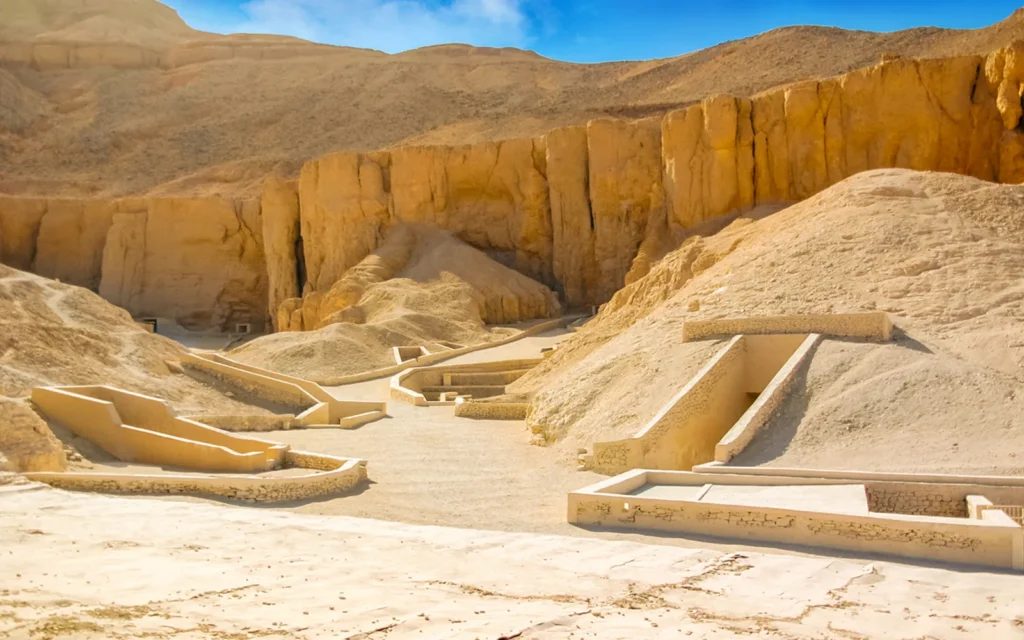
By 1914 the American millionaire Theodore Davis, who had held the digging rights for a decade, had declared the valley exhausted, and most Egyptologists agreed. Every known royal tomb in the Valley of the Kings had been robbed in antiquity, and Davis’s teams had found around 30 tombs and pits. In his 1912 publication he wrote that he feared the valley was “now exhausted”.
Howard Carter disagreed. He had come to Egypt in 1891, aged 17, as an artist copying tomb paintings, trained in excavation under Flinders Petrie at Amarna, and served as an inspector of antiquities in Luxor. He knew that no tomb of Tutankhamun had been found, and Davis had turned up tantalising clues: a faience cup bearing the king’s name, gold foil from a chariot harness, and a pit of jars holding linen and embalming material stamped with his name, which Davis took for leftovers from a burial that must be nearby or already lost.
When Davis gave up his concession in 1914, it passed to George Herbert, the fifth Earl of Carnarvon, a wealthy collector who had wintered in Egypt for his health since a car accident, and who had employed Carter on his excavations at Thebes for several years.
How did Carter search for the tomb?
Carter decided to clear the central valley down to bedrock, square by square, rather than dig where tombs seemed likely. The First World War delayed the work, and serious digging began in late 1917, concentrating on a triangle of ground between the tombs of Ramesses II, Merenptah and Ramesses VI.
Five seasons turned up little: the most notable find was a group of 13 calcite jars near Merenptah’s tomb in 1920. Thousands of tonnes of chippings had been moved. One area was left, under the remains of stone huts built for the workmen who cut the tomb of Ramesses VI, because clearing it would have blocked visitors to that popular tomb.
In the summer of 1922 Carnarvon, who had spent a fortune, considered stopping. At his country house, Highclere Castle, Carter persuaded him to fund one final season, by some accounts offering to pay for it himself if Carnarvon would not.
What happened on 4 November 1922?
Three days after the last season began, workmen clearing beneath the huts found a step cut into the rock, and by the next evening a staircase led down to a sealed, plastered doorway. A family tradition in Luxor holds that a water boy, Hussein Abdel Rassoul, found the step while setting down his water jars; it cannot be verified, but it is widely told.
- 4 November: the first step is uncovered just below the entrance to the tomb of Ramesses VI.
- 5 November: twelve steps are cleared to the top of a doorway stamped with the seal of the royal necropolis: a jackal above nine bound captives.
- 6 November: Carter refills the stairway, posts guards and cables Carnarvon: “At last have made wonderful discovery in Valley; a magnificent tomb with seals intact; re-covered same for your arrival; congratulations.”
- 23 November: Carnarvon and his daughter, Lady Evelyn Herbert, arrive in Luxor.
- 24 November: all 16 steps are cleared, and the lower door shows seals bearing Tutankhamun’s throne name, Nebkheperure. It also shows signs of having been opened and resealed in antiquity.
The resealing worried Carter. Debris on the stairs held objects with the names of several earlier kings, and he feared the tomb might be a robbed cache rather than an intact burial.
What did Carter see when he first looked inside?
On the afternoon of 26 November, after clearing a corridor packed with rubble, Carter made a small hole in a second sealed door, held up a candle and, asked whether he could see anything, replied “Yes, wonderful things.” That is the version in his published account; his diary records something closer to “Yes, it is wonderful”, but the published words stuck.
The candle lit up the antechamber: three gilded couches with the heads of animals, dismantled chariots, stacked boxes, and two life-size black and gold statues of the king guarding a sealed doorway in the right-hand wall. The rubble in the corridor contained a robbers’ tunnel, but the robbers had been caught or disturbed, and the burial itself was intact.
Officially, the antechamber was opened on 29 November in front of officials and press, and the burial chamber was not entered until February. It is now widely accepted, from evidence in the excavators’ own notes and letters, that Carter, Carnarvon, Lady Evelyn and the engineer Arthur Callender crept through a small hole into the burial chamber that first night, then hid the hole with a basket and reeds.
How long did it take to clear the tomb, and who did the work?
The clearance took ten seasons, from late 1922 until 1932, because every object had to be recorded, photographed and often stabilised before it could be moved. Carter assembled a remarkable team, several lent by the Metropolitan Museum of Art in New York: the photographer Harry Burton, the conservator Arthur Mace, the chemist Alfred Lucas from the Egyptian government, and the philologist Alan Gardiner to read the inscriptions. The nearby tomb of Seti II served as a laboratory.
- Winter 1922–23: the antechamber is emptied; the burial chamber is officially opened on 16–17 February 1923, revealing a gilded shrine almost filling the room.
- 5 April 1923: Carnarvon dies in Cairo of blood poisoning and pneumonia, giving birth to the curse legend. His widow takes over the concession.
- February 1924: the granite lid of the sarcophagus is raised. A row with the Antiquities Service over access for the excavators’ wives ends with Carter locked out for most of a year.
- October–November 1925: the three nested coffins are opened, the innermost of solid gold, and the gold mask is lifted from the king’s mummy, which is examined by the anatomist Douglas Derry.
- 1926–1930: the treasury and the crammed annexe are cleared; final conservation work runs into 1932.
Who got to keep the treasure?
All of it stayed in Egypt, a turning point in the history of archaeology. Under the old system, finds were divided between Egypt and the excavator, and Carnarvon had hoped for a share. But Egypt had been declared independent in February 1922, nationalist feeling was strong, and the Antiquities Service argued that an intact royal tomb could not be split. Carnarvon’s heirs eventually gave up their claim in exchange for compensation for the costs of the dig.
The press caused almost as much trouble as the politics. Carnarvon sold exclusive reporting rights to The Times of London, so rival newspapers, including the Egyptian press, were reduced to waiting outside the tomb and printing rumours. Carter never completed a full scientific report; his three popular volumes appeared between 1923 and 1933, and his notes, cards and Burton’s photographs are now held by the Griffith Institute in Oxford. Carter died in London in 1939, aged 64.
Where to follow the discovery story in Egypt today
You can stand on the same steps in Luxor and then see the treasures at Giza.
- Tomb of Tutankhamun (KV62): walk down the 16 steps into the antechamber, where the king’s mummy now lies, and look into the painted burial chamber. Separate ticket.
- Howard Carter’s House: Carter’s dig house near the valley entrance, with excavation photographs and a full-size replica of the burial chamber.
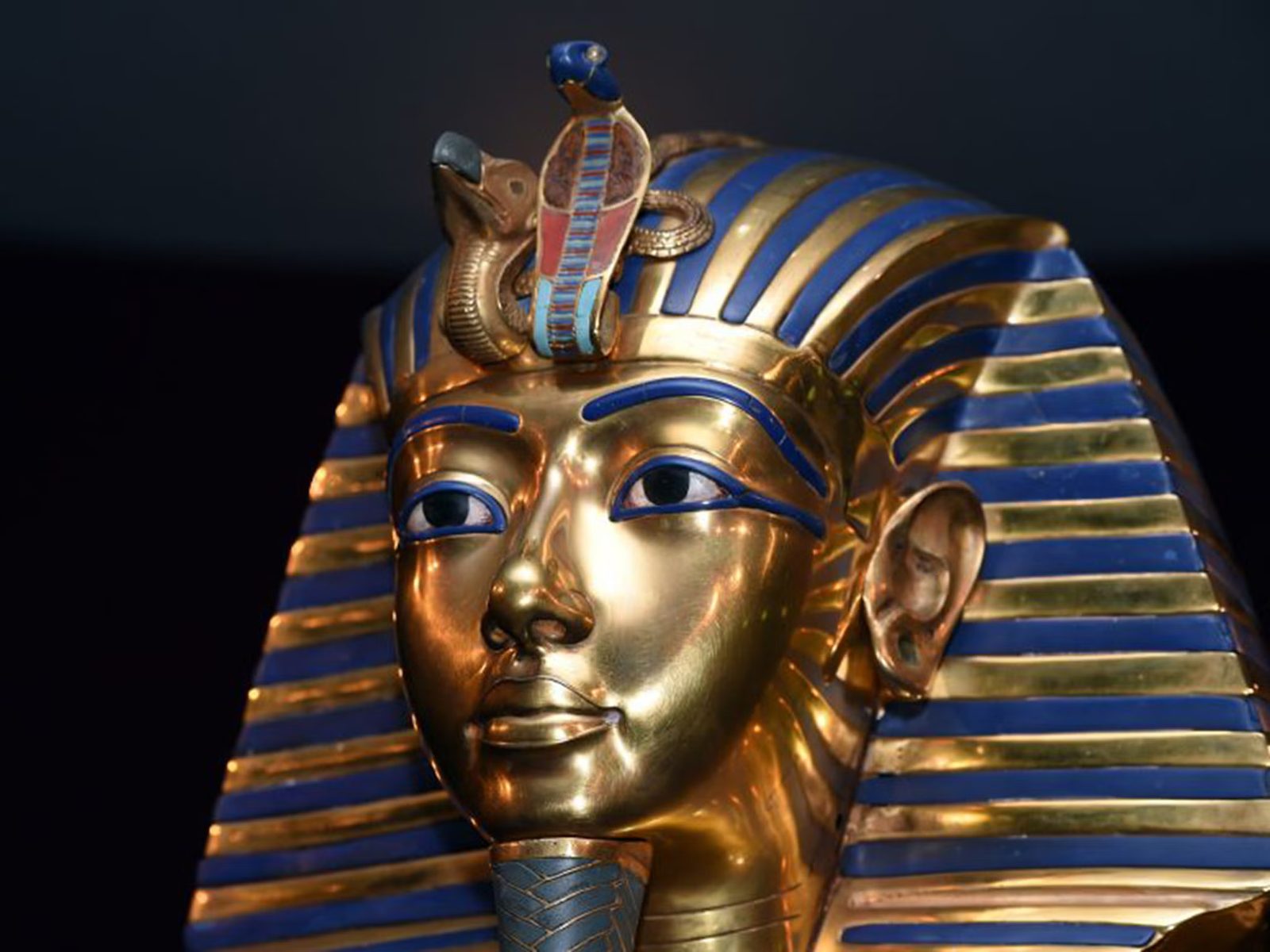
- Grand Egyptian Museum: the complete tomb collection, displayed together since the museum opened in full on 1 November 2025, including the gold mask, the shrines and the guardian statues Carter saw by candlelight.
Our King Tut program follows exactly this route, and any private itinerary can be built around it.
Frequently asked questions
Who discovered Tutankhamun’s tomb?
The British archaeologist Howard Carter, working for and funded by George Herbert, fifth Earl of Carnarvon. Carter’s Egyptian workforce, led by experienced foremen, did the digging, and a Luxor family tradition credits a water boy with spotting the first step.
When was Tutankhamun’s tomb discovered?
The first step was found on 4 November 1922. Carter first looked into the tomb on 26 November 1922, and the burial chamber was officially opened on 16–17 February 1923.
Why was Tutankhamun’s tomb not robbed?
It was robbed, at least twice, soon after the burial, but the thieves were interrupted and officials resealed it. Then debris and workmen’s huts from the cutting of Ramesses VI’s tomb, about two centuries later, buried the entrance until 1922.
How many objects were found in Tutankhamun’s tomb?
More than 5,000, from the gold mask and coffins to sandals, board games, chariots and food. All of them are now at the Grand Egyptian Museum, apart from the mummy and sarcophagus, which remain in the tomb.
What did Howard Carter say when he found the tomb?
According to his published account, when Carnarvon asked if he could see anything, Carter replied “Yes, wonderful things.” His diary records a slightly different phrase, but “wonderful things” became the famous version.