Quick answer
The curse of Tutankhamun is a legend, not a fact. It grew out of Lord Carnarvon’s death from an infection in April 1923, months after the tomb was opened, and was amplified by newspapers shut out of the story. No curse was written in the tomb, most people involved lived long lives, and a 2002 study found no difference in lifespan between those exposed to the tomb and those who were not.
Is the curse of Tutankhamun real?
No: there is no evidence that anyone died because they entered Tutankhamun’s tomb, and the man who spent the most time inside it, Howard Carter, lived for another 16 years. What is real is a chain of coincidences, a commercial row between newspapers and a public already primed by a century of mummy fiction. The story of the find itself is told in our guide to the discovery of Tutankhamun’s tomb.
The idea of a mummy’s curse was older than the tomb. Jane Loudon’s novel The Mummy! appeared in 1827, Louisa May Alcott wrote a short story about a mummy’s curse in 1869, and stage shows and magazines had long played with vengeful mummies. In 1922 all that was missing was a famous death.
How did Lord Carnarvon die?
Carnarvon died in Cairo on 5 April 1923, aged 56, after a mosquito bite on his cheek became infected when he nicked it shaving, leading to blood poisoning and then pneumonia. He was already frail: a serious car crash in Germany in 1901 had left him with lasting health problems, which is why he wintered in Egypt in the first place. Antibiotics did not yet exist.
Two stories, told later by his son, made the death sound supernatural: that the lights of Cairo went out at the moment he died, and that his dog at Highclere in England howled and died at the same hour. Power cuts in 1920s Cairo were common, and neither story can be checked.
The ground had already been prepared. In March 1923, weeks before Carnarvon’s death, the popular novelist Marie Corelli wrote to the press warning of “dire punishment” for those who entered a sealed tomb, citing an old book she claimed to own. After the death, Sir Arthur Conan Doyle, creator of Sherlock Holmes and a committed spiritualist, suggested that “elementals” created by the priests might be responsible.
Was there a curse written in the tomb?
No. The widely quoted line “Death shall come on swift wings to him who disturbs the peace of the king” does not appear anywhere in Tutankhamun’s tomb. It seems to have been put together by journalists, possibly from a protective spell on a magical object in the treasury, which speaks of driving back whoever would harm the deceased, not of punishing visitors.
Why could journalists invent so freely? Because Carnarvon had sold exclusive rights to the story to The Times of London. Other papers, including the Egyptian press, had no access to the tomb and filled their columns with speculation, and the curse sold better than conservation reports. Stories added along the way, such as Carter’s pet canary being eaten by a cobra, the royal serpent, as the tomb was opened, were repeated without checking.
Who supposedly died from the curse?
Lists of “victims” circulated for decades, but they mix people who never entered the tomb with ordinary deaths from illness, accident and old age. Commonly cited names include:
- George Jay Gould, the American financier, who visited the tomb in 1923 and died that May of pneumonia.
- Aubrey Herbert, Carnarvon’s half-brother, who died in 1923 of blood poisoning after dental treatment.
- Prince Ali Kamel Fahmy Bey, shot by his wife at the Savoy Hotel in London in 1923, with no clear connection to the tomb.
- Richard Bethell, Carter’s secretary, who died in 1929, followed by his father a few months later.
Against them stand the people at the heart of the work who lived long lives. Lady Evelyn Herbert, who entered the tomb in the first days, died in 1980. Douglas Derry, who cut into the king’s mummy in 1925, lived into his 80s. The photographer Harry Burton and the chemist Alfred Lucas both worked in the tomb for years and died in the 1940s.
What do the statistics say?
When researchers compared the people exposed to the tomb with those who were not, they found no difference in how long they lived. In 2002 Mark Nelson, an epidemiologist from Monash University in Melbourne, published a study in the British Medical Journal using Carter’s records to identify 44 Westerners in Egypt at the time of the key openings. The 25 who were present at the tomb, sarcophagus or coffins lived on average about as long as the 19 who were not; the small difference in their mean age at death was not statistically significant.
Earlier, in the 1930s, the Metropolitan Museum’s Egyptologist Herbert Winlock, who knew the team well, drew up his own tally of who had been present at the main events and found that most were still alive. Neither study proves a negative, but together they show the curse needs no explanation beyond coincidence.
Could mould or bacteria in the tomb have killed anyone?
It is possible in principle but there is no evidence it happened. Sealed tombs can contain fungi such as Aspergillus and bacteria, and the walls of Tutankhamun’s burial chamber still carry brown spots of long-dead microbial growth. Some writers have suggested that spores harmed Carnarvon, whose health was poor.
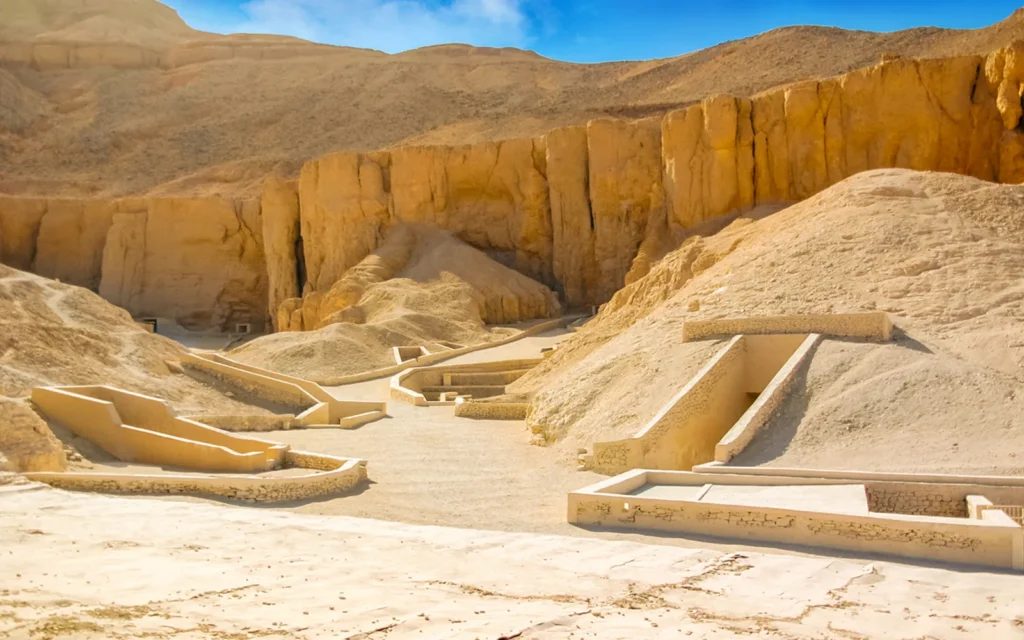
But his recorded cause of death was an infected bite, and no member of the excavation team is known to have developed a fungal lung infection. For a healthy visitor today the real hazards in the Valley of the Kings are heat, dust and dehydration; the tomb now has a ventilation and filtration system installed by the Getty Conservation Institute.
Did the ancient Egyptians curse tombs at all?
Yes, some private tombs carry threats against those who damage them, but they are found mainly in Old Kingdom tombs of officials, and no such curse appears in Tutankhamun’s tomb. Tomb owners warned that intruders would face judgement before the great god, or be seized by a crocodile in the water and a snake on land. Such texts can be seen in some mastaba tombs at Giza and Saqqara.
Royal tombs relied instead on secrecy, guards and protective magic. Tutankhamun’s burial chamber held four magical bricks placed at the cardinal points, each with a spell from the Book of the Dead to repel enemies of the dead king. They were meant to protect him from evil spirits, not to strike down archaeologists.
Where to see Tutankhamun safely in Egypt today
Thousands of visitors walk into his tomb every day without harm. The Tomb of Tutankhamun in Luxor holds his mummy and sarcophagus, the replica at Howard Carter’s House shows the burial chamber up close, and the Grand Egyptian Museum displays the full treasure. Our guide to Tutankhamun covers his life and his own, much better documented, death.
Frequently asked questions
How many people died from the curse of Tutankhamun?
None that can be linked to the tomb. Newspapers counted more than 20 “victims” by the 1930s, but the list mixed natural deaths, accidents and people who never entered the tomb, and most of the excavators lived normal lifespans.
Did Howard Carter die from the curse?
No. Carter died of lymphoma in London in March 1939, aged 64, more than 16 years after opening the tomb. He dismissed the curse as nonsense.
Is it safe to go inside Tutankhamun’s tomb?
Yes. The tomb has modern ventilation and air filtration, and huge numbers of visitors enter it every year. Bring water and a hat for the heat of the valley outside.
Why do people believe in the pharaoh’s curse?
Carnarvon’s sudden death made a dramatic story, rival newspapers shut out of the tomb printed rumours, and later films such as The Mummy (1932) turned the idea into popular culture.
Did ancient Egyptian tombs have curses?
Some private tombs of officials, mostly from the Old Kingdom, include threats against anyone who damages them. Royal tombs, including Tutankhamun’s, relied on protective spells rather than curses.