Quick answer
Ancient Egyptians believed death was a dangerous passage rather than an end. A person's spiritual elements, above all the ka and the ba, had to be sustained and reunited with a preserved body, pass judgement before Osiris, and then live forever, either in the Field of Reeds, an idealised Egypt, or travelling with the sun god. Tombs, mummies, offerings and spells all served that journey.
What did the Egyptians believe happens when you die?
They believed that with the right preparation, death led to a renewed and eternal life, but that it was a perilous transition that could also end in a final, second death. The land of the dead lay in the west, where the sun set, which is why most cemeteries, including the Valley of the Kings, are on the west bank of the Nile. The dead were called “westerners”, and Osiris was “foremost of the westerners”.
A tomb was a “house of eternity”, and Egyptians invested in it accordingly. The guiding model was the cycle of nature: the sun sets and rises again, the Nile floods and retreats, and Osiris was murdered and revived. Every person hoped to share in that renewal.
What were the ka, the ba and the akh?
Egyptians saw a person as a combination of physical and spiritual parts, each of which had to survive for the person to live on.
- Ka: the life force, born with the person as a kind of double. It stayed with the body and needed food and drink, which is why tombs had false doors and offering tables, and statues as a backup home.
- Ba: the individual personality, shown as a bird with a human head. It could fly out of the tomb by day and return to the body at night.
- Akh: the transfigured spirit created when the ka and ba were reunited after the proper rites. An akh was effective: families wrote “letters to the dead” on pottery bowls asking dead relatives to help with illness or disputes.
- Name, shadow and heart: the name had to be remembered and spoken, which is why hacking out a name, as happened to Hatshepsut and Akhenaten, was so serious. The heart, seat of thought and memory, would be tested at the judgement.
The body anchored them all, which explains mummification.
What was the Duat, the Egyptian underworld?
The Duat was the realm the sun god sailed through every night, full of gates, lakes of fire and monsters, and the dead had to cross it too. It was not a hell but a hazardous landscape that could be navigated with the right knowledge: the names of gatekeepers, the correct words and protective amulets.
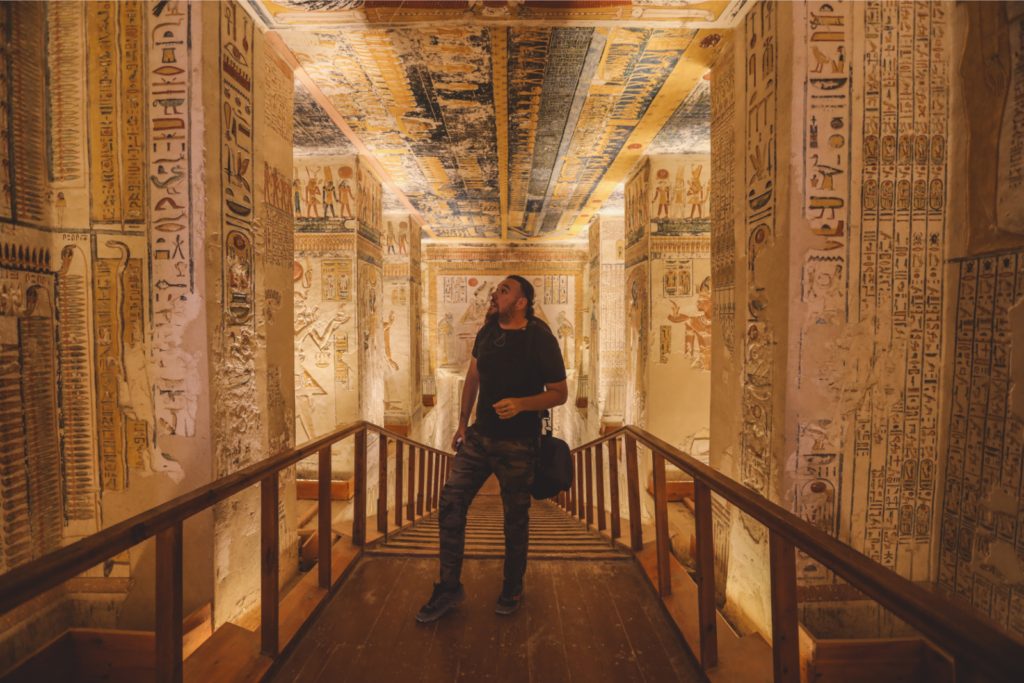
The royal tombs of the New Kingdom map it in detail. Texts such as the Amduat (“what is in the underworld”) and the Book of Gates divide the night into 12 hours. In each, the sun god travels in his boat, fights the chaos serpent Apep, unites with Osiris at midnight and is reborn at dawn as the scarab Khepri, and the king travels with him. The ceiling of the tomb of Ramesses VI shows the sky goddess Nut swallowing the sun in the evening and giving birth to it at dawn.
The oldest royal hope, in the Pyramid Texts of the Old Kingdom, was different: to rise to the northern sky and join the circumpolar stars, which never set.
How were the dead judged?
Before Osiris and 42 judges, the dead declared they had done no wrong, and their heart was weighed against the feather of Ma’at, the principle of truth and order. A heart in balance meant the person was “true of voice”, a phrase added after the names of the dead on countless monuments. A heart heavy with wrongdoing was eaten by the monster Ammit, ending the person’s existence for good.
The scene is the best-known vignette of the Book of the Dead, whose spell 125 gives the full text. Egyptians hedged their bets: a heart scarab placed on the mummy carried a spell ordering the heart not to speak against its owner.
What was the Field of Reeds?
The Field of Reeds was the Egyptian paradise: an idealised Nile valley of canals, plentiful harvests and familiar pleasures, where the blessed dead lived much as they had on earth, only better. Grain grew taller than a person, and there was no shortage of bread or beer.
The catch was work. The afterlife, like Egypt, had fields to plough and canals to dig, and anyone could be called up. The solution was the shabti, a small figurine that would answer and do the work instead. Wealthy burials could hold hundreds; by the later New Kingdom a full set might be one for every day of the year plus overseers to keep them in line, and Tutankhamun was buried with more than 400.
How did the living look after the dead?
Through offerings, rituals and remembrance: as long as the dead were fed and their names spoken, they lived on. Families brought food to tomb chapels, and the wealthy endowed land to pay ka-priests to make offerings forever.
Tomb inscriptions often appeal to passers-by to recite the offering formula, “a thousand of bread, a thousand of beer, a thousand of oxen and fowl” for the owner, since saying the words was believed to provide them. At Thebes, during the Beautiful Festival of the Valley, the statue of Amun crossed the river to the west bank and families feasted at the tombs of their ancestors, which is the setting of many of the banquet scenes you see in Luxor’s private tombs.
Not everyone could afford this. The poor were buried in simple graves with a few pots and personal items, and scholars debate how far elite afterlife beliefs were shared across society.
Where to see Egyptian afterlife beliefs today
Luxor’s west bank is the place: its tombs were designed as guidebooks to eternity.
- Valley of the Kings: royal tombs painted with the Amduat, the Book of Gates and the journey of the sun. The tomb of Thutmose III has a complete Amduat in a sketch-like style when it is open; the set of tombs open changes, so check before you go.
- Tombs of the Nobles: officials’ tombs with funerals, offering scenes and the banquets of the Valley Festival.
- Saqqara: Old Kingdom mastabas with false doors and offering scenes, and the Pyramid Texts of Unas.
- Abydos: the cult centre of Osiris, where Egyptians made pilgrimages for 2,000 years and set up memorial stelae to share in his resurrection.
- Grand Egyptian Museum: Tutankhamun’s shabtis, shrines and funerary equipment in one place.
Frequently asked questions
What is the difference between the ka and the ba?
The ka was a person's life force, which stayed at the tomb and needed food offerings. The ba was their personality, pictured as a human-headed bird, which could travel out of the tomb by day and return to the body at night.
Did ancient Egyptians believe in heaven and hell?
They believed in a paradise, the Field of Reeds, but not in a hell of eternal punishment. Those who failed the judgement were destroyed, devoured by the monster Ammit, which was considered the worst possible fate.
Why did Egyptians put objects in tombs?
Because the dead were thought to need food, clothing, furniture, tools and protection in the next life. Pictures and models could stand in for the real thing, and spoken or written offerings were believed to provide them magically.
What is the Duat?
The Egyptian underworld: the region the sun god travelled through every night between sunset and sunrise, and which the dead also had to cross, past gates guarded by dangerous beings.
What were shabtis for?
Shabtis were small figurines placed in tombs to do any manual labour demanded of the dead person in the afterlife. Each one carried a spell telling it to answer when its owner was called to work.