Quick answer
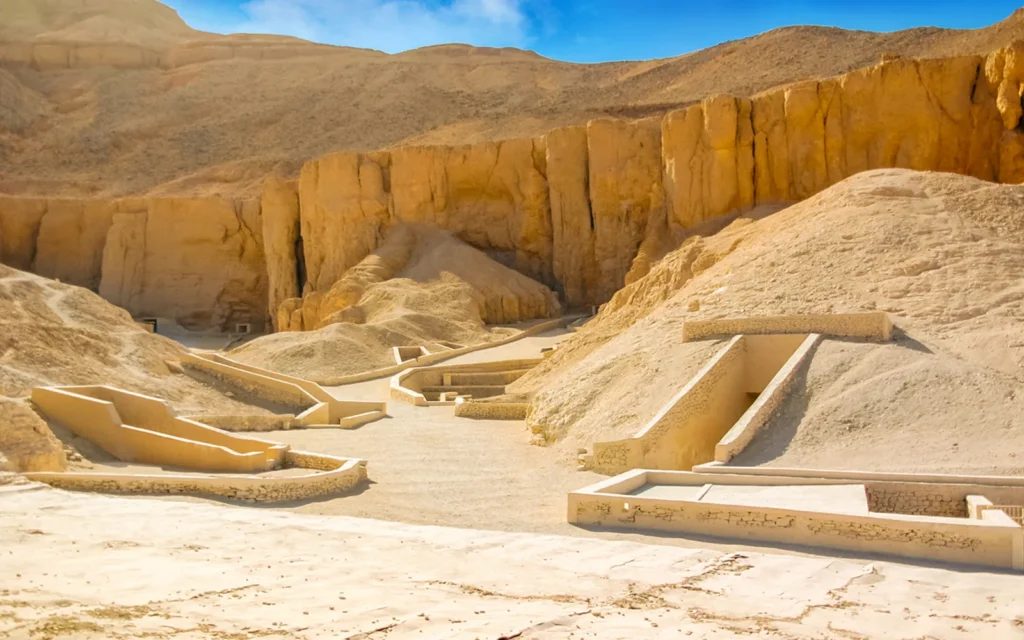
The Valley of the Kings is the royal burial ground of the New Kingdom pharaohs, a desert valley on Luxor's West Bank where more than 60 tombs have been found, including Tutankhamun's. The painted corridors of tombs such as Ramesses VI and Seti I are among the most extraordinary things to see in Egypt, and a visit takes two to three hours.
What is the Valley of the Kings?
The Valley of the Kings was the burial place of Egypt's pharaohs for almost 500 years, from Thutmose I in the early 18th Dynasty to Ramesses XI at the end of the 20th. Having seen how the pyramids attracted robbers, the New Kingdom kings chose a hidden desert valley in the Theban hills, overlooked by the pyramid-shaped peak of el-Qurn.
The tombs were cut deep into the limestone as long, sloping corridors leading to a burial chamber, and decorated with religious texts to guide the king through the underworld, such as the Amduat, the Book of Gates and the Book of Caves. Tombs are numbered in order of discovery with the prefix KV, for Kings' Valley. More than 60 are known, though not all belonged to kings.
Almost every tomb was robbed in antiquity. The great exception was Tutankhamun's tomb (KV62), found nearly intact by Howard Carter in November 1922. Its treasures are now displayed at the Grand Egyptian Museum near Giza.
Which tombs should you see in the Valley of the Kings?
If you only add one extra ticket, make it Seti I (KV17) or Ramesses VI (KV9); for your three standard tombs, choose from Ramesses IV, Ramesses III, Merenptah and Ramesses IX, depending on which are open. The selection of open tombs rotates for conservation, so the list on the day may differ.
- Seti I (KV17): discovered by Giovanni Belzoni in 1817 and, at well over 100 metres, the longest tomb in the valley. Every surface is decorated in fine raised relief. It requires a separate, premium ticket and is worth it.
- Ramesses VI (KV9): famous for its burial-chamber ceiling showing the sky goddess Nut swallowing and giving birth to the sun, from the Book of the Day and Book of the Night. Separate ticket.
- Tutankhamun (KV62): small and only partly decorated, but you can see the king's mummy in a climate-controlled case and the quartzite sarcophagus in the burial chamber. Separate ticket; worth it for the history rather than the decoration.
- Ramesses IV (KV2): near the entrance, with bright colours and graffiti left by Greek and Roman tourists.
- Ramesses III (KV11): known for its scene of two harpists and its side chambers showing everyday objects.
- Merenptah (KV8): a deep, steep tomb with a massive granite sarcophagus lid.
- Thutmose III (KV34): reached by steep stairs high in a cleft in the cliff, with an oval burial chamber decorated in an unusual stick-figure style.
How do tickets work at the Valley of the Kings?
The standard entry ticket covers three tombs from those open on the day, and separate tickets are needed for Tutankhamun (KV62), Seti I (KV17) and Ramesses VI (KV9). Tickets are bought at the visitor centre or online, and prices change, so check the official Egypt ticketing site, egymonuments.gov.eg, before you go.
The tomb of Ay (KV23) lies in the separate West Valley and also needs its own ticket and transport. At the time of writing there is also a Luxor Pass, a multi-day ticket covering most sites in Luxor, which can be good value for travellers spending several days here; check its current conditions on the official site.
Photography rules have changed several times over the years. At the time of writing, phone photography without flash is generally allowed in the tombs, while cameras may require a photography ticket. Never use flash, which damages the paint, and confirm the current rules at the ticket office.
How long do you need at the Valley of the Kings?
Allow two to three hours for the standard three tombs plus one or two premium tombs. Each tomb takes 15–25 minutes, but queues at popular tombs and the walk between them add up.
From the visitor centre, a small electric train (known locally as the tuf-tuf) runs to the valley entrance for a small additional charge, or you can walk the short distance. Inside the valley, tombs are spread along a few hundred metres of paths, some up stairs. In the visitor centre, take a few minutes at the large model of the valley and the cutaway of Tutankhamun's tomb, which help explain what you are about to see.
Most West Bank days combine the Valley of the Kings with the Temple of Hatshepsut and the Colossi of Memnon, finishing by lunchtime. On our Luxury Egypt tour, the same day also includes the Valley of the Queens and Nefertari's tomb.
When is the best time to visit the Valley of the Kings?
Be at the gate at opening time, usually around 6am, which gives you the coolest air and the emptiest tombs. Cruise groups generally arrive from about 8am, and by mid-morning popular tombs can have queues and become humid inside.
The valley is a natural heat trap with almost no shade. From May to September, temperatures can exceed 40°C by late morning, so finish your visit early. Even in winter, the sun is strong. If you are on a balloon flight, you can still reach the valley not long after opening once you have landed.
A strategic tip: head first to the premium tombs such as Seti I or Ramesses VI, which fill up fastest, then use your standard ticket on tombs nearer the entrance. See our best time to visit Egypt guide for seasonal advice.
What are the best practical tips for the Valley of the Kings?
- Guides cannot explain inside the tombs: at the time of writing, guides give their explanations outside, so listen closely before you enter.
- Bring water, a hat and sunscreen: drinks are sold at the visitor centre but there is little else in the valley itself.
- Expect steps and slopes: some tombs, such as Merenptah and Thutmose III, involve steep descents or stairs. Tombs near the entrance such as Ramesses IV are easier.
- Do not touch the walls: skin oils and humidity damage the paint, and guards are strict about this.
- See the replica: a full-scale facsimile of Tutankhamun's burial chamber has been installed near Howard Carter's house on the West Bank, a good complement to the real thing.
Valley of the Kings: FAQs
Is Tutankhamun's tomb worth the extra ticket?
It depends on your interests. The tomb is small and only the burial chamber is decorated, but it is the only tomb where the king's mummy is still on display in the valley. If your budget allows only one extra ticket, Seti I or Ramesses VI is more impressive to look at.
How many tombs are in the Valley of the Kings?
More than 60 tombs and pits have been found, numbered KV1 onwards. Only a rotating selection, usually around eight to twelve, is open to visitors at any one time.
Can you take photos in the Valley of the Kings?
At the time of writing, phone photography without flash is generally permitted, while cameras may need a separate photography ticket. Rules change, so check at the ticket office.
How far is the Valley of the Kings from Luxor?
The valley is on the West Bank, about 30 minutes' drive from central Luxor hotels via the Nile bridge, or a short boat crossing followed by a drive of around 15–20 minutes.
What is the most beautiful tomb in the Valley of the Kings?
Most Egyptologists would choose Seti I (KV17) for the quality of its relief, while Ramesses VI (KV9) has the most spectacular ceiling. Many visitors also rate Nefertari's tomb in the nearby Valley of the Queens as the finest in Egypt.