Quick answer
Khnum was the ram-headed Egyptian god who shaped each human being and their ka on a potter's wheel and who was believed to release the Nile flood from caverns at the First Cataract. His two great temples were at Elephantine Island in Aswan and at Esna, south of Luxor, whose Roman-era hall, recently cleaned, is the best place to see him today.
Who was Khnum?
Khnum was one of Egypt's oldest gods, a ram-headed creator associated with the Nile's source at Aswan and with the making of living bodies. His name is probably related to the Egyptian verb meaning "to build" or "to join", and he was worshipped from at least the Early Dynastic Period. The great pyramid builder Khufu was formally named Khnum-Khufu, "Khnum protects me", showing his importance already in the Fourth Dynasty.
The ram stood for virility and creative power. Khnum's ram, a breed with long horizontal corkscrew horns, had largely disappeared from Egypt by the Middle Kingdom, replaced by sheep with horns curling around the ear, the type later sacred to Amun. Egyptian artists kept Khnum's archaic horns, which is the quickest way to tell the two ram gods apart.
Khnum was worshipped in several places besides Aswan and Esna, including Herwer in Middle Egypt, and he was one of the gods most often merged with others: as Khnum-Ra he was the sun's evening form, and texts call him the ba (soul) of Ra, Osiris, Shu and Geb. That theological flexibility is typical of Egyptian religion, explained further in our overview of ancient Egyptian gods.
Did Khnum really make people on a potter's wheel?
In Egyptian belief, yes: Khnum modelled each child's body, and its ka or life force, from Nile clay on his wheel and placed it in the mother's womb. The image is ancient, but the fullest description comes from Roman-era hymns carved on the columns of Esna, which describe him shaping humans, animals, birds and fish, and building the skeleton, the veins and the skin.
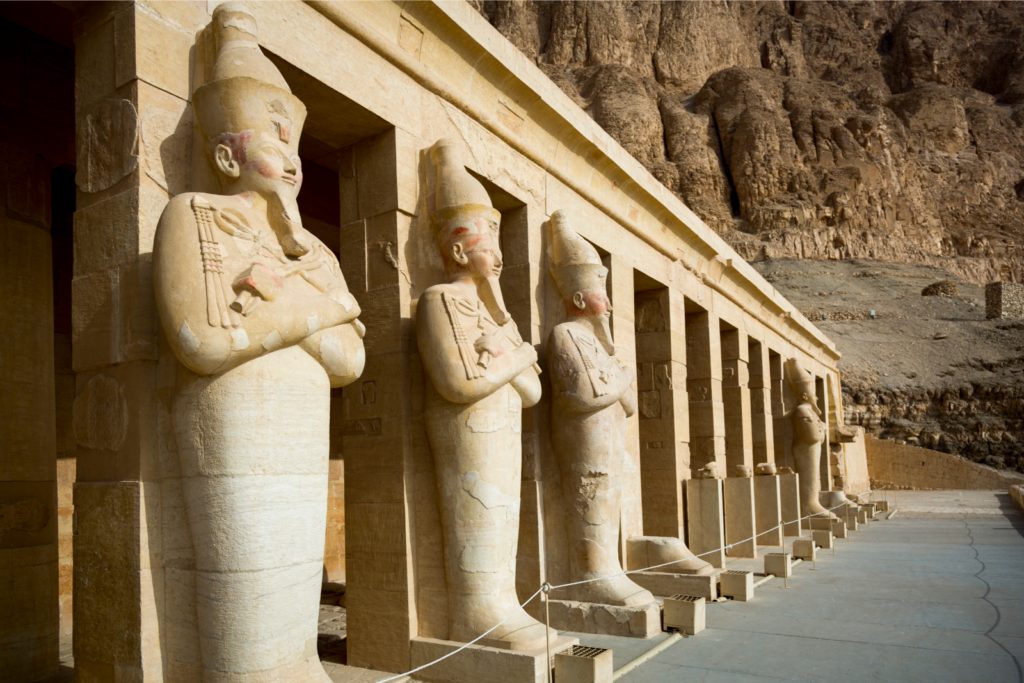
The idea mattered for kings. On the middle terrace of the Temple of Hatshepsut at Deir el-Bahari, her "divine birth" reliefs show Amun visiting her mother, then Khnum at his wheel fashioning the infant Hatshepsut and her ka as two identical little figures, while the frog goddess Heqet holds out the sign of life. Amenhotep III copied the cycle in his birth room at Luxor Temple. In the Westcar Papyrus, a Middle Kingdom story collection, Khnum attends the birth of the first three kings of the Fifth Dynasty with Isis, Nephthys, Meskhenet and Heqet, and "gives health to their bodies".
Why was Khnum lord of the First Cataract?
Egyptians believed the Nile flood rose from caverns beneath the rocks of the First Cataract at Aswan, and Khnum, as lord of Elephantine, controlled their opening. At Elephantine he formed a triad with Satet, goddess of the flood and of the southern frontier, and Anuket, goddess of the cataract region. Rams sacred to him were mummified and buried in a cemetery on the island, some with gilded headpieces.
The clearest statement of Khnum's power over the flood is the Famine Stela on Sehel Island. Carved in the Ptolemaic period but set in the reign of Djoser 2,500 years earlier, it tells how seven years of low floods brought famine until Imhotep advised the king that Khnum controlled the waters; after Djoser endowed Khnum's temple with land, the flood returned. Scholars read it as a Ptolemaic priestly claim to temple revenues dressed up in ancient authority, not as a record of a real Old Kingdom famine, and modern attempts to link it to the seven lean years of the biblical Joseph story remain speculation.
What happened between Khnum's priests and the Jews of Elephantine?
In about 410 BC Khnum's priests on Elephantine instigated the destruction of a neighbouring temple of Yahu (Yahweh) built by a Judean military garrison. We know the story from the Elephantine papyri, Aramaic letters found on the island, including a petition of 407 BC to the Persian governor of Judah asking permission to rebuild. The two temples stood almost side by side. Why relations broke down is unclear; one common suggestion is that the Judeans' sacrifice of lambs offended the priests of a ram god, though the letters themselves do not say so. Permission to rebuild was eventually given, though without animal sacrifice. It is a rare, documented glimpse of religious friction in a mixed frontier town.
How do you recognise Khnum?
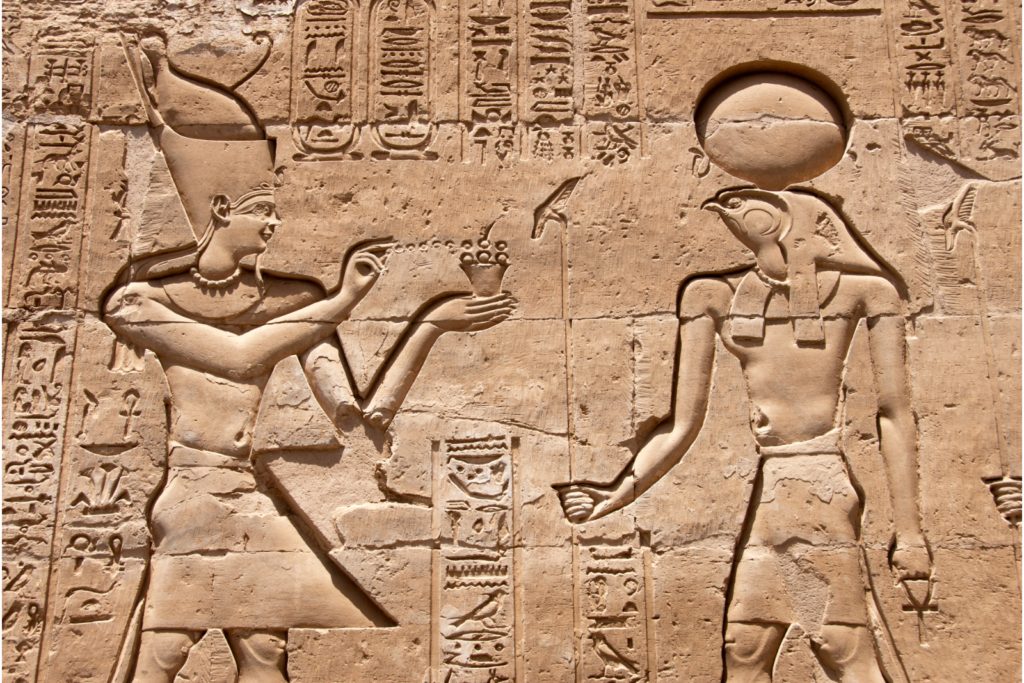
Look for a man with a ram's head and long horizontal wavy horns, often wearing the atef crown or tall plumes, sometimes seated at a potter's wheel. At Esna he is frequently paired with a lion-headed goddess (Menhyt) and with Neith of Sais, a creator goddess whom Esna's priests claimed as a mother of the gods. On amulets and in late temples Khnum can have four ram heads, representing his combination with Ra, Shu, Geb and Osiris.
Esna's texts also give Neith her own creation story, which visitors sometimes confuse with Khnum's: she emerges from the primeval waters, names the world into being, and the spittle she releases becomes the chaos serpent Apophis. Khnum then takes over the work of shaping living things. Each temple told creation in a way that put its own gods at the centre.
Where to see Khnum in Egypt today
Esna Temple is the place to see Khnum, with Elephantine Island a close second, and both are easy to add to a Nile cruise or a stay in Aswan.
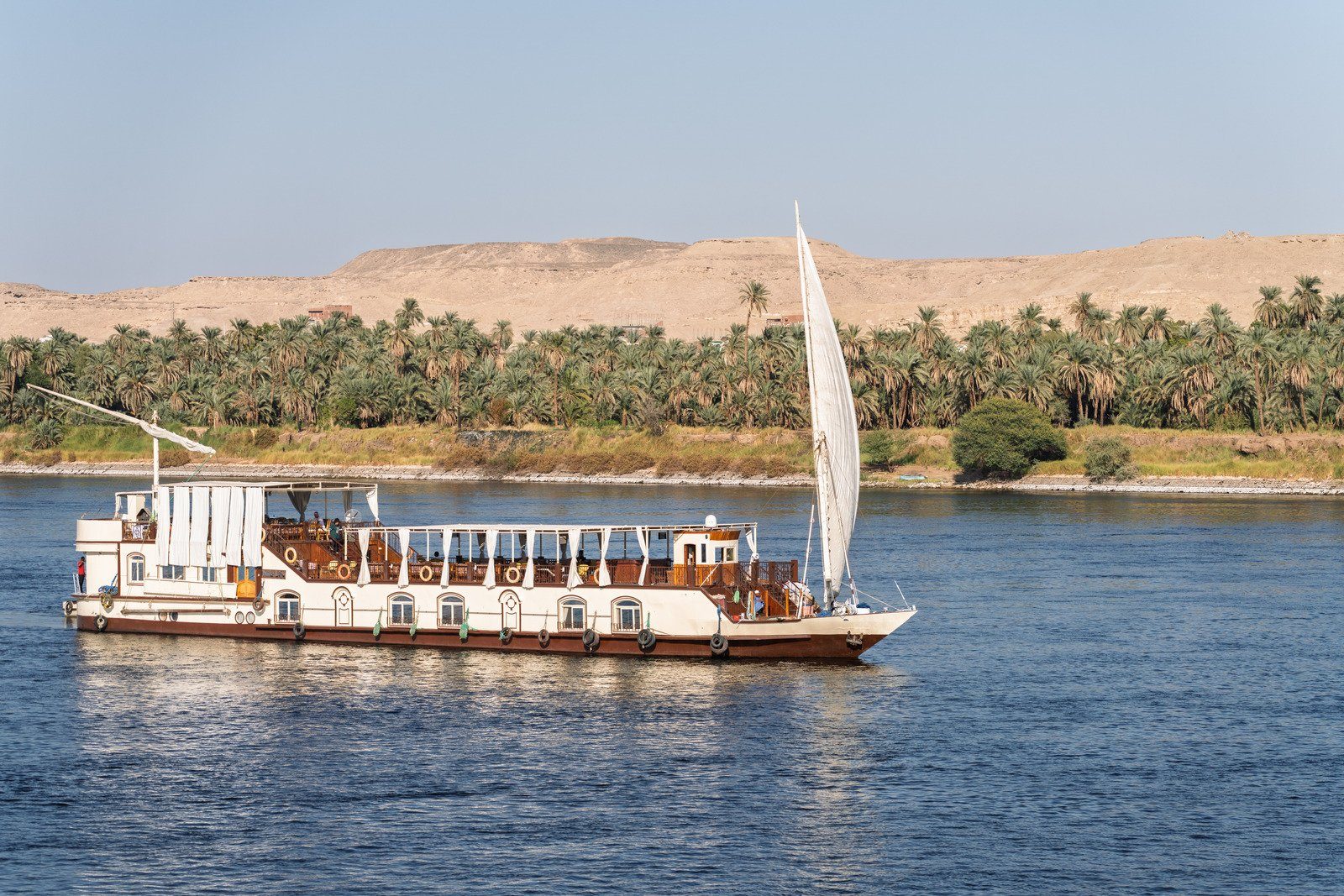
- Esna Temple: the surviving hypostyle hall of Khnum's temple sits about nine metres below the modern town, 55 km south of Luxor. Its 24 columns carry the Esna hymns and a calendar of festivals; the latest cartouche is that of the emperor Decius (about AD 250), among the last carved for any Roman emperor in Egypt. Restoration since 2018 has revealed vivid ceiling colours. Cruise boats stop here before passing through the Esna lock.
- Elephantine Island: the foundations of Khnum's temple, largely rebuilt under Nectanebo II, lie beside the reconstructed temple of Satet and the island's Nilometer. The small museum has displayed a gilded ram mummy from the sacred cemetery.
- Sehel Island: the Famine Stela, carved on a granite boulder, best reached by motorboat or felucca.
- Temple of Hatshepsut: the birth colonnade with Khnum at his wheel, on the north side of the middle terrace.
Frequently asked questions
What is Khnum the god of?
Khnum was the god who shaped human and animal bodies on a potter's wheel, and the lord of the First Cataract at Aswan, where the Nile flood was believed to rise.
Why does Khnum have a ram's head?
The ram symbolised fertility and creative power. Khnum's ram, with long horizontal horns, was an ancient breed that had disappeared from Egypt by the Middle Kingdom, which is why his horns differ from those of Amun's ram.
Where is the Temple of Khnum?
His two main temples were at Esna, 55 km south of Luxor, where a Roman-era hall survives in excellent condition, and on Elephantine Island at Aswan, where foundations remain.
Who were Khnum's wives?
At Elephantine he was grouped with Satet and Anuket; at Esna he was linked with Menhyt and Neith. Egyptian divine families varied from temple to temple.
What is the Famine Stela?
A Ptolemaic inscription on Sehel Island near Aswan describing a seven-year famine under King Djoser that ended when the king honoured Khnum. Scholars regard it as a later priestly text, not a contemporary record.