Quick answer
The ancient Egyptian year followed the Nile: three seasons of four months each, named for the flood (akhet), the growing time (peret) and the harvest (shemu). The civil calendar had 12 months of 30 days plus five extra days, a 365-day year that is the ancestor of the calendar we use today. The flood itself, fed by summer rains in Ethiopia, ended when the Aswan High Dam was built.
What was the Nile flood?
Every summer the Nile rose by several metres, spread across the valley floor for weeks, and drained away leaving a layer of black silt that fertilised the fields for the next crop. The water came from monsoon rains on the Ethiopian Highlands, carried by the Blue Nile and the Atbara; the White Nile kept the river flowing the rest of the year. Our guide to the Nile River covers its sources and course.
At Aswan the river started rising in June, and around Memphis it peaked in late August and September before falling back in October. Villages stood on mounds above the waterline, and the flood season was when the state could call up farmers for building work, since their fields were under water.
The Egyptians called the black land Kemet, which became a name for Egypt itself, and personified the flood as Hapi, a plump figure with heavy breasts and a belly, crowned with papyrus and lotus. Hapi was not the river but its abundance, and offerings were thrown into the water to encourage him.
How did a good or bad flood affect Egypt?
The height of the flood decided whether Egypt ate well, went hungry or was swept away: too low meant famine, too high meant destroyed villages and dykes. The Roman writer Pliny the Elder gave the ideal as 16 cubits at Memphis, about eight metres, with 12 cubits meaning hunger; a flood far above that swept away dykes and villages. A famous Roman statue of the Nile god, now in the Vatican, has 16 small children clambering over him for the 16 cubits.
A run of low floods could bring down governments. Many historians link the end of the Old Kingdom, around 2180 BC, partly to a series of poor floods, although that remains debated. On Sehel Island near Aswan, the Famine Stela tells of seven years of low floods under Djoser, ended when the king honoured Khnum, god of the cataract; it was actually carved in the Ptolemaic period, probably by priests asserting their temple’s rights.
Because taxes depended on the harvest, officials measured the rising river at nilometers: stairways or wells marked with a scale, from which they could predict the size of the crop.
How did the ancient Egyptian calendar work?
The civil calendar had three seasons of four 30-day months, plus five extra days at the end, making 365 days with no leap year.
| Season | Meaning | Roughly (ideal year) | Farming |
|---|---|---|---|
| Akhet | Inundation | Mid-July to mid-November | Fields under water; building projects |
| Peret | Coming forth (growth) | Mid-November to mid-March | Ploughing, sowing and growing |
| Shemu | Low water (harvest) | Mid-March to mid-July | Harvest, threshing, tax collection |
Each month was divided into three ten-day weeks, and dates were written as, for example, “year 5, third month of Shemu, day 9” of a king’s reign. The five extra days, the epagomenal days, were treated as the birthdays of Osiris, Isis, Seth, Nephthys and Horus the Elder; Plutarch’s story of how Thoth won them is told in our Thoth guide.
Alongside it ran a lunar calendar used to set religious festivals, so temples effectively juggled two calendars at once.
What did Sirius have to do with the flood?
The New Year was ideally marked by the first appearance of Sirius on the eastern horizon just before dawn, which in ancient times fell in midsummer, close to the start of the flood. Sirius, the brightest star in the night sky, was the goddess Sopdet, and its return after about 70 days hidden in the sun’s glare was celebrated as Wep Renpet, the Opening of the Year.
The problem was the missing quarter day. A 365-day year falls one day behind the solar year every four years, so the civil New Year slowly wandered through the seasons and only lined up with Sirius again after about 1,460 years. The Roman writer Censorinus recorded that the two coincided in AD 139, and Egyptologists have used this “Sothic cycle” as one tool for dating earlier reigns, though with growing caution.
The Egyptians knew about the drift. In 238 BC Ptolemy III’s Canopus Decree ordered a sixth extra day every fourth year, but priests ignored it. A leap year finally stuck under Roman rule in the 20s BC, and Julius Caesar’s own calendar of 46 BC had been designed with the help of the Alexandrian astronomer Sosigenes. The modern calendar descends from the Egyptian one.
Is the Egyptian calendar still used?
Yes: the Coptic calendar, used by Egypt’s Christians for church festivals and traditionally by farmers for planting, is the direct descendant of the ancient civil calendar. It keeps 12 months of 30 days plus a short 13th month of five or six days, and most month names come from ancient ones: Tout from Thoth, Hatour from Hathor, Baramouda from the harvest goddess Renenutet.
The Coptic year begins on 11 September (12 September in the year before a Gregorian leap year), and years are counted from AD 284, the Era of the Martyrs. Coptic Christmas falls on 29 Kiahk, which is why it is celebrated on 7 January. Older farmers still quote weather proverbs by Coptic month, such as the saying that Amshir, in February and March, is the “father of storms”.
The flood also lives on in Wafaa el-Nil, the “fidelity of the Nile”, a festival traditionally held in August, when Cairo once celebrated cutting the dam of the canal as the river rose. Our public holidays guide lists the festivals that matter to visitors.
Why doesn’t the Nile flood any more?
The Aswan High Dam, completed in 1970, holds the flood in Lake Nasser and releases water evenly through the year, so the river below Aswan no longer rises. It began holding back the summer floods in the mid-1960s. Farmers gained two or three crops a year, protection from drought and famine, and electricity; Egypt lost the free fertiliser of the silt, which now settles in the lake, and the Delta coast has been eroding.
The temples paid a price too. Groundwater no longer drains away each year, and salts rising into the stone damaged monuments at Luxor and Karnak until drainage schemes were installed, while the lake flooded Nubia and forced the rescue of Abu Simbel and Philae. Our guide to the Aswan High Dam explains a visit.
Where to see the flood and calendar in Egypt today
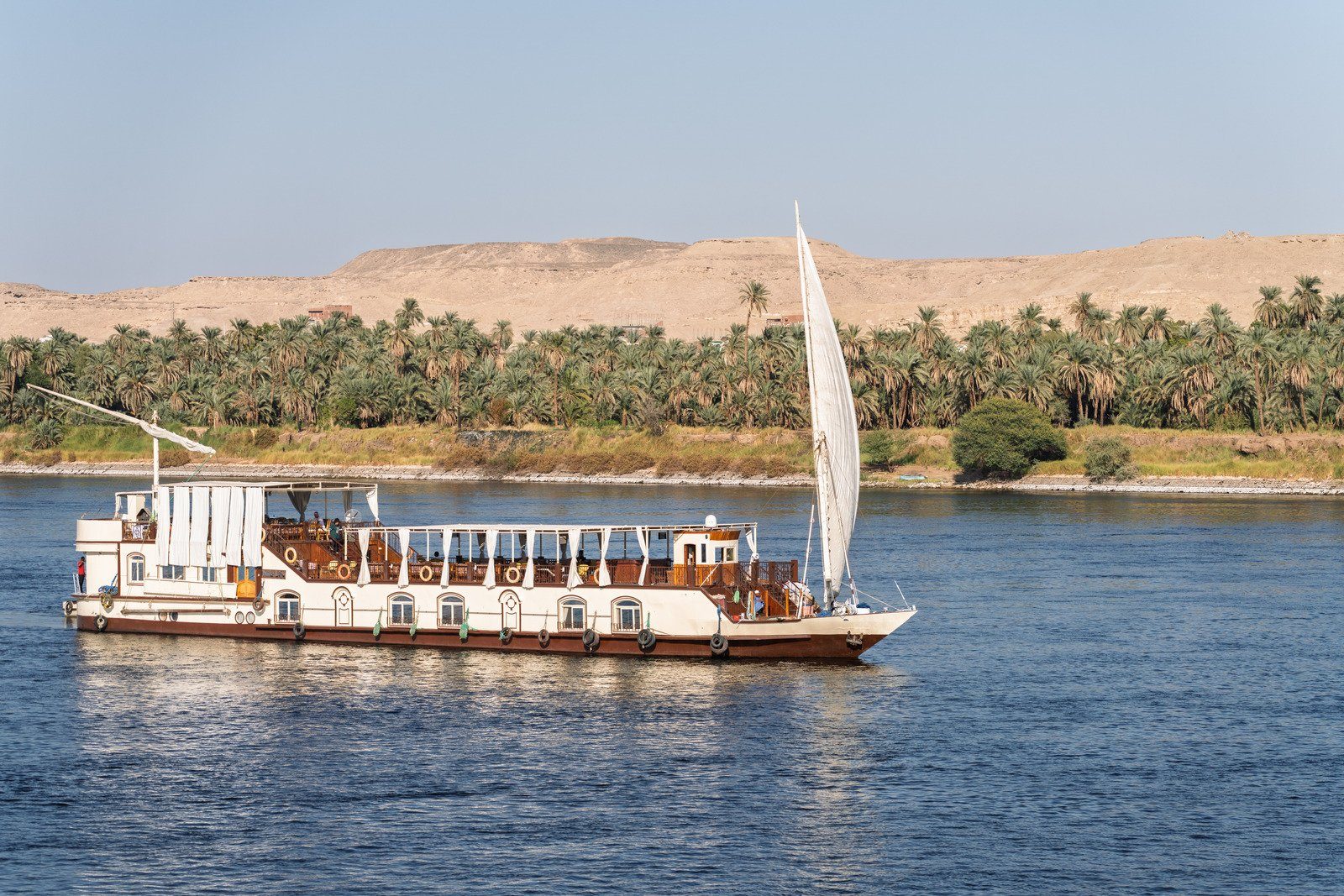
Look for nilometers, calendar inscriptions and Hapi figures; a Nile cruise passes most of them.
- Elephantine Island, Aswan: a stairway nilometer down to the river, with measuring scales cut into its walls in Roman and later times.
- Kom Ombo Temple: a well-shaped nilometer within the enclosure, and a festival calendar carved on a wall, listing offerings by month and day.
- Roda Nilometer, Cairo: a stone shaft with a marked central column built in AD 861, the finest surviving example.
- Temple bases: along the bottom of many temple walls, processions of plump Hapi figures carry offerings of the land, representing Egypt’s provinces.
Frequently asked questions
When did the Nile flood each year?
Roughly June to October. The river began rising at Aswan in June, peaked around Memphis in late August or September, and fell back through October, leaving fields ready for autumn sowing.
How many days were in the ancient Egyptian year?
365: twelve months of 30 days plus five extra days. There was no leap day, so the calendar slipped a day every four years against the seasons until a leap year was introduced under Roman rule.
What are the three seasons of ancient Egypt?
Akhet (inundation), Peret (growth, when crops were sown and grew) and Shemu (harvest and low water). Each had four months of 30 days.
Does the Nile still flood?
Not below Aswan. Since the High Dam was completed in 1970, the annual flood is stored in Lake Nasser and released gradually, so the river level in Egypt stays fairly steady through the year.
Is the Coptic calendar the same as the ancient Egyptian one?
It is the same structure with a leap year added: 12 months of 30 days and a short 13th month. Its month names are derived from ancient Egyptian ones, and the year starts in September, close to the ancient flood season.