Quick answer
Three days is the ideal length for Cairo. Spend day one at Saqqara, Memphis and Dahshur to see how the pyramid evolved, day two at the Giza pyramids and the Grand Egyptian Museum, and day three walking Islamic Cairo from the Mosque of Ibn Tulun to Khan el-Khalili. It covers the essentials in a logical order with time to rest each afternoon.
Why is three days the right length for Cairo?
Three days lets you see Cairo in the order its history happened, with each day based in one area and an afternoon break built in. It is the length we recommend for anyone who wants Cairo to be more than a stopover: history enthusiasts, travellers who dislike rushing, and those who want the medieval city as much as the pyramids.
The one-day and two-day plans both start at Giza because it is what time-poor visitors came for. With three days you can do something more satisfying: begin at Saqqara, where the first pyramid was built around 2650 BC, follow Sneferu's experiments at Dahshur, and arrive at the Great Pyramid on day two understanding why it looks the way it does. Day three then leaps 3,500 years to the mosques, gates and markets of Islamic Cairo. The guided version of a similar three-night stay is our Cairo and Pyramids Stopover, which orders the days slightly differently to suit arrival times.
Day 1: Saqqara, Memphis and Dahshur
Leave early for the necropolis south of Cairo, see three pyramid sites by 2pm, and spend the late afternoon resting. There is no practical public transport here, so you need a car and driver or a tour.
- 7.30am: Depart a Giza hotel. Saqqara is about 45 minutes south, through farmland along the canal road.
- 8.15–11.00am: Saqqara. Djoser's Step Pyramid and its enclosure, designed by Imhotep, the earliest monumental stone building in the world. Then the decorated mastaba tombs, whose scenes of farming, fishing and boat-building are some of the liveliest art in Egypt, and the Pyramid of Teti or Unas if the burial chambers with Pyramid Texts are open.
- 11.15am–noon: Memphis. A few minutes' drive away at Mit Rahina: the fallen colossus of Ramesses II and the alabaster sphinx in the garden of Egypt's first capital.
- 12.30–2.00pm: Dahshur. Sneferu's Bent Pyramid, whose angle changes halfway up, and the Red Pyramid, the first true smooth-sided pyramid. Climbing down the Red Pyramid's passage is usually allowed and rarely crowded.
- 2.00–3.30pm: Late lunch on the way back, then rest.
- Evening: Free, or a Nile dinner cruise from the central corniche.
Day 2: the Giza plateau and a full afternoon at the GEM
After Saqqara and Dahshur, Giza becomes the climax rather than the introduction: plateau at opening, then the Grand Egyptian Museum with time to do more than the highlights.
| Time | What you do |
|---|---|
| 7.45am | Leave the hotel for the plateau, 10–20 minutes |
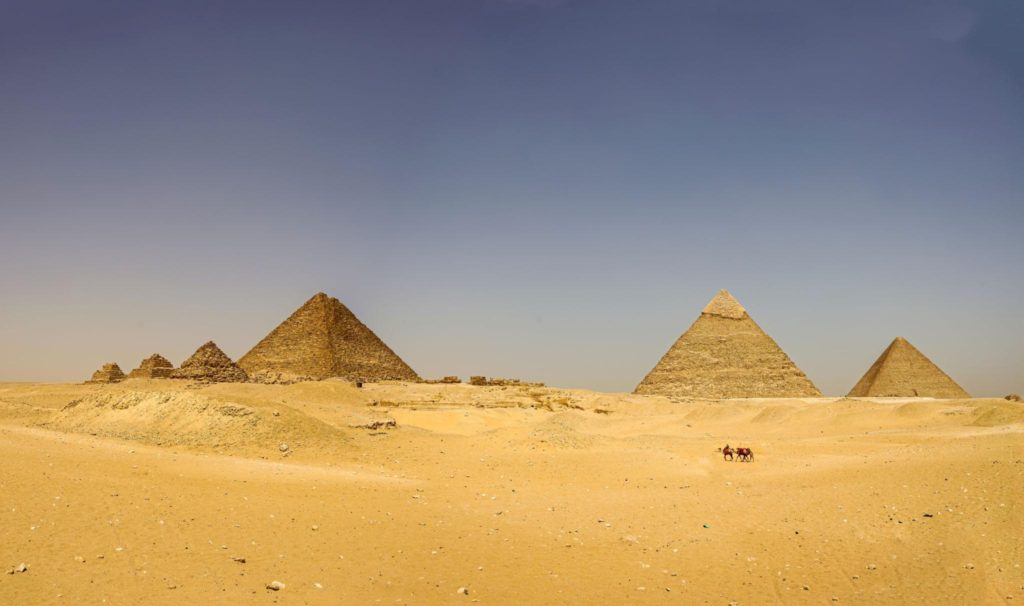
| 8.00–10.00am | The Great Pyramid, inside to the Grand Gallery if you choose, then Khafre and Menkaure |
| 10.00–11.30am | Panoramic viewpoint, then the Sphinx and Khafre's Valley Temple |
| 11.30am–12.30pm | Short drive to the GEM and lunch on site |
| 12.30–5.00pm | The Grand Egyptian Museum: Tutankhamun galleries, Grand Staircase, main galleries and Khufu's boat |
Having seen the real thing at Dahshur and Giza, the museum's Old Kingdom galleries make far more sense: the royal statues, tomb reliefs and Khufu's Solar Boat connect directly to the places you have just walked. Our Giza guide and GEM guide cover each in depth.
Day 3: Islamic Cairo on foot, from Ibn Tulun to the bazaar
Day three is a walking day through a thousand years of Islamic architecture, starting at the oldest intact mosque in the city and ending in Khan el-Khalili after dark. Wear comfortable shoes, cover shoulders and knees, and women should bring a scarf.
- 8.30am: Drive from Giza (45–75 minutes) to the Mosque of Ibn Tulun, built 876–879, with its spiral minaret. Next door, the Gayer-Anderson Museum is a pair of 16th and 17th-century houses full of mashrabiya screens.
- 11.00am: Five minutes by car to the Mosque-Madrassa of Sultan Hassan (1356–1363) and the Al-Rifa'i Mosque opposite, where the last Shah of Iran and King Farouk are buried.
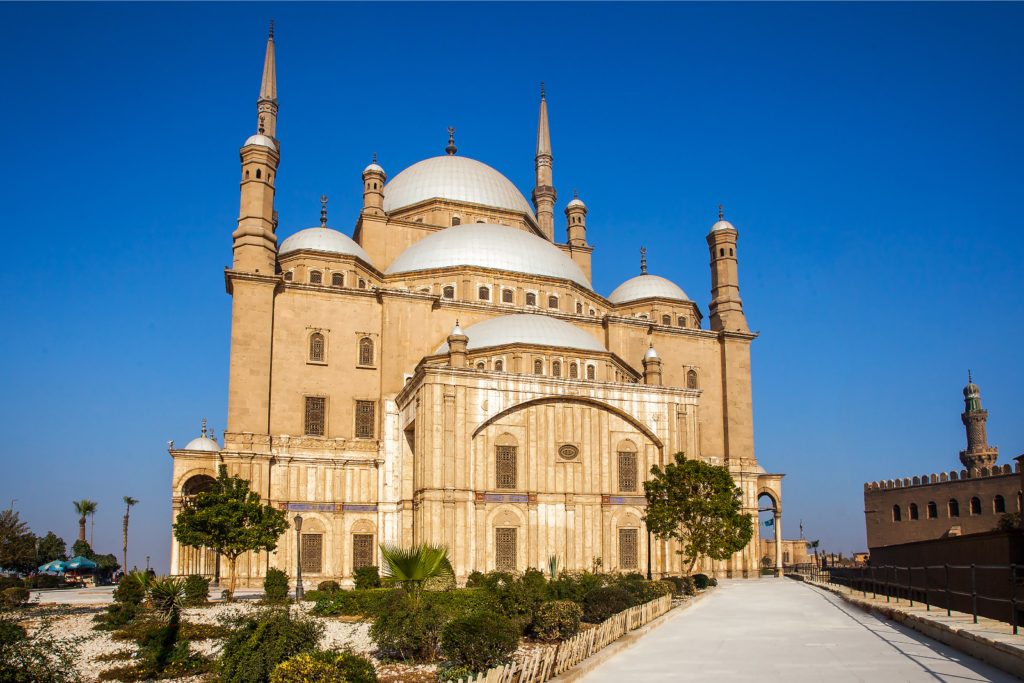
- 12.15pm: Walk uphill (about 10 minutes) or drive to the Citadel of Saladin for the Mosque of Muhammad Ali and the view west towards Giza on a clear day. Lunch afterwards.
- 3.00pm: Bab Zuweila, the 1092 Fatimid gate; climb its minarets for the view, then browse the Tentmakers' Street just outside.
- 4.00pm: Walk north along Al-Muizz Street past the Qalawun complex as the light turns gold, cutting across to the Al-Azhar Mosque between prayers.
- 6.00pm: Khan el-Khalili, mint tea at El Fishawy and dinner nearby.
If you prefer views to monuments for the late afternoon, swap the Al-Muizz walk for sunset in Al-Azhar Park, then dinner in the bazaar.
What does the three-day plan leave out, and what can you swap?
It leaves out Coptic Cairo and the royal mummies at the NMEC, which are about 10 minutes apart and together fill a morning. If those matter more than Ibn Tulun and the Gayer-Anderson house, begin day three in Old Cairo at 8.30am, see the NMEC until about 12.30pm, then drive 20 minutes to the Citadel and continue the walk from there. The two-day plan uses that sequence.
Other swaps that work well:
- Alexandria instead of day three. A long but rewarding day by road or train; see the Alexandria day trip.
- Coptic and Christian Cairo in depth. Add the Cave Church in the Mokattam hills to the Old Cairo morning for a full day of Christian sites.
- A slower Giza day. If you are travelling with children or older relatives, spread the GEM over two half-days and use the third afternoon for the pool.
Where to stay and how to pace three days in Cairo
Base yourself in Giza for days one and two, which are both on the west side of the river; if you can, move to a Nile-side hotel or Zamalek for the last night so day three starts 30 minutes from Islamic Cairo instead of an hour. If you would rather unpack once, Giza works for all three nights.
The plan is deliberately front-loaded: every day starts between 7.30 and 8.30am and has its hardest walking before 1pm. Afternoons are for rest on days one and two, which matters for travellers arriving on a long flight from Australia with a seven to nine-hour time difference. If you land in the morning, treat arrival day as day zero and start this plan the following morning. Between October and April, daytime temperatures in Cairo are usually in the low to high 20s; from June to August, expect mid to high 30s and adjust by finishing outdoor sightseeing by noon. Our where to stay in Cairo guide compares Giza, downtown and Zamalek hotels.
How does the plan change for families and older travellers?
Keep the same three areas but cut each day to a single morning session, finishing by about 1pm, and move the most strenuous parts to optional extras. Cairo's sites involve more walking, stairs and uneven ground than most visitors expect, and the drives add up.
- Day 1, lighter. Saqqara and the Step Pyramid only, about three hours including the drive back, skipping the climb into the Red Pyramid at Dahshur. Its passage is about 60 metres long, steep and low, with a strong smell of ammonia at the bottom; it is a highlight for fit teenagers and a trial for anyone with bad knees.
- Day 2, split. The pyramids and the Sphinx in the morning using the plateau's electric buses, then the GEM the following morning instead of the same afternoon. The museum has lifts as well as the Grand Staircase, and plenty of seating.
- Day 3, by car rather than on foot. Drive between the Citadel, Sultan Hassan and Khan el-Khalili rather than walking Al-Muizz Street, which is cobbled and busy with motorbikes. Children usually enjoy the bazaar and the view from the Citadel more than the mosques.
If you make these cuts, you effectively need a fourth day, which is why our Egypt with kids and Egypt for seniors guides both suggest four nights in Cairo rather than three.
Frequently asked questions
Is three days in Cairo too long?
No. Three days is the length we recommend for Cairo: enough for Saqqara, Dahshur, Giza, the GEM and Islamic Cairo without rushing. Most travellers who try to do it in less wish they had stayed longer.
Why visit Saqqara before Giza?
Because Saqqara and Dahshur show how the pyramid developed, from Djoser's step design to Sneferu's Bent and Red pyramids. Seeing them first makes the Great Pyramid easier to understand.
Can I go inside a pyramid on this itinerary?
Yes, twice: the Red Pyramid at Dahshur on day one, usually included in the site ticket, and the Great Pyramid on day two with a separate interior ticket. Check what is open on egymonuments.gov.eg before you go.
Do I need a car for three days in Cairo?
For Saqqara and Dahshur, yes: there is no practical public transport. For Giza and Islamic Cairo, ride-share apps work well, though a private driver is less effort.
What should I add with a fourth day?
Coptic Cairo and the royal mummies at the NMEC, or a day trip to Alexandria. Our Cairo and Alexandria tour combines both cities.