Quick answer
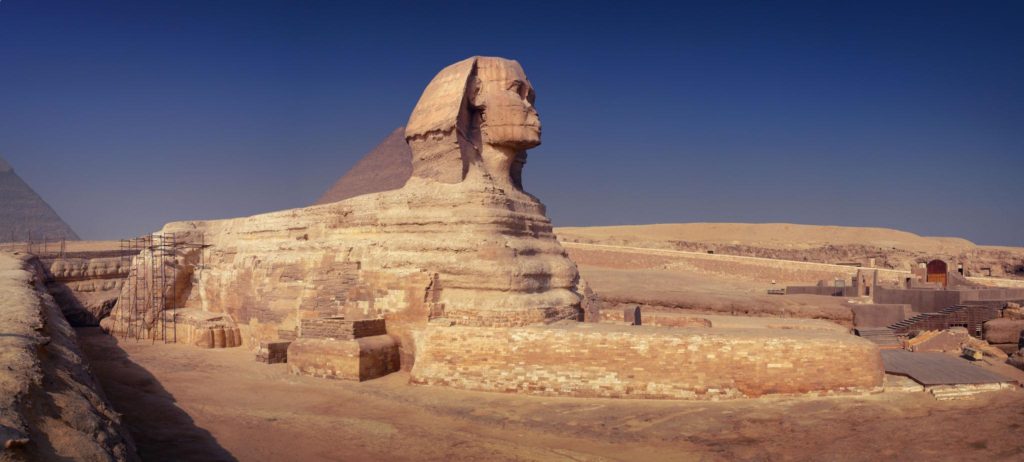
The Great Sphinx is a lion with a king's head carved from the bedrock of the Giza plateau, about 73 metres long and 20 metres high, and most Egyptologists attribute it to Khafre around 2500 BC. You see it from terraces beside Khafre's Valley Temple, and its missing nose was hacked off by hand centuries before Napoleon ever reached Egypt.
Who built the Sphinx?
The Sphinx is almost certainly the work of Khafre, Khufu's son, because it sits beside his causeway and Valley Temple and was shaped from the same quarry that supplied the blocks of the temple in front of it. No inscription of the Old Kingdom names its builder, which leaves room for debate: a minority of scholars argue for Khufu or for Khafre's brother Djedefre. But the archaeology of the enclosure, studied in detail by Mark Lehner, ties the carving to Khafre's building programme around 2500 BC.
Workers cut a deep trench around a knoll of rock left by the quarrymen and carved the body in place. The rock is layered: the hard lower bed forms the floor, the soft middle beds form the body, which has eroded into deep ripples, and the harder top layer forms the head, which is why the face has survived so well. The body has been patched with masonry repeatedly, from the New Kingdom and Roman periods to restoration campaigns in the 20th century.
What should you look for at the Sphinx?
Look beyond the face: the Valley Temple, the unfinished Sphinx Temple and the stela between the paws tell you how the monument was built, forgotten and rediscovered.
- Khafre's Valley Temple: walls of huge limestone blocks faced with red Aswan granite, square granite pillars and an alabaster floor. In a pit here in 1860 Auguste Mariette found the great seated statue of Khafre protected by Horus, one of the masterpieces of Egyptian sculpture. You walk through it on the way to the Sphinx terrace.
- The Sphinx Temple: directly in front of the paws, built from blocks cut out of the enclosure but apparently never finished. It is usually viewed from above rather than entered.
- The Dream Stela: the granite slab between the paws, set up by Thutmose IV around 1400 BC. It tells how the young prince fell asleep in the Sphinx's shade and dreamed that he would become king if he cleared away the sand burying it.
- The head: note the royal nemes headcloth, the cobra (uraeus) whose stump remains on the forehead, and traces of red pigment that survive in sheltered spots.
By the New Kingdom the Sphinx was worshipped as Horemakhet, 'Horus in the Horizon', and Amenhotep II built a temple to it just north-east of the enclosure.
Which Sphinx myths are false?
Napoleon's soldiers did not shoot off the nose, there is no hidden hall of records beneath it, and geology does not show it to be thousands of years older than the pyramids.
- The nose: drawings by the Danish traveller Frederik Norden, made in 1737, already show the Sphinx without a nose, decades before Napoleon's 1798 expedition. The 15th-century historian al-Maqrizi recorded that a Sufi zealot damaged the face in 1378, and marks left by rods hammered into the nose show it was levered off deliberately.
- The beard: it did exist, probably added in the New Kingdom. Fragments are held in the British Museum and in Cairo.
- The 'water erosion' theory: the claim that rain weathering proves an age of 10,000 years or more is rejected by mainstream geologists and Egyptologists, who explain the erosion by the soft rock, salt crystallisation and wind.
- Secret chambers: a few short tunnels and cavities exist, mostly left by early explorers and restorers. Surveys have found no hidden library.
Where are the best places to see the Sphinx?
The main terrace in front of the Valley Temple gives the face-on view, the walkway to the north gives the classic profile with the pyramids behind, and the evening show gives you the Sphinx floodlit.
- Front terrace: the face, the paws and the Dream Stela, with Khafre's pyramid directly behind. Morning light from the east falls on the face, so the front is best before about 11am.
- North side: the side profile with the ripples of the eroded body. In late afternoon the light rakes along it beautifully.
- Khafre's causeway: looking down into the enclosure from above shows how the figure was cut out of the bedrock, which is hard to grasp from the front.
- After dark: the Sphinx is the narrator of the Giza Sound and Light Show; see our comparison of sound and light shows.
Crowds peak from mid-morning to early afternoon. The plateau-wide advice on entrances, shuttles and touts is in our Pyramids of Giza guide.
How long do you need, and how does it fit your day?
Allow 45 minutes to an hour for the Sphinx, the Valley Temple and photographs; most visitors see it last, walking or riding the shuttle down from the pyramids. The Sphinx is included in the general Giza plateau ticket at the time of writing; for current prices check egymonuments.gov.eg.
The Sphinx sits at the low eastern edge of the plateau, right beside the village of Nazlet el-Samman and a short drive from the Grand Egyptian Museum, so a morning at the pyramids and Sphinx followed by an afternoon in the museum works well. Behind the Sphinx rises Khafre's pyramid; read about it on our Khafre and Menkaure page.
Great Sphinx of Giza: FAQs
How old is the Great Sphinx?
About 4,500 years. Most Egyptologists date it to the reign of Khafre, around 2500 BC.
What happened to the Sphinx's nose?
It was deliberately prised off with rods, probably in the medieval period; al-Maqrizi blamed a Sufi zealot in 1378. Drawings from 1737 show it already missing, so Napoleon's troops were not responsible.
Can you touch or walk around the Sphinx?
No. Visitors view it from terraces and walkways around the enclosure; the base and paws are closed off for conservation.
Is the Sphinx included in the pyramids ticket?
At the time of writing the Sphinx and Valley Temple are covered by the general Giza plateau ticket. Check current arrangements before you go.
Which way does the Sphinx face?
Due east, towards the rising sun and the Nile valley, which fits its later worship as Horemakhet, 'Horus in the Horizon'.