Quick answer
Khafre's pyramid, the second at Giza, is slightly smaller than Khufu's but looks taller because it stands on higher rock, and it is the only one that keeps a cap of its original casing. Menkaure's, the third, is less than half the height but was partly cased in red Aswan granite. Both can be entered on separate tickets when open.
Why does Khafre's pyramid look taller than Khufu's?
Khafre's pyramid stands on bedrock about 10 metres higher than his father's and is a little steeper, so from most angles it seems the tallest, even though it was about 3 metres lower when finished. Khafre reigned after his brother Djedefre, who built his own pyramid at Abu Rawash to the north, and returned to Giza to build right beside Khufu.
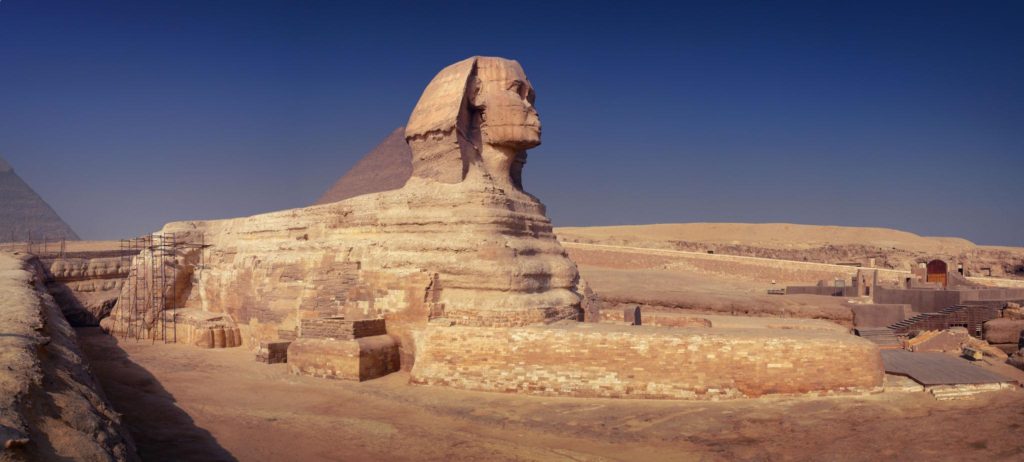
The giveaway is the summit. The top quarter or so still wears its smooth Tura limestone casing, showing how all three pyramids once looked: bright, sharp-edged and polished. Lower down you can make out a course of rough red granite casing on the lowest level. Khafre's complex is also the best preserved at Giza: you can trace the mortuary temple against the east face, the causeway running down the slope and the Valley Temple beside the Sphinx, plus a small satellite pyramid on the south side.
What is it like inside Khafre's pyramid?
Khafre's interior is shorter and simpler than the Great Pyramid's: a steep, low passage down into the rock, a level corridor, and a large gabled burial chamber with a granite sarcophagus sunk into the floor. It takes about 15 to 20 minutes and involves stooping on the way down and back up, but no long climb.
There are two entrances on the north face, one in the pyramid face and one cut into the pavement below, joined inside. The burial chamber is carved out of the bedrock and roofed with huge pitched limestone beams. On the wall, in large letters, is the graffito of the Italian strongman-turned-explorer Giovanni Belzoni, who found the way in on 2 March 1818 and wrote 'Scoperta da G. Belzoni' with the date. He was disappointed: the chamber had been robbed long before, and the sarcophagus held only bones later identified as a bull's. It is a good alternative if the Great Pyramid's interior seems too much, though authorities rotate which pyramids are open, so ask your guide.
What makes Menkaure's pyramid different?
Menkaure's pyramid is less than half the height of the other two, but it was the most lavishly finished: its lower courses were cased in red granite brought from Aswan, much of it never smoothed. Walk to the north face and you can see the granite blocks still in their rough, quarry-faced state, with only the area around the entrance dressed flat: a rare snapshot of a building left unfinished, perhaps at the king's death.
The deep vertical gash in the north face dates to 1196, when al-Aziz Uthman, son of Saladin, ordered the pyramids dismantled. After months of work his men had removed so little that the project was abandoned.
Inside, a descending passage leads to an antechamber carved with panelled niches, the only decorated room in any Giza pyramid, and then down to a burial chamber lined with granite. In 1837 the British explorer Howard Vyse removed a basalt sarcophagus from here, but it went down with the ship carrying it to England off the Spanish coast in 1838 and has never been recovered. Menkaure's Valley Temple yielded famous slate statues of the king with the goddess Hathor, now divided between Cairo and the Museum of Fine Arts in Boston.
Can you see the queens' pyramids?
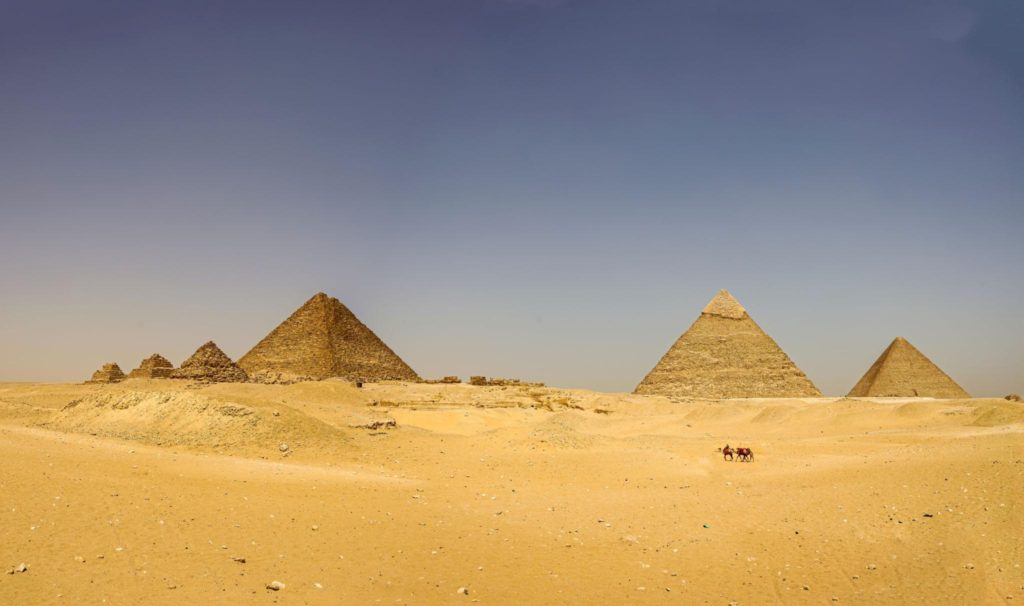
Yes: three small queens' pyramids stand in a row south of Menkaure's, and they frame the best photographs of the whole group. The easternmost was cased in granite and limestone like a true pyramid; the other two were left as step pyramids, and their inner structure shows clearly. Their owners are not certainly known. Khafre has a single small satellite pyramid on his south side, mostly reduced to its foundation.
The shuttle stop at the Panoramic Point, on the desert ridge to the south-west, lines up the queens' pyramids, Menkaure, Khafre and Khufu in one frame. For how the viewpoint, shuttles and camel rides work, see our Pyramids of Giza guide.
How long should you allow, and when?
Give the two pyramids about an hour and a half on top of your time at the Great Pyramid: 30 to 40 minutes around Khafre (more if you go in), and 30 minutes walking to Menkaure and its queens. Menkaure is the furthest monument from the Sphinx, so many visitors skip it; on foot it is about 15 minutes from Khafre across open sand, and there is no shade.
In the morning the east faces are lit and Khafre's casing glows; late afternoon light from the west suits Menkaure's granite. Interior tickets are separate from the plateau ticket and at the time of writing are sold at the visitor centre and on egymonuments.gov.eg; check prices and which interiors are open. To see how these pyramids fit into the wider story of pyramid building, read Egypt's pyramids: the complete list.
Pyramids of Khafre and Menkaure: FAQs
Which Giza pyramid still has casing stones?
Khafre's. The top quarter or so keeps its original smooth Tura limestone casing. Menkaure's keeps some of its red granite casing on the lowest courses.
Can you go inside Khafre's pyramid?
Usually, on a separate ticket, though the authorities rotate interior access between the pyramids for conservation. It is shorter and less strenuous than the Great Pyramid.
Is Khafre's pyramid taller than Khufu's?
No. It was about 143 m against Khufu's 146 m, but it stands on higher ground and still has its pointed top, so it often looks taller.
What happened to Menkaure's sarcophagus?
It was removed by Howard Vyse in 1837 and lost at sea in 1838 when the ship carrying it to Britain sank off the coast of Spain.
Is it worth walking out to Menkaure's pyramid?
Yes, if you have the time and the weather is not too hot. The unfinished granite casing, the 1196 gash and the queens' pyramids are well worth 30 minutes.