Quick answer
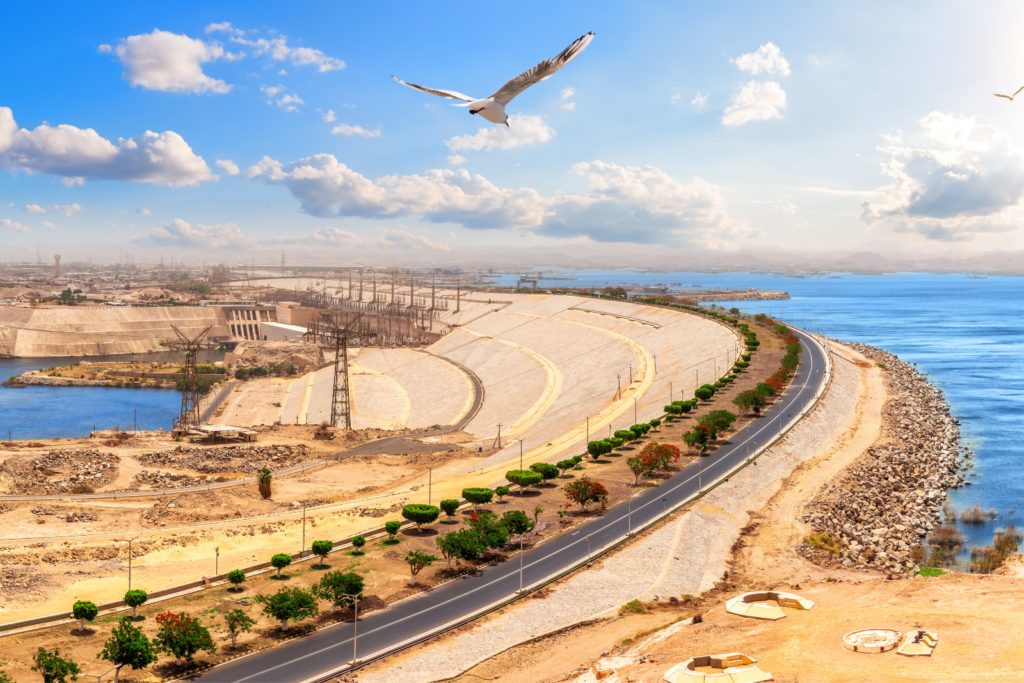
The Aswan High Dam is the rock-and-clay dam built across the Nile south of Aswan between 1960 and 1970, which ended the annual flood and created Lake Nasser. It reshaped Egyptian farming and electricity supply, flooded Lower Nubia and forced the rescue of its temples; as a sight it is a 20–30 minute stop for the view and the story.
Why was the Aswan High Dam built?
To control the Nile flood, store water for dry years, irrigate more land and generate electricity for a fast-growing Egypt. For thousands of years Egyptian farming depended on the annual summer flood, which could be too low (famine) or too high (destruction). The British-built Old Aswan Dam, completed in 1902 a few kilometres downstream and raised twice, could only hold back part of one season's water.
After the 1952 revolution, Gamal Abdel Nasser made a much larger dam the centrepiece of his development plans. When the United States and Britain withdrew their offer of finance in 1956, Nasser nationalised the Suez Canal to pay for it, triggering the Suez Crisis, and turned to the Soviet Union, which provided loans, engineers and heavy equipment. Work began in 1960, the river was diverted in 1964 and the dam was finished in 1970, the year Nasser died.
What did the dam change?
It ended the flood for good: since the 1970s the Nile below Aswan has flowed at a controlled level all year. That allowed two or three crops a year instead of one, protected Egypt from both the droughts and the high floods of later decades, and its turbines (about 2,100 megawatts) at one point supplied around half of the country's electricity.
The costs were real too. The fertile silt that the flood once spread over the fields now settles in Lake Nasser, so farmers rely on chemical fertiliser; the Nile Delta coastline is no longer replenished and erodes; and perennial irrigation has raised soil salinity in places.
How did the High Dam create Lake Nasser and affect the Nubians?
The dam backed the river up for about 500 km into Sudan, drowning Lower Nubia and displacing roughly 100,000 Nubians on both sides of the border. In Egypt, Nubian villages between Aswan and the Sudanese frontier were cleared in the mid-1960s and their people resettled in purpose-built villages on the Kom Ombo plain, far from the river that had defined their way of life. In Sudan, the town of Wadi Halfa was flooded and its population moved hundreds of kilometres east.
The ancient monuments of Nubia faced the same fate, which led to the UNESCO campaign that moved Abu Simbel, Philae, Kalabsha and some 20 other temples. The story is told best at the Nubian Museum in Aswan; for the lake itself, its rescued temples and cruises, see our Lake Nasser and Nubia guide.
What do you see when you stop at the dam?
From the crest you look south over the open blue of Lake Nasser and north down the narrow Nile channel towards Aswan, with the power station below. The contrast between the two sides is the point of the visit: on one side a vast reservoir stretching to the horizon, on the other a river tamed to a steady flow.
- The Soviet–Egyptian Friendship Monument: a tall concrete tower of five lotus-leaf columns on the western end, built to commemorate the cooperation that built the dam. It is usually seen from the road.
- Commemorative panels: a memorial near the eastern end records the dam's construction in Arabic and Russian.
- Kalabsha on the shore: on a clear day you can pick out the promontory where Kalabsha Temple was rebuilt, reached by boat from the dam's west side.
The dam is a strategic site with soldiers on duty. At the time of writing tourists can photograph the general view, but do not photograph or fly anything near military posts or installations, and ask your guide if unsure.
Is the Aswan High Dam worth visiting?
As a 20–30 minute stop on the way to Philae, yes; as a destination in its own right, not really. Most visitors find the engineering more interesting than beautiful, and the crest can be windy and hot. It makes sense because it explains so much of what you see elsewhere: why Philae and Abu Simbel were moved, why the Nile no longer floods and why Nubian culture now centres on Aswan.
If you are short on time in Aswan, prioritise Philae and a felucca sail, then fit the dam in only if it is on the way. Travellers heading onto a Lake Nasser cruise will see it anyway, as ships leave from the lake side; our Lake Nasser cruise guide explains how that works.
How do you get there and how does it fit into a day?
Drive about 20–25 minutes south from the Corniche; it is almost always combined with the Unfinished Obelisk and Philae in one morning. A typical order is the Unfinished Obelisk first, then the High Dam, then down to the Shellal marina for the boat to Philae, which sits between the old and new dams. Vehicles pay a small fee to stop on the crest; on a cruise or private tour this is included.
There is no public transport to the viewpoint, so independent travellers need a taxi or driver for the round trip.
Aswan High Dam: FAQs
What is the difference between the Old Aswan Dam and the High Dam?
The Old Aswan Dam was built by the British and completed in 1902, a few kilometres north. The much larger High Dam, finished in 1970 about 6–7 km further upstream, created Lake Nasser and stopped the annual flood entirely. Philae Temple sits on an island between the two.
How long is the Aswan High Dam?
About 3.6 km long and 111 metres high, and nearly a kilometre thick at its base.
Can you take photos at the Aswan High Dam?
General views from the visitor stopping area are normally fine, but it is a security-sensitive site. Avoid photographing soldiers or installations, never fly a drone, and check current rules with your guide.
Did the High Dam stop the Nile flooding?
Yes. Since the early 1970s the river below Aswan has been regulated year-round, which ended the annual flood that shaped Egyptian life for millennia.
Who built the Aswan High Dam?
Egyptian workers and engineers, with major financial and technical support from the Soviet Union, between 1960 and 1970.