Quick answer
Tutankhamun was an 18th Dynasty pharaoh who came to the throne as a child of about eight or nine and ruled for roughly nine or ten years, around 1332–1323 BC. Raised in Akhenaten’s court at Amarna, he restored the old gods and the god Amun, died at about 18 or 19, and became world-famous only because his nearly intact tomb was found in 1922.
Who was Tutankhamun?
Tutankhamun was a minor king of a troubled moment: a child pharaoh who ruled for about a decade in the 14th century BC and whose main job was to undo the religious revolution of his predecessor. He was born around 1341 BC, probably at Akhetaten (modern Tell el-Amarna), the new capital Akhenaten had built for his sun god, the Aten. His birth name, Tutankhaten, means “living image of the Aten”.
He came to the throne aged about eight or nine, around 1332 BC, after the brief and still-murky reigns that followed Akhenaten’s death. Within two or three years he had changed his name to Tutankhamun, “living image of Amun”, a public signal that the court was returning to Egypt’s traditional state god. His throne name was Nebkheperure, the name that appears most often on objects from his tomb.
A boy king did not govern alone. Real power lay with two senior men: Ay, an elderly courtier who held the title “God’s Father”, and Horemheb, commander of the army and the king’s deputy. Both would later sit on the throne themselves.
Who were Tutankhamun’s parents and wife?
Most Egyptologists now accept that Tutankhamun’s father was Akhenaten, and that his mother was a sister of Akhenaten whose name we do not know. The key evidence is a 2010 DNA and CT study of the royal mummies led by Zahi Hawass. It matched Tutankhamun to the anonymous male mummy from tomb KV55, usually identified as Akhenaten, and to a female mummy from KV35 known as the “Younger Lady”. The two were full siblings, children of Amenhotep III and Queen Tiye. The KV55 identification and the DNA methods have both been challenged, so treat this as the leading view rather than settled fact.
His wife was Ankhesenpaaten, third daughter of Akhenaten and Nefertiti, and probably his half-sister. Like her husband she changed her name, to Ankhesenamun. The golden throne from his tomb shows her tenderly anointing him, one of the most intimate royal images to survive.
The couple had no surviving heir. Two tiny mummified foetuses, girls stillborn at roughly five and seven months, were buried in miniature coffins in his tomb and are generally thought to be their daughters.
What did Tutankhamun actually do as king?
His reign is best remembered for restoring the old religion after Akhenaten’s experiment: temples were reopened, priesthoods re-established and the court moved away from Amarna. The clearest statement is the Restoration Stela, set up at Karnak, which describes the land in turmoil and the gods having “turned their backs” on Egypt because their temples had been neglected. The king promises new cult statues of gold, new priests drawn from good families and new temple estates.
- A new seat of government: the administration moved to Memphis, near modern Cairo, and Thebes (modern Luxor) regained its role as Amun’s religious capital. Akhetaten was gradually abandoned.
- Building in Luxor: the reliefs of the Opet Festival procession on the walls of the great colonnade at Luxor Temple were carved in his reign, though Horemheb later put his own name over Tutankhamun’s.
- Warfare by proxy: objects in his tomb, such as a painted chest, show him crushing Nubians and Syrians, and there is evidence of campaigns in his name, but there is no sign he led armies himself.
Much of this was surely steered by Ay and Horemheb, but it was Tutankhamun’s name on the decrees.
How did Tutankhamun die?
Nobody knows for certain; the most widely supported view is that a young man already weakened by illness and a bone condition died after a leg injury, perhaps complicated by malaria. He died around 1323 BC, aged about 18 or 19, apparently without warning, since his burial shows signs of haste.
The theories have shifted as the science has improved:
- Murder: a 1968 X-ray showed bone fragments inside the skull, and for decades writers suspected a blow to the head. CT scans in 2005 concluded the fragments were moved during embalming or by Carter’s team, and most specialists now reject this theory.
- A broken leg: the 2005 scans found a fracture above the left knee that may have happened shortly before death, which fed the popular chariot-accident idea. Others think it was damage done after death.
- Illness: the 2010 study reported DNA from the parasite that causes severe malaria and bone damage in the left foot consistent with Köhler disease. The claim that he had a club foot and walked with a cane is still debated.
Our guide to the curse of Tutankhamun deals with the separate legend about the deaths that followed the tomb’s opening.
Why was Tutankhamun forgotten, and why is he so famous now?
Later kings deliberately wrote the Amarna family out of history, which is exactly why Tutankhamun’s tomb survived nearly intact for 3,200 years. His successor Ay held the throne for only about four years, and the next king, Horemheb, took over Tutankhamun’s monuments and treated the whole Amarna line as illegitimate. When Seti I carved his list of royal ancestors at Abydos, Akhenaten, Tutankhamun and Ay were simply left out.
A forgotten king’s tomb attracted less attention. Tutankhamun’s small tomb was robbed at least twice soon after the burial and resealed, then its entrance was buried under debris and workmen’s huts when the tomb of Ramesses VI was cut above it about two centuries later. Every other New Kingdom royal tomb was emptied in antiquity.
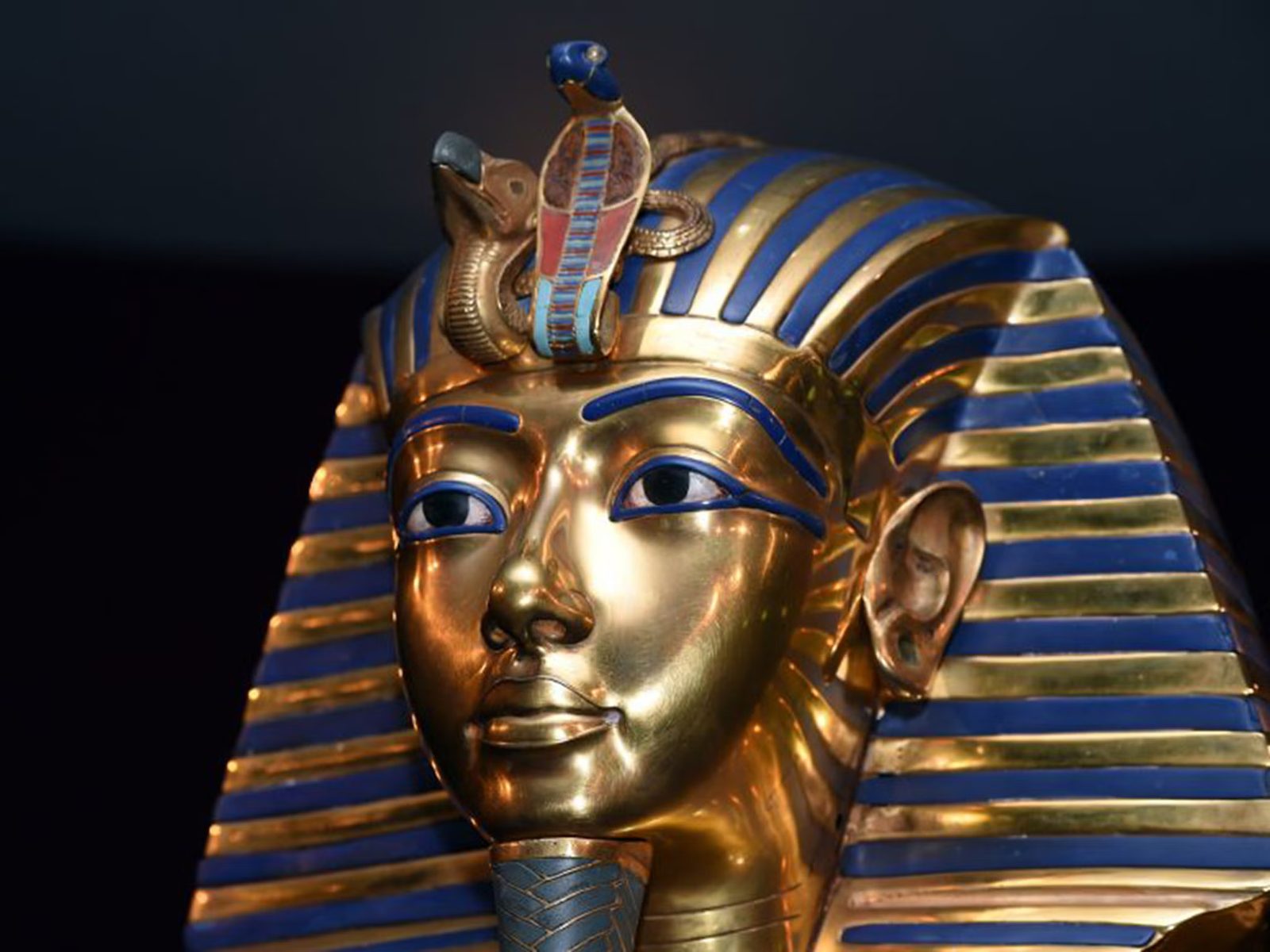
Howard Carter found the first step on 4 November 1922, and the clearance took a decade; the full story is told in our guide to the discovery of Tutankhamun’s tomb. The haul of more than 5,000 objects, including the gold mask of about 10 kg and an innermost coffin of solid gold weighing around 110 kg, turned a short-lived boy king into the most famous pharaoh in the world.
Who ruled after Tutankhamun?
Ay, his elderly adviser, became king, and Ay is shown performing Tutankhamun’s funeral rites on the burial chamber wall, which was his way of claiming the throne. Hittite records add a remarkable episode: a widowed Egyptian queen wrote to the Hittite king Suppiluliuma asking for one of his sons to marry, saying she would never take a servant as husband. The prince, Zannanza, died on the way to Egypt. Many scholars think the widow was Ankhesenamun, though some argue for Nefertiti or her daughter Meritaten.
After Ay came Horemheb, and after him a family of army officers from the eastern Delta who founded the 19th Dynasty, the line of Seti I and Ramesses II. Our guide to the Amarna period puts the whole family drama in context.
Where to see Tutankhamun in Egypt today
His treasures are at the Grand Egyptian Museum near Giza and his body is still in his tomb in Luxor, so seeing “all” of Tutankhamun means visiting both ends of the country.
- Grand Egyptian Museum, Giza: the complete tomb collection, shown together since the museum opened in full on 1 November 2025, including the gold mask, coffins, shrines, chariots and the golden throne.
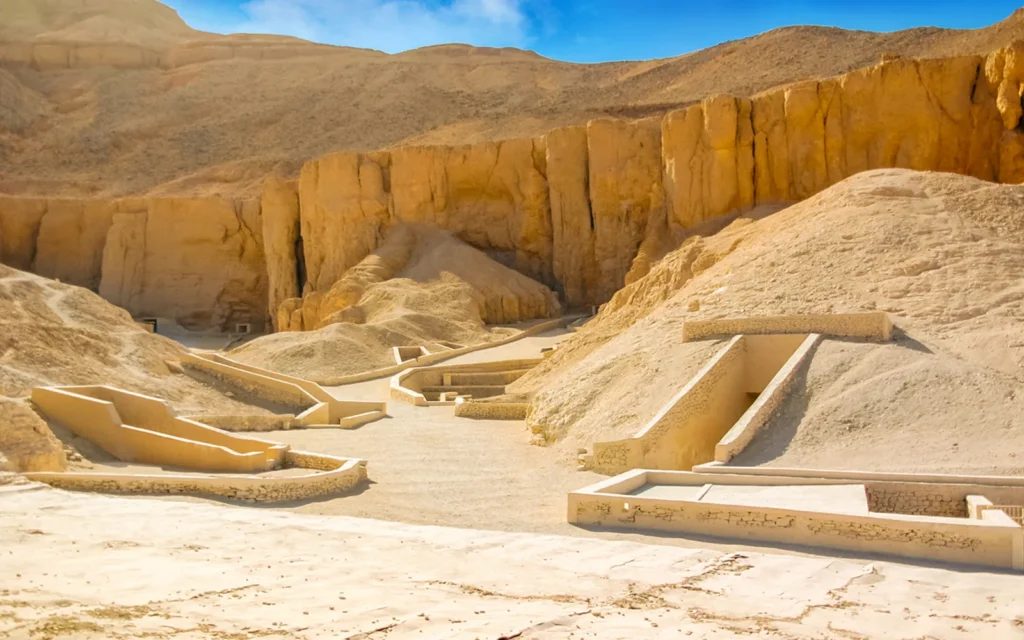
- Tomb of Tutankhamun (KV62): his mummy in a glass case, his quartzite sarcophagus and the painted burial chamber, on a separate ticket in the Valley of the Kings.
- Howard Carter’s House: the excavator’s dig house and a full-size replica of the burial chamber you can study at leisure.
- Luxor Temple and Luxor Museum: the Opet colonnade reliefs from his reign, and a small group of objects from his tomb, at the time of writing.
- Tomb of Ay: his successor’s tomb in the West Valley, possibly begun for Tutankhamun himself.
All of these are on the route of our Classic Egypt and Nile Cruise or can be added to any private itinerary.
Frequently asked questions
How old was Tutankhamun when he became king?
About eight or nine years old, around 1332 BC. He ruled for roughly nine or ten years and died at about 18 or 19.
Was Tutankhamun murdered?
Probably not. The murder theory rested on skull fragments seen in a 1968 X-ray, but CT scans in 2005 suggested they were displaced during embalming or after discovery. Illness, a leg fracture and malaria are the leading explanations, though none is proven.
Is Tutankhamun’s mummy still in his tomb?
Yes. Unlike most royal mummies, which are in Cairo, Tutankhamun lies in a climate-controlled case inside KV62 in the Valley of the Kings.
Where is Tutankhamun’s gold mask now?
At the Grand Egyptian Museum near the Giza pyramids, displayed with the rest of his tomb collection. It left the old Egyptian Museum in Tahrir Square before the GEM opened in full in November 2025.
Was Tutankhamun an important pharaoh?
Politically he was a minor king with a short reign, but he presided over the return to traditional religion after Akhenaten. His fame comes almost entirely from the near-intact tomb found in 1922.