Quick answer
The Nile is one of the two longest rivers on Earth, about 6,650 km, formed by the White Nile from the Lake Victoria basin and the Blue Nile from Ethiopia, which meet at Khartoum. In Egypt it crosses desert with no tributaries, and its narrow valley and Delta have held almost all of the country's people from the pharaohs to today. Travellers see it best on a Luxor–Aswan cruise or a felucca.
Where does the Nile start, and how long is it?
The Nile has two main sources: the White Nile, which flows out of Lake Victoria and gathers its farthest headwaters in Rwanda and Burundi, and the Blue Nile, which leaves Lake Tana in the Ethiopian highlands. They meet at Khartoum in Sudan. Measured from the most distant headstream, the river is about 6,650 km long; whether it or the Amazon is the world's longest depends on how you measure, and geographers still argue.
About 300 km north of Khartoum the Atbara, also from Ethiopia, joins in. After that the Nile receives no further tributary for the rest of its journey, flowing through the Sahara, over a series of rocky rapids called cataracts, and into Egypt. The First Cataract, at Aswan, marked Egypt's traditional southern border. Below Cairo the river fans out into the Delta, with two main branches today, the Rosetta and the Damietta, where ancient writers counted seven.
Why did the Nile flood every summer?
Because monsoon rains fell on the Ethiopian highlands each summer, swelling the Blue Nile and the Atbara, which carried a huge surge of water and silt down to Egypt. The White Nile gave a steady flow all year, but the flood came almost entirely from Ethiopia.
In Egypt the water usually began rising in June, peaked in August and September, and fell back in October, leaving a layer of fertile black mud. Farmers sowed into it as the water retreated. A good flood meant plenty; a low one meant famine, and a very high one swept away villages. Egyptians measured each year's level with nilometers, stepped shafts or gauges at sites such as Elephantine and Roda Island in Cairo. The flood also set the ancient calendar, which our guide to the Nile flood and the Egyptian calendar explains.
How did the Nile shape ancient Egypt?
It made a long, narrow oasis in the desert, and the Egyptians organised their land, their religion and even their sense of direction around it. They called their country Kemet, “the black land”, after the dark soil of the valley, in contrast to Deshret, “the red land”, of the desert on either side. The Greek historian Herodotus called Egypt “the gift of the river”.
- Direction: because the river flows north, “Upper Egypt” is the south and “Lower Egypt” the Delta. The hieroglyph for sailing south shows a boat with its sail up, catching the prevailing north wind; sailing north, a boat with its sail down, drifting with the current.
- Transport: the river was the highway for everything from grain to obelisks. Our guide to ancient Egyptian boats covers the ships.
- Religion: the flood was personified as Hapi, a plump figure with a crown of papyrus or lotus, and the daily journey of the sun god was imagined as a voyage by boat.
- Geography of the dead: most cemeteries lay on the west bank, where the sun set, while towns and many temples stood on the east.
How did the Aswan High Dam change the Nile?
The High Dam, finished in 1970, ended the flood: since then the river below Aswan flows at a controlled level all year, fed from Lake Nasser. Farmers gained two or three harvests a year and protection from droughts and floods, and the dam's turbines added large amounts of electricity. The costs include silt trapped in the lake instead of the fields, more chemical fertiliser, a Delta coastline that is no longer replenished, and the drowning of Nubia. Our Aswan High Dam guide covers the dam and its viewpoint.
Water is now Egypt's most sensitive foreign-policy issue. Under a 1959 agreement with Sudan, Egypt is allotted 55.5 billion cubic metres a year, and the great majority of Egyptians live in the valley and Delta, a small fraction of the country's land. Ethiopia's Grand Ethiopian Renaissance Dam on the Blue Nile, filled in stages from 2020 and inaugurated in 2025, has caused years of tension between the two countries, and negotiations over how it is operated are unresolved at the time of writing.
Which stretch of the Nile will you see on a trip to Egypt?
Most travellers see three stretches: the city river in Cairo, the 200-odd km between Luxor and Aswan, and Lake Nasser south of the High Dam.
| Stretch | What it's like | How to see it |
|---|---|---|
| Cairo | Wide, busy, lined with towers; islands of Gezira and Roda | A dinner cruise, a felucca at sunset, the Cairo Tower view |
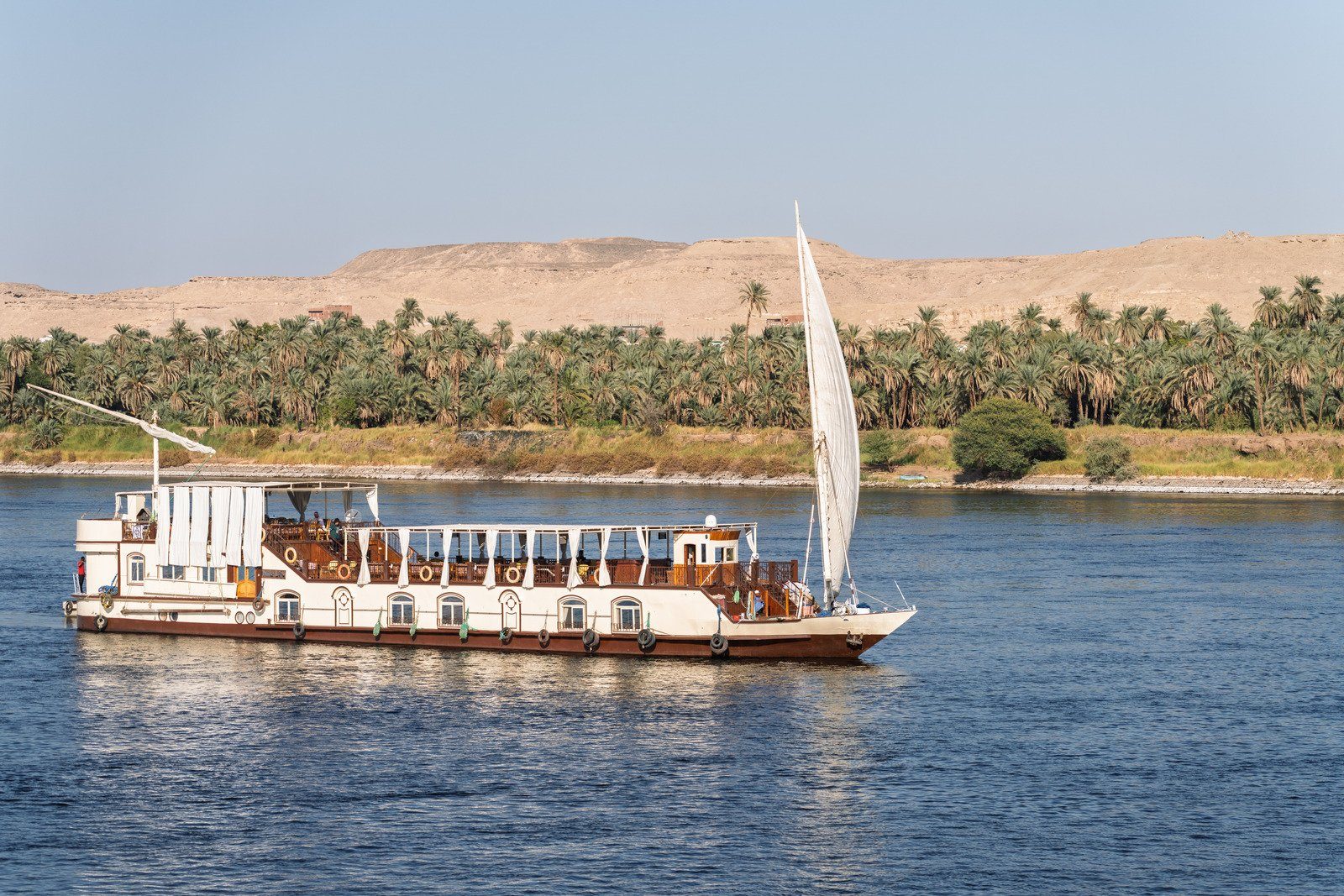
| Luxor to Aswan | Palm-fringed fields, villages, sandstone cliffs, the Esna lock | A 3–4 night cruise or a 4–5 night dahabiya |
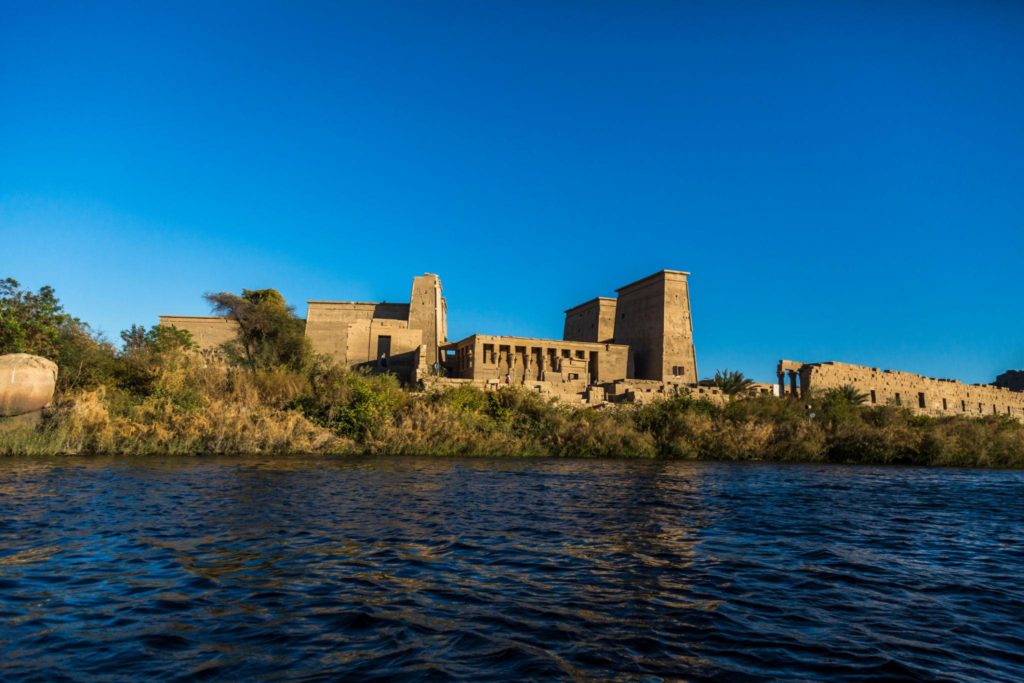
| Aswan | Granite boulders and islands of the First Cataract, golden dunes on the west bank | Felucca, motorboat to Philae, Nubian villages |
| Lake Nasser | Open water and desert, almost no settlement | A 3–4 night Lake Nasser cruise ending at Abu Simbel |
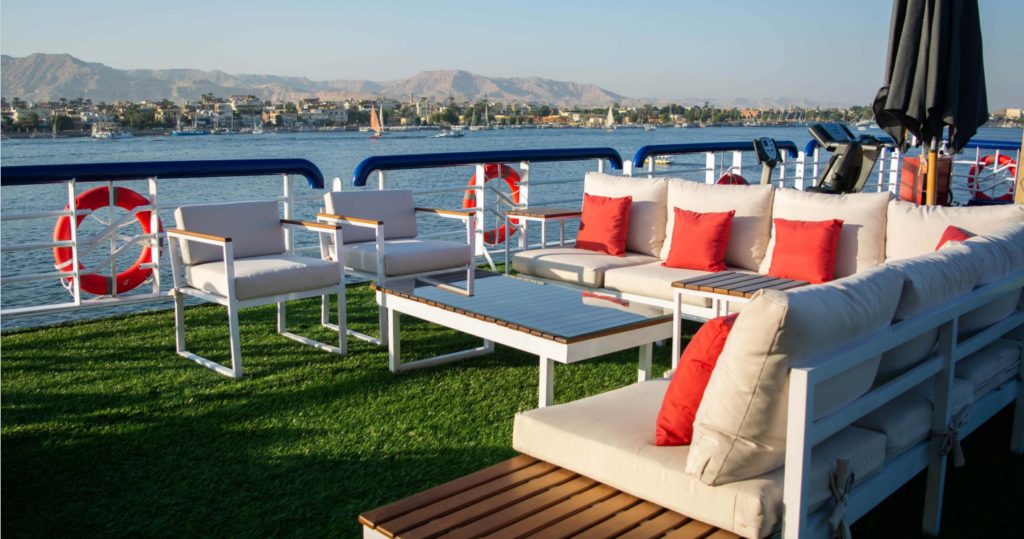
Our Nile cruises guide explains the boats and routes, and our felucca guide covers the traditional sailing boats.
Can you swim in the Nile?
It is best not to: the river has strong currents and heavy boat traffic, and freshwater in Egypt has long been associated with bilharzia (schistosomiasis), a parasite caught through the skin. Some boat crews take guests to swim near Aswan's islands, and the risk there is often described as low, but there is no reliable way to judge it yourself. Ask your doctor or a travel clinic before you go, check the health section of Smartraveller, and never drink untreated river water. Swim in your hotel or cruise-ship pool instead, and save the Nile for the view.
Where to experience the Nile in Egypt today
To understand the river rather than just look at it, combine time on the water with the places that measured and tamed it.
- Elephantine Island, Aswan: one of the oldest nilometers, a stairway down to the water with level markings.
- Roda Island, Cairo: the 9th-century Roda Nilometer, a stone-lined shaft with a central graduated column.
- Kom Ombo: a temple nilometer and a museum of mummified crocodiles, sacred to Sobek; see the Kom Ombo Temple guide.
- The Aswan High Dam: the lake on one side, the tamed river on the other.
- A felucca at sunset: Aswan, around Elephantine and Kitchener's Island, is the classic place.
The cooler months, October to April, are the most comfortable for time on deck; in summer, plan river time for early morning and evening.
Frequently asked questions
Which way does the Nile flow?
North. It rises in East Africa and flows north through Sudan and Egypt to the Mediterranean, which is why southern Egypt is called Upper Egypt.
Does the Nile still flood?
Not in Egypt. Since the Aswan High Dam was completed in 1970, the flood has been held in Lake Nasser and released at a controlled rate.
How many countries does the Nile flow through?
The Nile basin is shared by 11 countries. The main river and its two great branches flow through Uganda, South Sudan, Sudan, Ethiopia and Egypt, with headwaters in several more.
Is the Nile the longest river in the world?
It is usually listed as the longest, at about 6,650 km, but some measurements put the Amazon slightly ahead. The answer depends on where you place each river's source and mouth.
What is the best way to see the Nile?
A Nile cruise or dahabiya between Luxor and Aswan, which combines the river scenery with the temples of Edfu and Kom Ombo, plus a felucca sail in Aswan.