Quick answer
Egyptian mathematics was practical arithmetic and geometry for scribes: a decimal number system, multiplication by doubling, fractions written as sums of unit fractions, and formulas for areas, volumes and pyramid slopes. Astronomy served timekeeping and religion, dividing the night into 12 hours using groups of stars called decans and aligning pyramids and temples to north and to the sun.
How did ancient Egyptians write numbers?
Egyptians counted in tens, with a different hieroglyph for each power of ten, repeated as many times as needed. There was no zero and no place value: 342 was written as three coils of rope, four heel bones and two strokes.
| Value | Sign |
|---|---|
| 1 | A single stroke |
| 10 | A hobble for cattle (often described as a heel bone) |
| 100 | A coil of rope |
| 1,000 | A lotus plant |
| 10,000 | A raised finger |
| 100,000 | A tadpole |
| 1,000,000 | The god Heh with raised arms, also meaning “millions” or “eternity” |
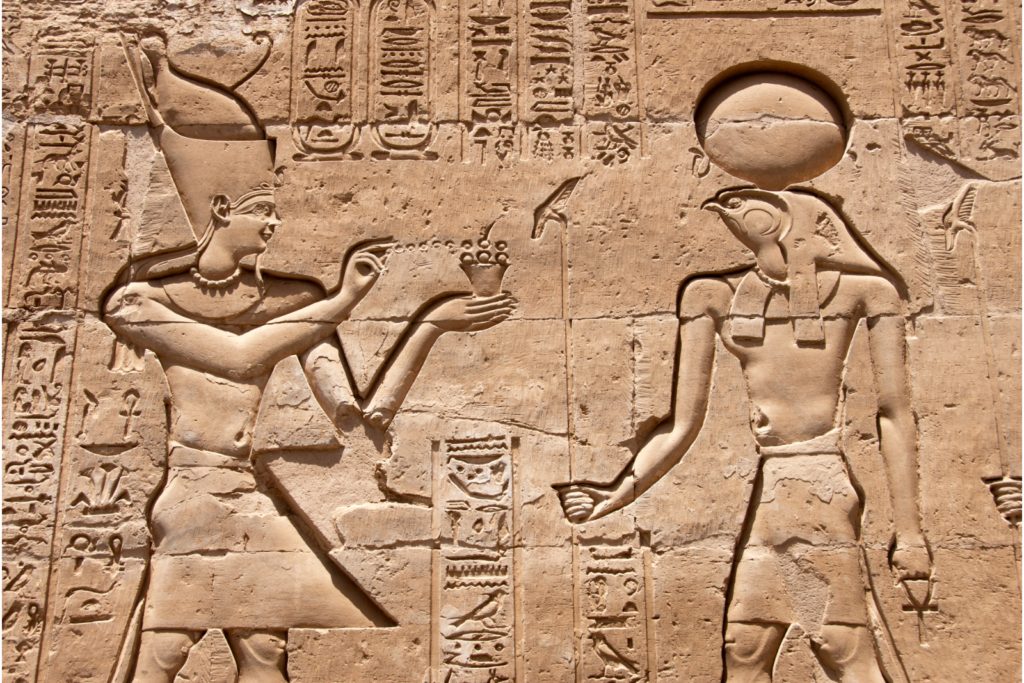
Scribes doing everyday sums used hieratic, a cursive script with compact signs for each number. Our guide to hieroglyphs explains how the scripts relate. Look for the numerals on temple walls, where kings boast of captives and offerings; the tadpole and the kneeling Heh are easy to spot.
What does the Rhind papyrus teach us?
The Rhind Mathematical Papyrus is a scribe’s textbook of more than 80 worked problems, copied by a scribe named Ahmes around 1550 BC from an older Middle Kingdom original. It was bought in Luxor in 1858 by the Scottish lawyer Alexander Henry Rhind and is now in the British Museum. Its opening promises “accurate reckoning for inquiring into things, and knowledge of all things”.
The problems are practical: dividing loaves among workers, the volume of a granary, the area of a field, the slope of a pyramid. Multiplication was done by doubling and adding: to multiply 13 by 12, a scribe doubled 12 to get 24, 48 and 96, then added the multiples of 1, 4 and 8 that make 13. Fractions were written as sums of unit fractions with 1 on top, so two-fifths became 1/3 + 1/15, and the papyrus opens with a ready-reckoner table of these.
The Moscow Mathematical Papyrus, in the Pushkin Museum, holds the most impressive single result: a correct method for the volume of a truncated pyramid. For the circle, Egyptians took the area as the square of eight-ninths of the diameter, which works out to a pi of about 3.16.
How did maths build the pyramids?
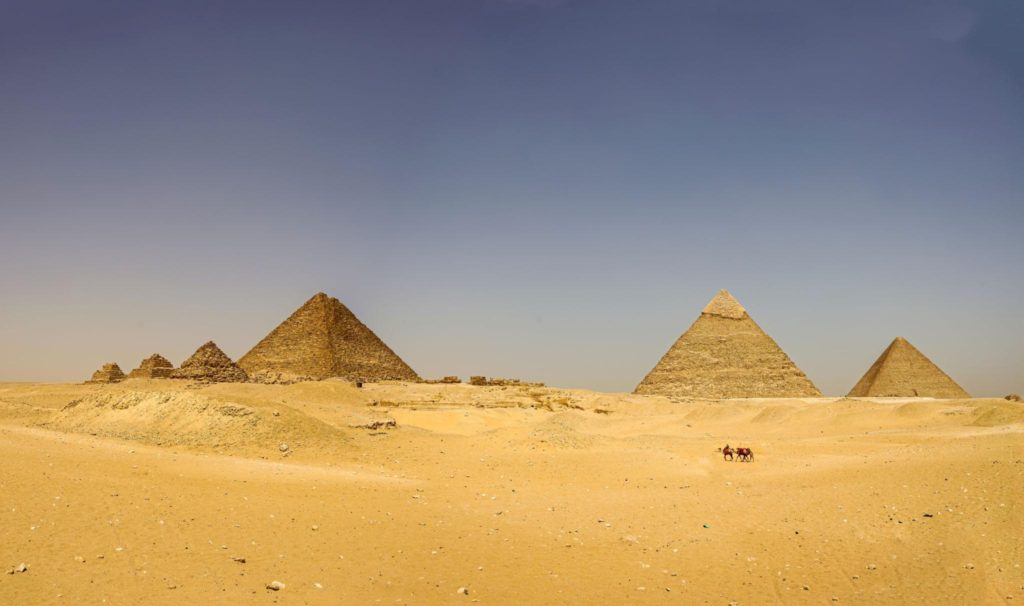
Builders specified a pyramid’s slope as a seked, the horizontal run in palms for each cubit of rise, and the Great Pyramid’s seked of five and a half palms gives its angle of about 51.8 degrees. The royal cubit, about 52.4 cm, was divided into 7 palms of 4 fingers each, and master cubit rods kept measurements consistent across huge sites.
The precision is real. The Great Pyramid’s base sides differ in length by only a few centimetres, and its sides are aligned to true north within about 4 arcminutes, a fifteenth of a degree. How they achieved it is debated: proposals include sighting on two stars circling the pole, or marking the sun’s shadow before and after noon. Theories that the proportions encode pi or the golden ratio are coincidences of the seked chosen, not evidence of secret knowledge. The construction itself is covered in how the pyramids were built.
Surveyors also re-marked field boundaries every year after the flood. Herodotus believed geometry was born from this, and the Greek name “geometry” literally means “measuring the earth”.
What did the Egyptians know about the stars?
Egyptian astronomy was observational and practical: priests tracked the stars to tell the time at night, set the calendar and align buildings, but did not build predictive models of the planets as the Babylonians did.
- Decans: 36 star groups, each rising at dawn for about ten days in turn. At night, a dozen of them rose in succession, which is why the night came to be divided into 12 hours. Combined with the 12 hours of day, this gave us the 24-hour day.
- Star clocks: Middle Kingdom coffin lids carry grids called diagonal star clocks, tables of which decan marked each hour on each ten-day week of the year.
- Instruments: a merkhet, a plumb line with a sighting bar, was used with a slotted palm rib to observe stars crossing the meridian. A stone water clock from Karnak, made under Amenhotep III, measured hours by water dripping from a hole at the base.
- Planets: five were known and named; Jupiter, Saturn and Mars were all forms of Horus, Mars being “Horus the red”.
- Sirius: its dawn rising marked the ideal New Year, as our guide to the Nile flood and the calendar explains.
Is the Dendera zodiac Egyptian?
Only partly: the 12 signs of the zodiac came to Egypt from Babylon via the Greeks, and they appear only in Ptolemaic and Roman temples, blended with Egyptian decans and gods. The famous round zodiac was carved on the ceiling of a rooftop chapel of Osiris at Dendera around 50 BC. In 1821 it was cut out and taken to Paris, and it is now in the Louvre; a cast fills its place.
Look closely at the cast and you can find a ram, a bull, a lion and a scorpion beside Egyptian figures such as Sirius as a reclining cow and the hippopotamus constellation that stood for stars near the pole. Scholars have matched its depiction of planets and eclipses to dates in the first century BC.
Dendera’s great hypostyle hall keeps a rectangular astronomical ceiling in place, and at Esna the temple ceiling also carries zodiac signs. Both have been cleaned in recent years, revealing strong original colour.
Where to see Egyptian maths and astronomy today
The best astronomy is on ceilings, so look up in temples and tombs; the maths is written into the monuments themselves.
- Dendera Temple: the astronomical ceiling of the hypostyle hall and the cast of the round zodiac on the roof.
- Esna Temple: a restored ceiling with zodiac signs, now visible in colour.
- Tomb of Ramesses VI: the burial chamber ceiling shows the sky goddess Nut twice, back to back, swallowing and giving birth to the sun in the Books of the Day and the Night.
- Ramesseum: an astronomical ceiling in the small hypostyle hall, with decans, constellations and a calendar of months.
- Giza: stand at a corner of the Great Pyramid and sight along its base to appreciate the alignment.
Egypt’s desert skies are still superb for seeing the stars the priests used; our guide to stargazing in Egypt suggests where to go.
Frequently asked questions
Did ancient Egyptians have a zero?
Not as a number. Their counting system had no place value, so they did not need a zero digit, although a sign meaning “nfr” was used in some accounts and building plans to mark a zero balance or a base level.
Where is the Rhind papyrus kept?
In the British Museum in London. It was bought in Luxor in 1858 by Alexander Henry Rhind and acquired by the museum in 1865. A few fragments are in the Brooklyn Museum.
Did the ancient Egyptians invent the 24-hour day?
Largely, yes. They divided the night into 12 hours marked by rising stars and the day into 12 hours measured by shadow clocks. The hours were not fixed lengths until Greek astronomers standardised them.
Is the original Dendera zodiac still in Egypt?
No. It was removed in 1821 and is displayed in the Louvre in Paris. A cast replaces it in the rooftop chapel at Dendera.
How accurate were Egyptian pyramid measurements?
Extremely. The Great Pyramid’s four sides differ in length by only a few centimetres over roughly 230 metres, and its alignment to true north is within about a fifteenth of a degree.