Quick answer
Women in ancient Egypt had more legal independence than in most ancient societies: they could own and inherit property, sign contracts, go to court, make wills and divorce. Most ran households and worked at weaving, baking and brewing, while a few became priestesses, powerful queens and even pharaohs, such as Hatshepsut. Their temples and tombs at Luxor and Abu Simbel are among Egypt's finest.
Did women have rights in ancient Egypt?
Yes: in law, an Egyptian woman could own, buy, sell and inherit property in her own name, make contracts, bring cases to court, act as a witness, free slaves, make a will and seek a divorce. Greek visitors such as Herodotus were struck by how differently Egyptian women behaved from women in Athens, who needed a male guardian for any legal act.
That did not make Egypt equal. Government, the army and most priesthoods were run by men, and a woman's status usually depended on her father or husband. But the legal records are real. The best-known example comes from Deir el-Medina around 1145 BC, where a widow named Naunakhte formally disinherited four of her eight children for failing to support her in old age, and the court upheld her will.
What was a woman's life like?
For most women, life centred on marriage, children and running a household, and the commonest title on their monuments is nebet per, “mistress of the house”. Girls married young, often in their early to mid teens, usually to older men. There was no religious wedding: setting up house together made a marriage, and later contracts set out what the wife brought and what she would receive if the marriage ended. Divorce was possible for either partner, and a divorced wife could keep her own property and often a share of what the couple had built up.
Childbirth was the greatest danger. Women gave birth squatting on decorated birth bricks, protected by the household gods Bes and Taweret, and medical papyri include recipes for contraception and pregnancy tests. Our guide to daily life in ancient Egypt describes the homes they ran.
What work did women do?
Women ground grain, baked bread, brewed beer, spun and wove linen, and sold surplus goods at market, and some held paid jobs outside the home. Tomb scenes show women selling vegetables and cloth, working in weaving workshops, and serving as musicians, dancers, professional mourners and wet nurses, a respected role in royal households.
In religion, women served as priestesses, especially of Hathor, and in the New Kingdom many women of good family held the title “chantress of Amun”, singing in temple rituals. A few Old Kingdom women held higher titles: a woman named Peseshet is recorded as an overseer of female physicians, although how many female doctors existed is debated. Literacy among women seems to have been rare, but letters show some could read and write.
Could a woman be pharaoh?
Yes, but rarely: kingship was a male role, so the few women who ruled in their own right usually came to power when the male line failed, and some were shown with the king's regalia, including the false beard.
| Ruler | When | Notes |
|---|---|---|
| Merneith | 1st Dynasty, c. 2950 BC | Probably regent for her son; her tomb at Abydos is as large as a king's |
| Sobekneferu | 12th Dynasty, c. 1800 BC | The first woman securely attested as king |
| Hatshepsut | 18th Dynasty, c. 1479–1458 BC | Ruled about 20 years; built Deir el-Bahari and sent an expedition to Punt |
| Nefertiti? | 18th Dynasty, c. 1335 BC | Possibly ruled after Akhenaten under another name; still debated |
| Twosret | 19th Dynasty, c. 1190 BC | Ruled briefly as king at the end of the dynasty |
| Cleopatra VII | 51–30 BC | Last ruler of Ptolemaic Egypt |
Hatshepsut is the most successful. Our Hatshepsut guide tells how she went from regent to king and why her images were later attacked.
Which queens held real power?
Several queens wielded great influence without becoming king, as regents, diplomats and religious leaders. Ahhotep and Ahmose-Nefertari helped found the New Kingdom around 1550 BC; Ahmose-Nefertari was later worshipped as a goddess and patron of the Theban tomb-builders. Queen Tiye, wife of Amenhotep III, appears in diplomatic letters from foreign kings, and Nefertari, chief wife of Ramesses II, wrote to the Hittite queen.
The most powerful religious office open to women was God's Wife of Amun, the god's earthly consort at Thebes. Under the Nubian and Saite kings of the 25th and 26th Dynasties, unmarried royal daughters such as Amenirdis I and Shepenwepet held it, controlling great estates and acting as the king's representative in the south. Their funerary chapels still stand at Medinet Habu.
How were women shown in Egyptian art?
As young, slender and pale-skinned, following strict conventions: women were usually painted in a lighter yellow tone than men's reddish brown, reflecting an ideal of indoor life rather than real skin colour. Wives are often shown smaller than their husbands, kneeling by his leg, to signal status rather than size. That makes exceptions telling: at Abu Simbel, Nefertari's statues are the same height as her husband's, and Akhenaten's queen Nefertiti is shown smiting enemies, a scene normally reserved for kings. The great goddesses, Isis, Hathor, Mut and Sekhmet, offered powerful female models of motherhood, love and fury.
Where to see the women of ancient Egypt today
Some of Egypt's most beautiful monuments were built for or by women.
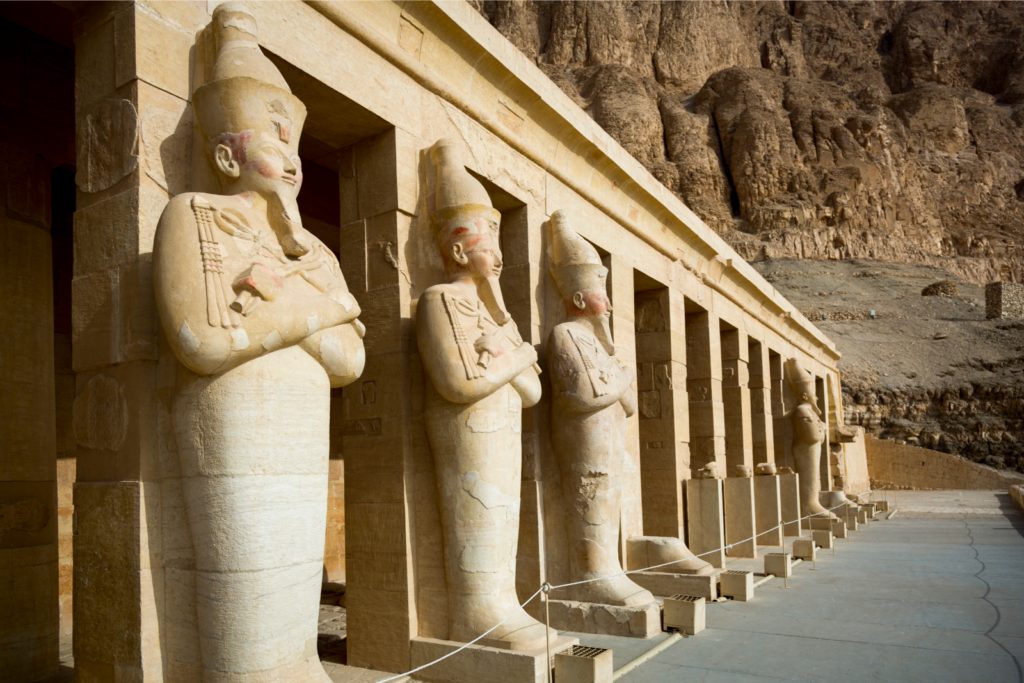
- The Temple of Hatshepsut, Luxor: her terraced mortuary temple, with reliefs of the Punt expedition and her divine birth.
- The Valley of the Queens, Luxor: the tomb of Nefertari (QV66), often called the most beautiful in Egypt; it needs a separate, premium ticket at the time of writing.
- The Temple of Nefertari, Abu Simbel: a rock temple shared by the queen and Hathor.
- Dendera: the Temple of Hathor, with Cleopatra VII and her son Caesarion carved on the rear wall.
- Medinet Habu: the chapels of the God's Wives of Amun.
- Deir el-Medina: the village where Naunakhte lived and made her will.
Tomb openings change, so check which are open, and current ticket prices, on egymonuments.gov.eg before you go.
Frequently asked questions
Were women equal to men in ancient Egypt?
Not socially or politically, but legally they had many of the same rights: they could own property, make contracts, inherit, go to court and divorce. That was unusual in the ancient world.
How many female pharaohs were there?
Only a handful ruled as king in their own right in some 3,000 years: Sobekneferu, Hatshepsut, Twosret and Cleopatra VII are certain, and Nefertiti may have ruled under another name.
Who was the most powerful woman in ancient Egypt?
Hatshepsut, who ruled as king for about 20 years around 1479–1458 BC. Cleopatra VII is the most famous, but ruled Egypt more than a thousand years later, as the last of the Ptolemies.
Could women divorce in ancient Egypt?
Yes. Either partner could end a marriage, and a wife generally kept her own property and could claim a share of joint property or compensation, as later marriage contracts show.
What jobs did women have in ancient Egypt?
Weaving, baking, brewing, trading at market, music and dance, mourning, wet-nursing and temple service as priestesses and chantresses. A few held official titles.