Quick answer
Ancient Egyptians built boats from papyrus reeds for the marshes and from planks of acacia and imported cedar for the river and sea, sewn and pegged together without nails. The Nile made sailing easy: the current carried boats north, and the prevailing north wind blew them south. The best preserved example is Khufu’s 43-metre cedar ship, about 4,500 years old, now displayed at the Grand Egyptian Museum.
Why were boats so important in ancient Egypt?
The Nile was Egypt’s only highway, so almost everything that moved, from granite obelisks to grain taxes, kings and gods, moved by boat. Almost every town lay within a few kilometres of the river, and there were no bridges across it in pharaonic times. Our guide to the Nile River explains its geography.
Nature made river travel unusually simple. The current flows north, so boats heading downstream drifted or were rowed; the prevailing wind blows from the north, so boats heading upstream raised a sail. The language reflected this: the hieroglyph meaning “to travel south” is a boat with its sail up, and “to travel north” is a boat with its sail down.
Boats also carried meaning. The sun god crossed the sky in a day boat and the underworld in a night boat, the dead hoped to sail to Abydos to join Osiris, and gods visited each other by river at festivals.
How were ancient Egyptian boats built?
Egyptian shipwrights built the hull first, from thick planks edge-joined with mortise-and-tenon joints and lashed together with rope through hidden channels, with no keel and no metal nails. When the planks were soaked, the wood swelled and the lashings tightened, making the hull watertight.
- Papyrus skiffs: bundles of reeds tied together, used for fishing and fowling in the marshes from prehistoric times; tomb paintings show nobles hunting birds from them.
- Wooden river boats: built from short planks of local acacia and sycamore fig, fitted together like a jigsaw.
- Cedar ships: long timbers had to be imported. The Palermo Stone, a royal annal, records 40 ships arriving laden with cedar under Sneferu around 2600 BC, from the region of Byblos in modern Lebanon.
- Cargo barges: huge flat barges carried obelisks from Aswan. A relief at the Temple of Hatshepsut shows two obelisks loaded end to end on a single barge towed by a fleet of rowing boats.
Because the hulls had no keel, long ships were braced with a hogging truss: a thick rope running from bow to stern over posts, tightened to stop the ends sagging.
What is the Khufu ship?
The Khufu ship is a full-size cedar vessel, 43.6 metres long, buried in pieces in a sealed pit beside the Great Pyramid around 2560 BC and found intact in 1954. The Egyptian archaeologist Kamal el-Mallakh discovered it while clearing the south side of the pyramid. It had been dismantled into 1,224 parts, laid in 13 layers, and the conservator Hag Ahmed Youssef Moustafa spent more than a decade working out how to rebuild it, using the carpenters’ marks still on the timbers.
It is often called a “solar boat”, built for the dead king to sail with the sun god. Some Egyptologists think it was instead a real funeral barge that carried Khufu’s body, or a ship he used in life, since there are signs of wear on the timbers. Either way, it is one of the oldest intact large ships in the world.
For nearly forty years it stood in a purpose-built museum beside the pyramid. In August 2021 it was moved in one piece on a remote-controlled vehicle to the Grand Egyptian Museum, where it is displayed in its own gallery. A second boat from a neighbouring pit has been lifted by a Japanese-Egyptian team and is being conserved and reassembled at the museum; check whether that work is on view when you visit.
Sacred barques: boats that never touched water
Every major god owned a portable boat, or barque, in which its statue travelled inside a cabin shrine, carried on poles on the shoulders of priests. In temple sanctuaries the barque rested on a stone pedestal, and at festivals it was carried out in procession or loaded onto a real river boat.
The greatest of these processions was the Opet Festival, when the barques of Amun, Mut and Khonsu travelled from Karnak Temple to Luxor Temple, by land along the Avenue of Sphinxes or by river, with crowds along the way. In the Beautiful Festival of the Valley, Amun crossed to the West Bank to visit the royal temples.
You can still see the infrastructure: barque shrines and way-stations at Karnak, Hatshepsut’s Red Chapel rebuilt in the Karnak Open Air Museum, and at Edfu a replica barque in front of the granite shrine in the sanctuary, which gives the clearest sense of how they looked.
Did Egyptians sail the sea?
Yes: Egyptian ships sailed the Mediterranean to Lebanon and the Red Sea to Punt, a land somewhere in the southern Red Sea region rich in incense, ebony and gold. The most famous voyage is Hatshepsut’s expedition to Punt around 1470 BC, carved on the middle terrace of her temple at Deir el-Bahari: five ships with furled sails and hogging trusses, villagers in houses on stilts, and myrrh trees being carried aboard in baskets.
Archaeology shows how it was done. At Mersa Gawasis on the Red Sea coast, excavations in the 2000s found Middle Kingdom harbour caves holding ship timbers, steering oars, coils of rope and cargo boxes, one labelled with the “wonders of Punt”. Ships were built in the Nile Valley from cedar, taken apart, carried across the Eastern Desert and reassembled on the coast. Further north, the harbour at Wadi al-Jarf produced the logbook of Merer, whose crew shipped limestone to Giza; our guide to how the pyramids were built tells that story.
Where to see ancient Egyptian boats today
Start at the Grand Egyptian Museum for Khufu’s ship, then look for models in museums and real descendants on the river.
- Grand Egyptian Museum, Giza: the Khufu ship, plus model boats from Tutankhamun’s tomb, which held some 35 of them.
- Egyptian Museum, Tahrir: wooden models from the Middle Kingdom tomb of Meketre, found in 1920 and shared with New York’s Metropolitan Museum, show crews rowing, sailing and cooking aboard.
- Abydos: in 1991 a US team found 14 wooden boats, around 20 metres long and some 5,000 years old, buried in mud-brick graves near the enclosure of King Khasekhemwy. They are not on public display, but the temple of Abydos has superb reliefs of sacred barques.
- Temple of Hatshepsut: the Punt ships and the obelisk barge.
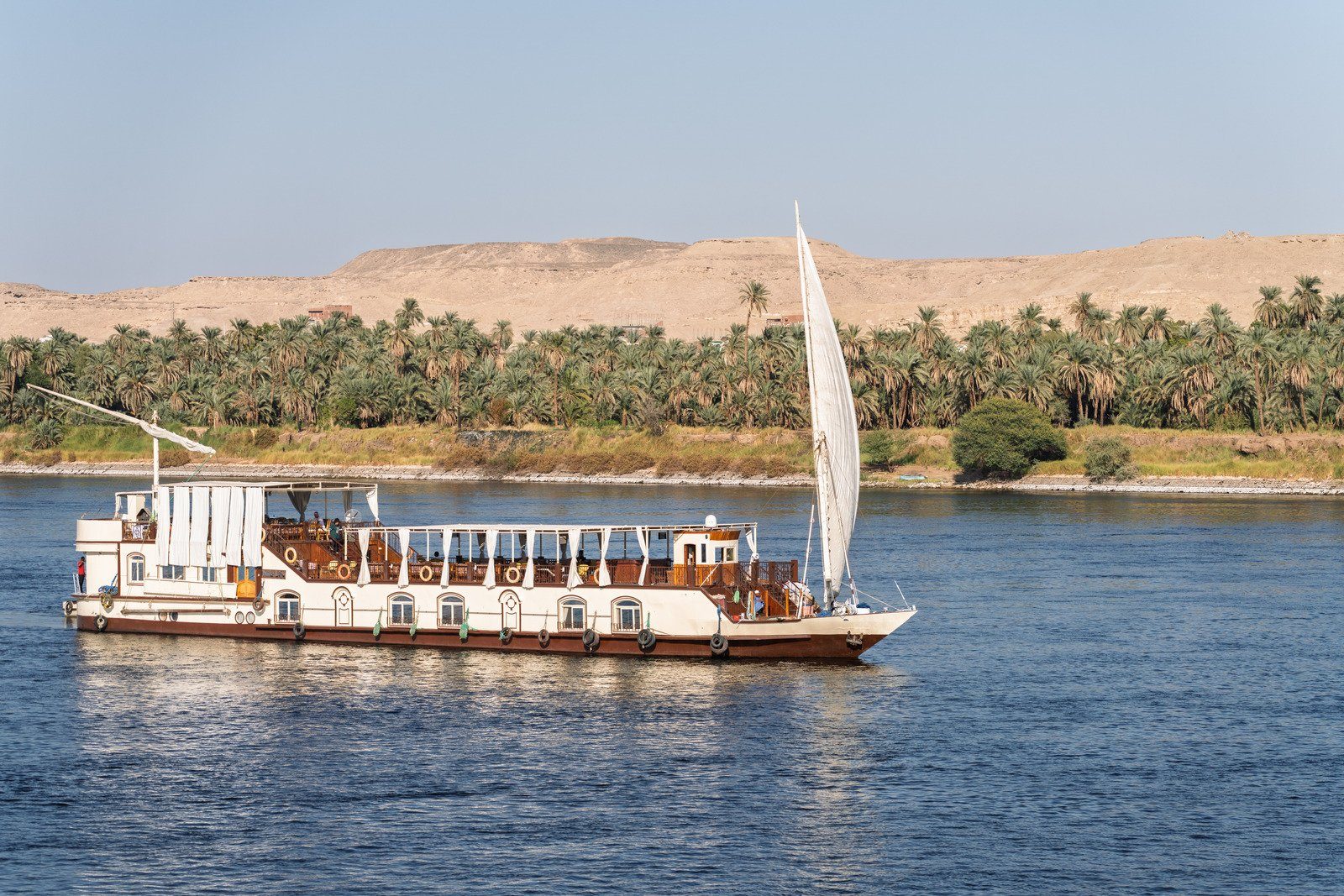
- On the Nile itself: the lateen sail of a felucca is a later, Arab-era design, but the principle of drifting north and sailing south is unchanged. Our felucca ride and dahabiya guides explain how to do it.
Frequently asked questions
How old is Khufu’s boat?
About 4,500 years. It was buried beside the Great Pyramid around 2560 BC, at the end of Khufu’s reign or just after his death, and was found in 1954.
Where is the Khufu solar boat now?
In the Grand Egyptian Museum near Giza. It was moved from its old museum beside the Great Pyramid in August 2021 and is displayed in a dedicated gallery.
What wood did ancient Egyptians use for boats?
Mainly local acacia and sycamore fig for river craft, and cedar imported from Lebanon for large ships, because Egypt lacked tall trees. Papyrus reeds were used for small skiffs.
Did ancient Egyptian boats have sails?
Yes, from at least about 3300 BC, when sails appear on painted pottery. Early sails were tall and narrow; later ones were wide and square, set on a single mast that could be lowered when drifting downstream.
What was a sacred barque?
A ceremonial boat holding a god’s statue in a shrine, carried by priests on poles during festivals. Sanctuaries at Karnak, Luxor and Edfu were built around the stone pedestal where the barque rested.