Quick answer
Ma'at was both a goddess and the central idea of Egyptian civilisation: truth, justice and the right order of the universe, the opposite of chaos (isfet). Shown as a woman with an ostrich feather on her head, she was weighed against the heart of the dead in the Hall of Judgement, and every pharaoh's duty was to uphold her. You see her in almost every temple and royal tomb.
Was Ma'at a goddess or an idea?
Both: Ma'at was the abstract principle of order, truth and justice, and the goddess who personified it. The word covers what English splits into several concepts. Ma'at is the regular rising of the sun and the annual flood, a fair judgement in court, honest weights in the market and a son caring for his parents. Its opposite, isfet, is disorder in all its forms, from rebellion to lying.
As a goddess Ma'at is the daughter of the sun god Ra, who is said to "live on Ma'at", and she stands at the prow of his boat. She is often linked with Thoth, god of writing and wisdom, as his female counterpart. Unlike Amun or Ptah she had few temples of her own; she did not need them, because every temple ritual was ultimately about maintaining her.
What did Ma'at mean for the pharaoh?
The king's fundamental job was to "set Ma'at in place of isfet": to keep the cosmos, the country and the courts in order on behalf of the gods. Temple walls show it literally. In a scene repeated thousands of times, the king offers the gods a small figure of a seated Ma'at with her feather, an offering that summed up every other gift: he was handing back the order the gods had created.
Kings wove her into their names. Hatshepsut's throne name was Maatkare, Amenhotep III's Nebmaatre and Ramesses II's Usermaatre. Officials claimed in their tomb autobiographies to have "spoken Ma'at and done Ma'at", fed the hungry and given a boat to the boatless. The Middle Kingdom story of the Eloquent Peasant, in which a robbed farmer lectures a high official on justice, shows how seriously the ideal was taken, at least in literature. Practice, naturally, did not always match.
What happened at the weighing of the heart?
In the Egyptian judgement of the dead, the deceased's heart was placed on a scale against Ma'at, shown as her feather or as a small figure of the goddess, and only a balanced scale let the person pass into eternal life. The scene comes from chapter 125 of the Book of the Dead, a New Kingdom collection of spells, and is illustrated on many papyri, including the papyri of Ani and Hunefer in the British Museum.
- The dead person is led into the Hall of the Two Truths (the Two Ma'ats), often by Anubis.
- Before Osiris and a panel of 42 judges, they recite a list of sins they did not commit.
- Anubis checks the scale; Thoth records the result.
- Beside the scale crouches Ammit, the Devourer, with a crocodile's head, lion's forequarters and hippopotamus hindquarters, waiting to eat a heart that fails.
- The justified are presented to Osiris by Horus and declared "true of voice".
Details vary between papyri: sometimes Horus works the scale, sometimes Ma'at herself sits on it, and the order of events is not fixed. Notably, no surviving papyrus shows Ammit eating anyone: the outcome was assured by the spell itself, and many burials included a heart scarab inscribed with a spell asking the heart not to testify against its owner. For the wider picture see the ancient Egyptian afterlife.
Are the '42 laws of Ma'at' ancient?
The 42 declarations are ancient, but the "42 laws" or "42 ideals of Ma'at" circulating online are a modern rewording, not an Egyptian law code. In chapter 125 the dead person addresses each of the 42 judges by name (one for each province of Egypt, it is usually said) and denies a specific wrong: "I have not stolen", "I have not killed", "I have not reduced the measure of grain", "I have not polluted the water", "I have not been arrogant". Egyptologists call this the Negative Confession or Declaration of Innocence.
Some modern spiritual and Kemetic groups have turned these denials into positive commandments ("I honour…", "I live in truth"). That is a legitimate modern practice, but the phrasing is theirs. The ancient list was a ritual statement made at death, varies between manuscripts and mixes moral wrongs with ritual ones such as damaging temple offerings.
The list is also revealing about what Egyptians valued. Alongside murder and theft it condemns eavesdropping, losing one's temper, making someone weep, blocking an irrigation channel and turning away the Nile flood in its season: a farming society's idea of a good life, in which wrongs against neighbours and against the shared water supply mattered as much as crimes against the gods.
How is Ma'at shown in art?
Ma'at is a woman wearing a tall ostrich feather in a headband, usually seated or kneeling, sometimes with outstretched wings. The feather alone stands for her in hieroglyphs and on the scale of judgement. The plinth on which gods stand is often shaped like the hieroglyph for her name, a sign that the god stands on order itself. Judges were described as priests of Ma'at, and Greek writers claimed the chief judge wore a small image of truth on a chain, though that detail comes from late classical authors.
Where to see Ma'at in Egypt today
Ma'at is everywhere in Egyptian monuments once you know the feather, but a few places put her centre stage.
- Deir el-Medina: the small Ptolemaic temple above the workmen's village was dedicated to Hathor and Ma'at, and one of its chapels holds a well-preserved judgement-of-the-dead scene, a rare chance to see the weighing of the heart on a temple wall.
- Tomb of Nefertari, Valley of the Queens: a kneeling Ma'at spreads her coloured wings protectively in this finest of painted tombs (separate ticket, when open).
- Abydos Temple: Seti I offers the Ma'at figure to the gods in some of the most delicate reliefs in Egypt.
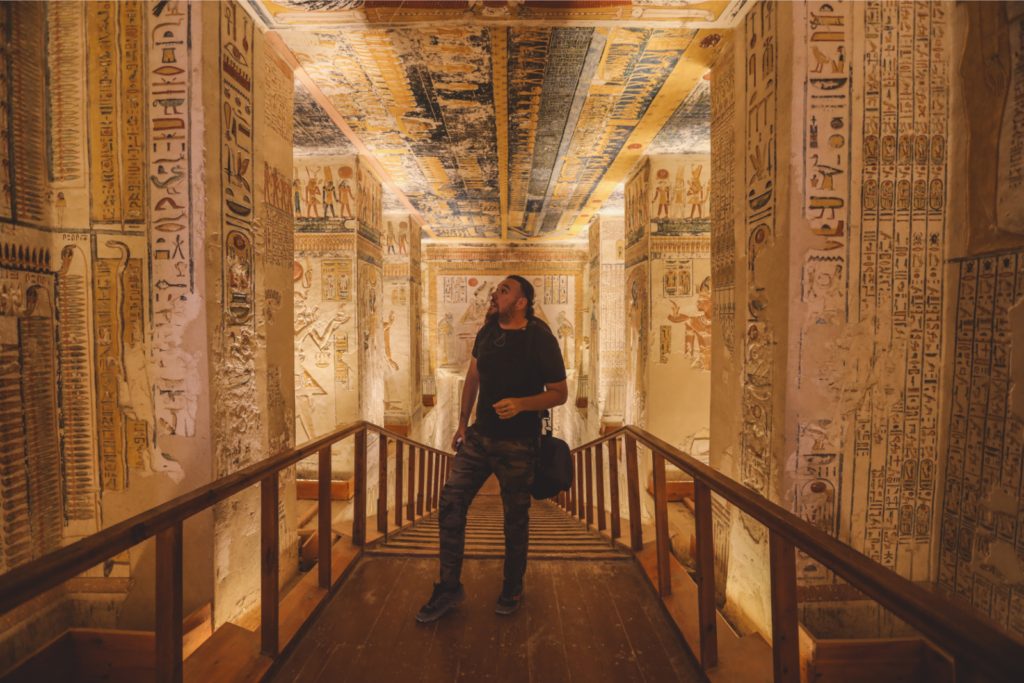
- Valley of the Kings: winged Ma'at figures guard the entrances of several Ramesside tombs.
Frequently asked questions
What is Ma'at the goddess of?
Ma'at was the goddess of truth, justice, balance and cosmic order. Her name is also the Egyptian word for those ideas, which every pharaoh was expected to uphold.
What does the feather of Ma'at mean?
The ostrich feather is her emblem and stands for truth. In the judgement of the dead, the heart was weighed against the feather; a heart in balance with it showed a life lived in accordance with Ma'at.
What happened if your heart was heavier than the feather?
Texts say it would be eaten by Ammit, the Devourer, ending the person's existence. However, no surviving papyrus shows this happening; the spells were designed to guarantee a good outcome.
What is the opposite of Ma'at?
Isfet, meaning chaos, injustice and falsehood. Egyptian kingship and temple ritual were framed as a constant effort to keep isfet at bay.
Did Ma'at have temples?
A few. There was a small temple of Ma'at within the Montu precinct at Karnak, and she shares the Ptolemaic temple at Deir el-Medina with Hathor, but mostly she was honoured within other gods' temples.