Quick answer
Non-Muslim visitors are welcome in many of Egypt's historic mosques, including the Mosque of Muhammad Ali at the Citadel, Sultan Hassan and Al-Rifai, Ibn Tulun and Al-Azhar in Cairo. Visit outside prayer times and avoid Friday midday, cover arms and legs, women should cover their hair, remove your shoes at the door, and keep your voice low inside.
Can non-Muslims visit mosques in Egypt?
Yes: most of Egypt's great historic mosques welcome respectful non-Muslim visitors outside prayer times, and many are among the finest buildings in the country. Cairo alone has hundreds of historic mosques spanning more than a thousand years, which is why its medieval centre is a UNESCO World Heritage Site as Historic Cairo.
The rules are simple and familiar to anyone who has visited a church or temple abroad: dress modestly, take off your shoes, keep quiet and stay out of the way of people praying. A few mosques that are mainly shrines, such as the Mosque of Al-Hussein beside Khan el-Khalili, may not admit non-Muslims to the prayer hall or the shrine itself; your guide will know the current practice. Smaller neighbourhood mosques are working places of worship, so ask before entering.
For Muslim travellers, Egypt's mosques are of course open for prayer; see our guide for Muslim travellers for Friday prayers, Ramadan and Islamic heritage itineraries.
What makes Egypt's mosques different from one another?
Each great Cairo mosque reflects the dynasty that built it, so visiting three or four in a day is a quick lesson in more than a thousand years of Islamic architecture. Knowing what to look for makes the visits far more rewarding.
- Courtyard (sahn) mosques: the early plan, seen at Ibn Tulun and Al-Azhar, with an open courtyard surrounded by arcades and a deep prayer hall on the side facing Mecca.
- Iwan mosques: the Mamluk style of Sultan Hassan, with four vaulted halls (iwans) opening onto a central court, each once used to teach a different school of Islamic law.
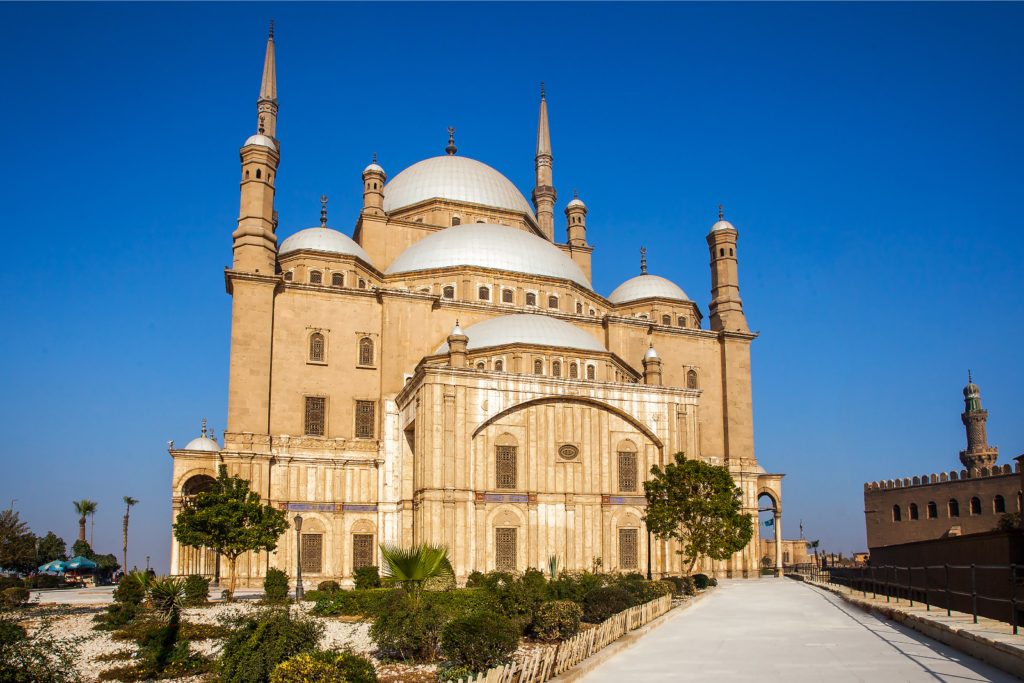
- Ottoman domed mosques: Muhammad Ali's mosque follows the great domed mosques of Istanbul, with a central dome, half-domes and slender minarets.
Inside, look for the mihrab (the niche showing the direction of prayer), the minbar (the stepped pulpit used for the Friday sermon), carved stucco, coloured marble and lamps, and the inscriptions in Arabic calligraphy that run around the walls.
Which mosques in Egypt are worth visiting?
The essential mosques are the Mosque of Muhammad Ali at the Citadel, Sultan Hassan and Al-Rifai, Ibn Tulun and Al-Azhar, all in Cairo; each represents a different era of Islamic architecture.
- Mosque of Muhammad Ali (Citadel): the Ottoman-style "Alabaster Mosque", built from the 1830s to the 1840s, with its great dome and pencil minarets dominating Cairo's skyline. Included in the Citadel ticket. See our Citadel guide.
- Sultan Hassan and Al-Rifai: facing each other below the Citadel. Sultan Hassan (1356–1363) is the masterpiece of Mamluk architecture, with a vast courtyard and soaring iwans. Al-Rifai, completed in 1912, holds the tombs of Egypt's royal family, including King Farouk, and of the last Shah of Iran. See our Sultan Hassan guide.
- Mosque of Ibn Tulun: completed in 879, the oldest mosque in Cairo surviving in close to its original form, with an enormous courtyard and a unique spiral minaret you can usually climb. See our Ibn Tulun guide.
- Al-Azhar Mosque: founded by the Fatimids in 970 and one of the oldest centres of learning in the world, opposite Khan el-Khalili. See our Al-Azhar guide.
- Mosque of Amr ibn al-As: in Old Cairo near the Coptic quarter, founded in the 640s as the first mosque in Egypt, though rebuilt many times since.
Outside Cairo, the small Mosque of Abu al-Haggag, built on top of Luxor Temple and still in use, is a striking reminder of how sacred places layer over time, and the Mosque of Abu al-Abbas al-Mursi in Alexandria is a landmark of the corniche. For the story behind these buildings, read our history of Islamic Cairo.
What should you wear to visit a mosque?
Everyone should wear loose clothing covering shoulders, arms and legs; women should also cover their hair with a scarf. If you are dressed for sightseeing in Egypt, you are most of the way there.
- Women: long sleeves or a light cardigan, an ankle-length skirt or loose trousers, and a scarf large enough to cover the hair. Avoid tight or sheer clothing.
- Men: long trousers and a T-shirt or shirt with sleeves. Shorts are not appropriate inside.
- Cover-ups: some of the most visited mosques lend robes or scarves at the entrance to visitors who need them, but do not rely on it; carry a scarf in your day bag.
- Shoes: you remove them at the entrance. Slip-on shoes save time, and socks help on hot stone courtyards in summer. Either leave shoes with the attendant or carry them in a bag, soles together.
Our guide to what to wear in Egypt covers clothing for the rest of your trip.
How do prayer times affect your visit?
Plan mosque visits between prayer times, and avoid Friday midday entirely, when the main congregational prayer fills the mosques and they are closed to sightseers. Muslims pray five times a day: at dawn (fajr), around midday (dhuhr), mid-afternoon (asr), sunset (maghrib) and nightfall (isha).
The times follow the sun, so they move through the year; in Cairo the midday prayer falls a little before or around 12pm in winter and around 1pm in summer when daylight saving applies. Prayer apps and websites list exact daily times. You will hear the call to prayer (adhan) from the minarets about 10–20 minutes before prayers begin, and visitors are usually asked to wait or leave for the duration, typically 20–30 minutes.
- Best times: mid-morning, between the dawn and midday prayers, and the early afternoon gap between dhuhr and asr.
- Fridays: visit in the afternoon after the midday prayer is over, or choose another day.
- Ramadan: mosques are busier, especially in the evenings with the special tarawih prayers. Daytime visits are generally fine; see travelling during Ramadan.
How should you behave inside a mosque?
Keep your voice low, do not walk in front of anyone praying, avoid touching the Qur'an or religious objects, and ask before photographing people. These small courtesies are appreciated, and caretakers are usually friendly to visitors who follow them.
- Walking: pass behind, not in front of, people praying. Stay in the parts of the prayer hall that are open to visitors.
- Women's areas: some mosques have separate areas for women; follow the caretaker's direction.
- Photography: generally allowed of the architecture, but never photograph people at prayer and switch your phone to silent.
- Behaviour: no eating, no public displays of affection, and children should be kept close and quiet.
- Sitting: it is fine to sit on the carpet to rest or admire the space, but avoid pointing the soles of your feet towards the qibla wall, the wall facing Mecca.
- Tips: a small tip for the shoe attendant, or for a caretaker who opens a minaret or a locked room, is customary. See tipping in Egypt.
Do you need tickets, and how do you plan a mosque day?
Some mosques are managed as ticketed monuments, including the Citadel and the Sultan Hassan and Al-Rifai complex, while working mosques such as Al-Azhar are free to enter; check current arrangements on egymonuments.gov.eg. Ticketing and opening hours change, so confirm before you go.
Islamic Cairo's mosques sit close together, so a well-planned day covers several. A good route starts at the Citadel in the morning for the Mosque of Muhammad Ali, walks down to Sultan Hassan and Al-Rifai, continues 10–15 minutes by car or on foot to Ibn Tulun and the Gayer-Anderson Museum next door, and finishes in the late afternoon at Al-Azhar and Khan el-Khalili. Plan your stops around the midday and afternoon prayers, and stop for lunch during one of them.
A guide who knows the caretakers makes a big difference: they can explain the architecture, tell you when prayers are about to start and often get minarets or locked rooms opened. Our Cairo and Pyramids stopover includes the Citadel and Islamic Cairo.
Frequently asked questions
Can women visit mosques in Egypt?
Yes. Women are welcome in the main historic mosques. Wear loose clothing covering arms and legs, and cover your hair with a scarf. Some mosques have a separate women's area.
Do I need to cover my hair in a mosque in Egypt?
Women should cover their hair inside mosques. Men do not need to cover their heads but should wear long trousers and shirts covering the shoulders.
When should I avoid visiting mosques in Cairo?
Avoid Friday midday and the 20–30 minutes around each of the five daily prayers. Mid-morning and early afternoon are usually best.
Can I take photos inside mosques in Egypt?
Usually, yes, of the architecture. Do not photograph people praying, and ask before photographing anyone.
Which is the most beautiful mosque in Cairo?
It is a matter of taste: Sultan Hassan is often considered the finest Mamluk building, Ibn Tulun is the most serene, and Muhammad Ali has the most famous skyline.