Quick answer
Egypt's dry desert air gives some of the clearest night skies within easy reach of a tourist itinerary. The darkest spots are the White Desert, Siwa's Great Sand Sea, the mountains of South Sinai, the coast near Marsa Alam and the deck of a Lake Nasser cruise. Plan your night within a few days of the new moon; the Milky Way's bright core is best from about April to August, while winter brings Orion and Sirius.
Why is Egypt good for stargazing?
Most of Egypt is desert with very low humidity and little cloud, and once you leave the Nile Valley's towns, there is almost no artificial light. Over 90 per cent of the population lives along the Nile and the Delta, so a drive of an hour or two into the desert takes you to genuinely dark skies.
The ancient Egyptians watched the same sky closely. The annual return of Sirius, which they called Sopdet, to the dawn sky in summer marked the coming of the Nile flood and the start of their year. You can see their star maps on the astronomical ceiling of the tomb of Ramesses VI and in the zodiac and sky goddess Nut at Dendera Temple. Our guide to Egyptian mathematics and astronomy explains how they used them.
Where are the best dark-sky spots?
The best places to see a truly dark sky are the White Desert, Siwa's Great Sand Sea, the high mountains of South Sinai, the Red Sea coast south of Marsa Alam, and Lake Nasser.
- White Desert: camp among the chalk formations, which glow faintly in starlight, far from any town. The most popular stargazing night in Egypt; see desert camping.
- Siwa and the Great Sand Sea: the dunes block the oasis lights, and the remoteness of Siwa means very little sky glow.
- South Sinai: camps around St Catherine sit above 1,500 metres in dry mountain air, and the pre-dawn climb of Mount Sinai is a stargazing walk in itself.
- Marsa Alam and Wadi el-Gemal: eco-lodges along the quiet southern Red Sea coast have minimal lighting and clear sea horizons.
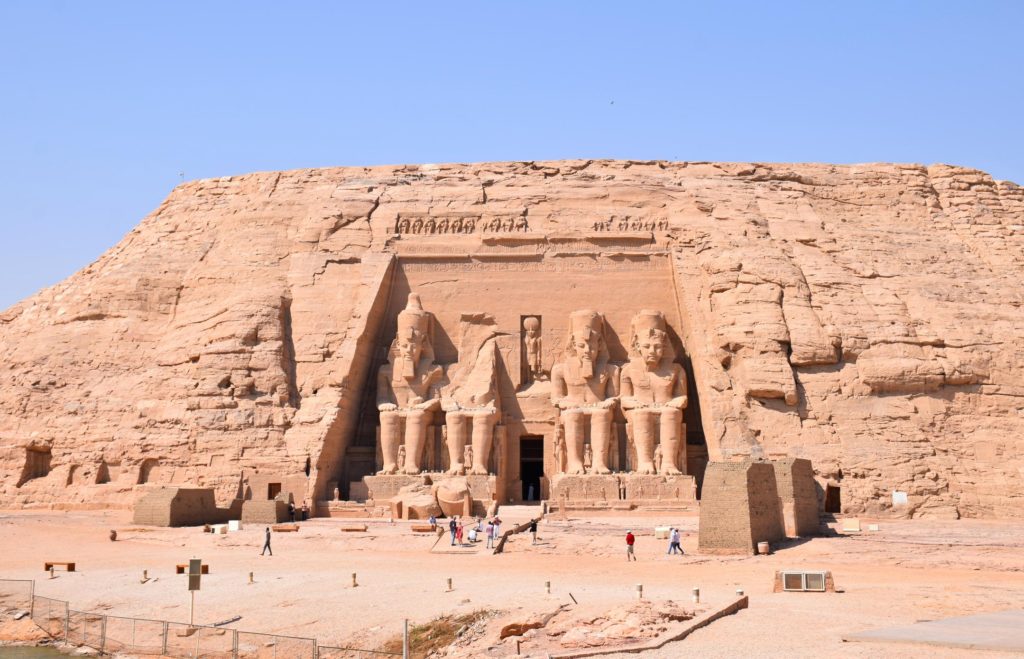
- Lake Nasser: cruise ships moor at night far from any settlement, and the top deck becomes an observatory. Abu Simbel, at about 22°N, is the southernmost point most visitors reach.
- Fayoum: Wadi el-Hitan and Wadi el-Rayan, two to three hours from Cairo, are the closest decent dark sky to the capital.
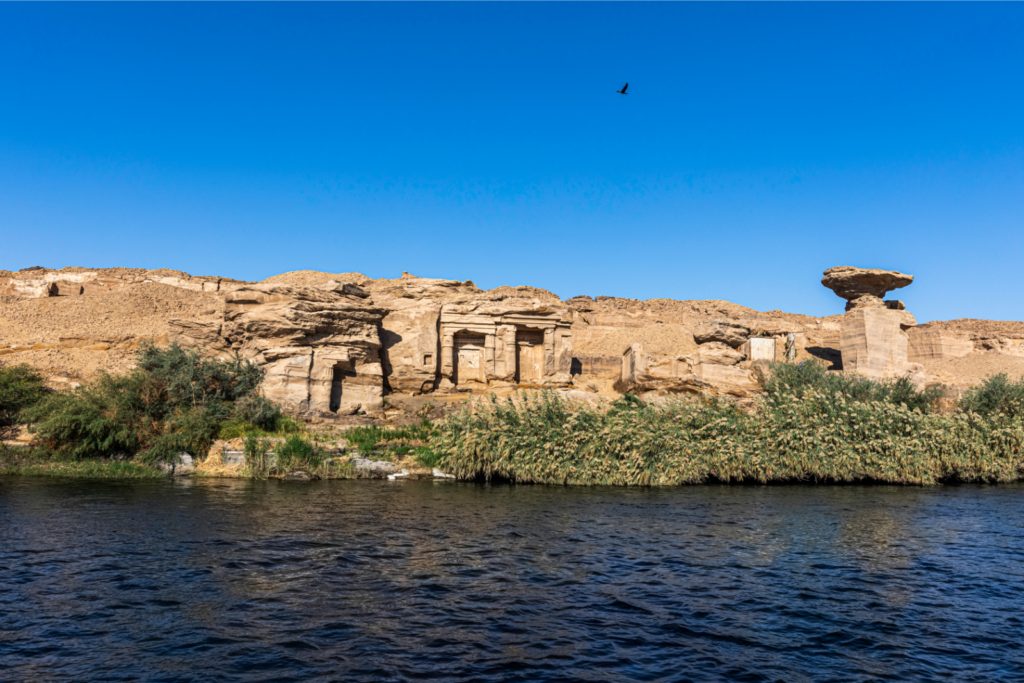
Cairo, Luxor, Hurghada and Sharm el-Sheikh are too bright for good stargazing, though a dahabiya moored at an island between Esna and Aswan can give a pleasant sky.
When is the best time to see the Milky Way in Egypt?
The bright central core of the Milky Way, in Sagittarius and Scorpius, is best seen from Egypt between about April and August; in the October to March travel season it is only visible low in the evening early or late in the season, or before dawn in spring. That is a real trade-off, because summer nights in the desert are warm but the days are fiercely hot.
- October and early November: the core is visible low in the south-west soon after dark, setting by mid-evening.
- December to February: the core is below the horizon at night, but the fainter winter Milky Way runs through Orion, Gemini and Auriga, with Sirius blazing beside it.
- March and April: the core rises in the early morning hours; get up around 3–4am.
- May to August: the core is high for much of the night. Camp in Siwa or Sinai's mountains, where nights are milder than the days.
Whatever the month, the moon matters more. Book your desert night within about five days either side of the new moon. See best time to visit Egypt for weather by month.
What can you see with the naked eye?
On a dark night in the Egyptian desert you can see thousands of stars, the Milky Way as a clear band, bright planets, satellites crossing every few minutes and, on the right dates, meteor showers. Give your eyes 20–30 minutes away from torches and phone screens to adapt fully.
- Meteor showers: the Leonids peak around mid-November, the Geminids, usually the strongest of the year, around 13–14 December, and the Quadrantids in early January, all in the desert camping season. The Perseids peak around 12–13 August, when only Sinai's mountains or Siwa nights are comfortable. Moonlight in a given year can spoil a peak, so check the moon phase.
- Planets: Venus, Jupiter and Saturn are often visible as bright, steady points; which ones are up depends on the year.
- The International Space Station: a bright moving light that crosses the sky in a few minutes; free apps show pass times for your location.
- Star clusters: the Pleiades in winter and the Beehive in spring are easy with binoculars, which are worth packing.
Some desert camps and Red Sea operators bring a small telescope to show Saturn's rings or the Moon's craters. Ask in advance if that matters to you.
What will Australians and New Zealanders notice in Egypt's sky?
The sky looks upside down compared with home: Orion stands the other way up, the Plough (Big Dipper) and the Pole Star appear in the north, and the Southern Cross is either invisible or a few degrees above the southern horizon.
From Cairo, at about 30°N, the Southern Cross never rises properly. From Aswan, Abu Simbel and Marsa Alam, between roughly 22 and 25°N, it can just clear the southern horizon on spring nights, around March to May, if the horizon is flat and clear, such as from a Lake Nasser deck. Canopus, the second-brightest star and a familiar sight from Australia, is visible low in the south during winter across much of Egypt.
Look also for the zodiacal light, a faint cone of light above the western horizon after dusk in spring, which is often visible from the deep desert.
How do you photograph the stars in Egypt?
Bring a camera that allows manual settings, a wide fast lens, a sturdy tripod and a red head torch, and shoot in the open desert, not at ticketed monuments. A starting point for the Milky Way is a 14–24 mm lens at f/2.8 or wider, ISO 3,200 and 15–20 seconds. Phones with night modes can capture surprisingly good shots of the White Desert formations under the stars.
- Drones: banned for tourists and liable to confiscation at the airport. See photography and drone rules.
- Tripods at monuments: archaeological sites usually require a special permit for tripods and close at sunset, so night photography of temples is generally not possible except during sound and light shows.
- Light painting: keep it to a minimum when other groups are camped nearby; a red light preserves everyone's night vision.
- Cold: batteries drain quickly on winter nights; keep spares in an inside pocket.
How can you build a stargazing night into a trip?
The easiest way is an overnight White Desert camp from Cairo, timed for a moonless night; a Lake Nasser cruise or a stay in Siwa or Marsa Alam are gentler alternatives with a bed.
- Short on time: two days and one night in the White Desert from Cairo.
- Want comfort: a Lake Nasser cruise between Aswan and Abu Simbel, with dark decks every night.
- Combining with the beach: an eco-lodge near Marsa Alam, with snorkelling by day.
- Serious astrophotographers: Siwa or Sinai between April and June, accepting hot days in exchange for the Milky Way core.
Our longer itineraries can include a desert night, and we can align the dates of any private trip with the moon calendar.
Frequently asked questions
Can you see the Milky Way in Egypt?
Yes, clearly, from the desert on moonless nights. The bright core is best from about April to August; in winter you see the fainter outer Milky Way through Orion and Gemini.
Can you see the Southern Cross from Egypt?
Only from the far south, around Aswan, Abu Simbel and Marsa Alam, where it can just clear the southern horizon on spring nights. From Cairo it does not rise.
Where is the best stargazing in Egypt?
The White Desert is the most popular and very dark. Siwa's Great Sand Sea, the mountains of South Sinai and Lake Nasser are also excellent.
Can I fly a drone to photograph the desert at night?
No. Drones are banned for tourists in Egypt and are routinely confiscated on arrival. Use a tripod instead.
Is the full moon bad for a desert trip?
For stargazing, yes, as it washes out all but the brightest stars. But a full moon over the White Desert formations is beautiful in its own way, and you can see without a torch.