Quick answer
On a dahabiya you share a two-masted wooden-style sailing boat with roughly 8 to 24 guests and a crew of about 10 to 15 for 4 or 5 nights, usually between Esna and Aswan. Expect compact en-suite cabins, meals cooked for the group and served on deck, sailing when the wind allows with a tug when it does not, quiet island moorings at night, and visits to small sites such as El Kab and Gebel el-Silsila as well as Edfu and Kom Ombo. There is usually no pool, no lift and little Wi-Fi.
What is life on a dahabiya really like?
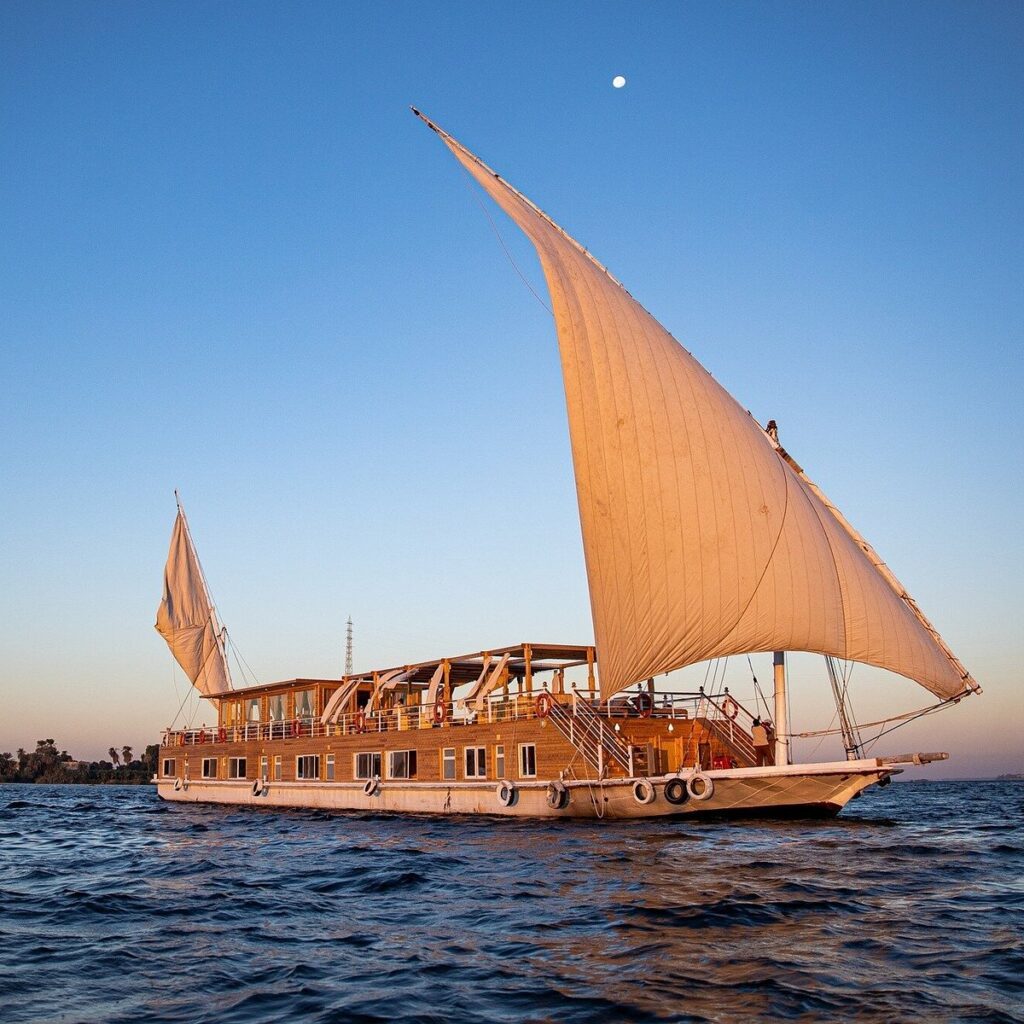
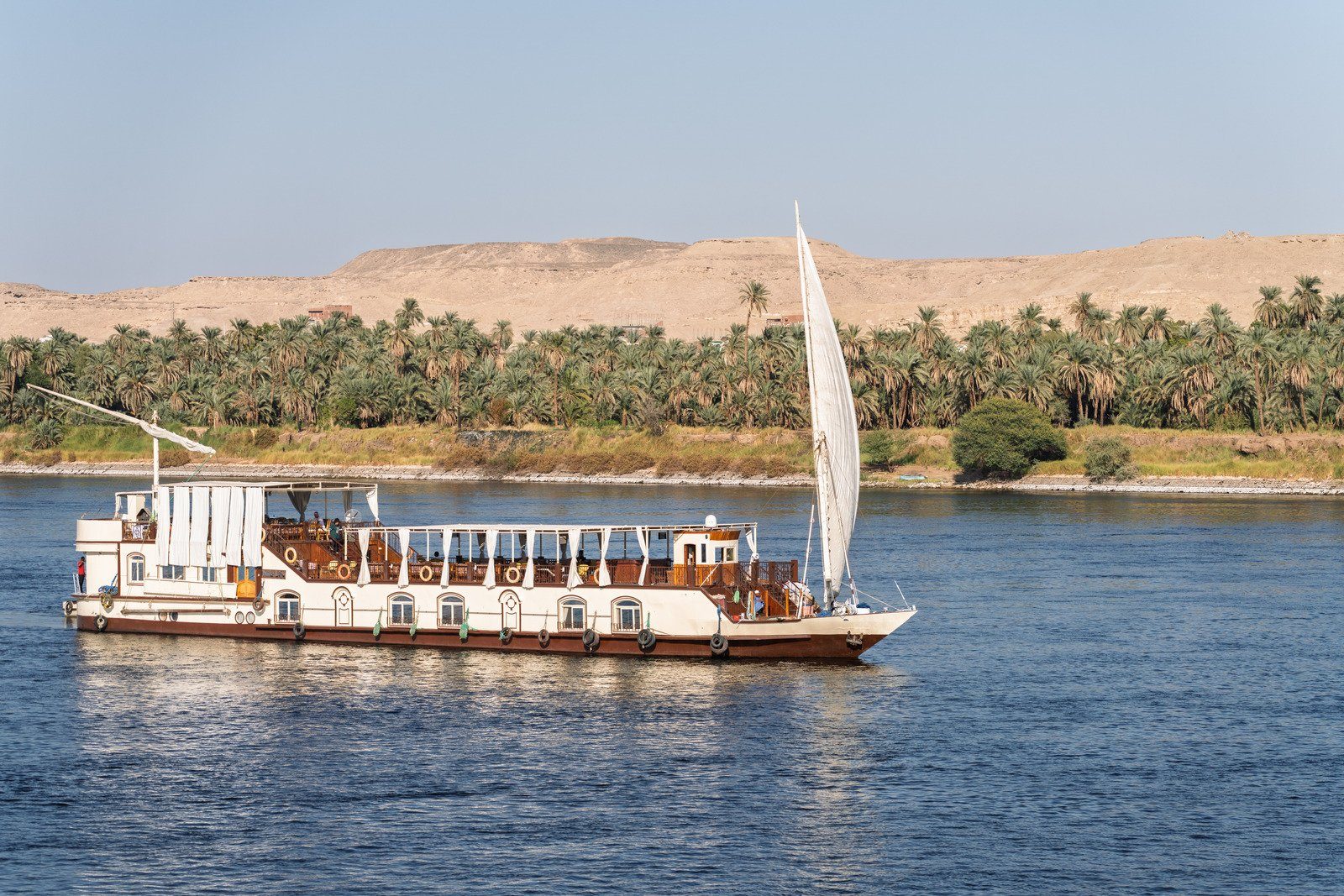
Life on a dahabiya feels like a slow house party on the river: a small group, a crew who quickly know your name and coffee order, long days on an open deck, and evenings moored somewhere quiet with no other boats in sight.
Whether a dahabiya is right for you, compared with a cruise ship, is covered in Nile cruise vs dahabiya. This page is for travellers who are leaning towards one, or have booked, and want to know how it actually works day to day: what the cabin is like, what happens when there is no wind, what you eat, and what you will not find on board.
The pace is the point. Dahabiyas cover the roughly 160 km from Esna to Aswan in four or five nights, when a cruise ship would do the whole Luxor to Aswan route in three or four. The extra time goes on sailing, unhurried temple visits and stops that only a small boat can make.
What happens on boarding day at Esna?
Most dahabiya trips begin at Esna, about an hour's drive south of Luxor, with boarding around midday, a welcome drink, lunch and a visit to Esna Temple before the first sail or mooring.
You are usually driven from your Luxor hotel, often after a morning of sightseeing on the West Bank. At the landing the crew carry bags on board; there are no porters' trolleys or lifts, so soft bags help. After a briefing from the captain and guide, many boats visit the Temple of Khnum, whose restored ceilings are some of the most colourful in Egypt, then cast off in the afternoon. Starting at Esna avoids the busy stretch of river below the Esna lock, which is why most boats begin there. Our Dahabiya Nile Sailing journey follows exactly this pattern.
What are dahabiya cabins and bathrooms like?
Dahabiya cabins are compact but comfortable, with proper beds, air-conditioning on most boats, an en-suite shower and toilet, and large windows or doors onto the side deck; one or two larger suites usually sit at the stern.
- Size: smaller than a cruise-ship cabin, with limited storage. Unpack into the drawers and stow the bag under the bed.
- Beds: twin or double, sometimes convertible. Ask when you book.
- Bathrooms: showers rather than baths; hot water is normal. Water pressure can vary.
- Windows: on many boats cabins open onto a narrow walkway, so draw the curtains when moored near a village or when the crew are working.
- Suites: at the stern, with windows on two or three sides; worth booking early for honeymoons and special occasions.
Power comes from the boat's generator, so bring a multi-port charger; our Nile cruise packing list has a dahabiya section.
Does a dahabiya really sail?
Yes, when the wind allows: the crew raise the two great lateen sails and the boat glides almost silently upstream or down, but on calm days a tug or the boat's own motor keeps it on schedule.
The prevailing wind on the Nile blows from the north, which historically let boats sail south against the current and drift north with it. In practice the wind is unpredictable, and most itineraries rely on a tug, a small motor boat that tows or pushes the dahabiya, for part of each day. The tug may also carry crew quarters or supplies. Expect some engine noise while towing, then the magic of silence when the sails fill.
Dahabiyas generally sail only in daylight and moor before dark. The captain, known as the rais, chooses the night's mooring based on the wind, the river level and the next morning's visit.
What is a typical day on a dahabiya?
A typical day mixes one or two guided visits with several hours of sailing, a long lunch on deck, and an evening moored at an island or riverbank. Here is a representative day; your guide will adjust it to the wind and the crowds.
- 6.30–7am: coffee on deck as the boat casts off, or an early visit to beat the big ships, for example to Edfu.
- 8am: breakfast on deck: eggs, fruit, bread, cheese, ful and fresh juice.
- Mid-morning: sailing, reading, a talk from the guide on what you will see next.
- 1pm: lunch on deck, often salads, a soup and a hot dish.
- Afternoon: a stop at a small site such as El Kab or Gebel el-Silsila, or a walk through fields and a village.
- Sunset: drinks on deck as the boat moors for the night.
- Evening: dinner on deck or, on some nights, on a sandbank by lantern light; then stargazing.
Some crews offer a swim from a sandbank. Health advice warns against freshwater swimming in Egypt because of the parasitic infection schistosomiasis, so check current advice and talk to your doctor before deciding.
What is the food like on a dahabiya?
Food on a dahabiya is fresh, home-style Egyptian and international cooking prepared by an onboard chef for the group, usually served family-style on deck.
Chefs often buy vegetables, bread and fruit along the way, and dishes such as mahshi, molokhia, grilled fish, slow-cooked stews and salads appear alongside pasta and roasts. Special diets are easier to cater for than on a big ship, because everything is cooked to order; tell the operator in advance. Soft drinks, tea and coffee are often included, while alcohol is usually extra. More on ship food and drink is in food and drink on a Nile cruise.
Who are the crew, and how do you get on with them?
A dahabiya crew of around 10 to 15 usually includes the captain (rais), sailors, a chef and kitchen hands, housekeeping, a host or manager, and an Egyptologist guide, all looking after a small group.
Many crew members come from villages along the river between Esna and Aswan, and some have sailed for decades. They raise and trim the sails by hand, a sight worth watching from the deck, and they know every sandbank and mooring. Learn a few words of Arabic, such as shukran (thank you) and sabah el-kheir (good morning), and you will be rewarded with smiles. Evenings sometimes end with the crew drumming and singing Nubian and Upper Egyptian songs. On the last night the manager usually explains how the shared tip for the crew works.
What will you not find on a dahabiya?
You will usually not find a pool, a lift, a gym, a shop, reliable Wi-Fi or formal entertainment, and that absence is much of the appeal.
- No lift: stairs are steep and narrow, which can be a problem for travellers with limited mobility; see accessible travel in Egypt.
- Little connectivity: Wi-Fi is limited or absent. Mobile data works much of the time along the river with a local SIM or eSIM.
- No pool on most boats: a few have a small plunge pool; otherwise it is shade, day beds and the breeze.
- No dress code: casual clothes throughout, with modest dress for village walks.
- No anonymity: with a dozen or so fellow guests you will get to know everyone, which most people love.
Tipping works much as on a larger ship, with a pooled envelope for the crew at the end and a separate tip for your guide; see tipping in Egypt. If you are travelling as a family or group of friends, chartering the whole boat lets you set the pace entirely.
Frequently asked questions
How many people are on a dahabiya?
Typically between 8 and 24 guests in 4 to 12 cabins, with a crew of around 10 to 15, including the captain, chef, housekeeping and an Egyptologist guide.
Do dahabiyas have air-conditioning?
Most modern dahabiyas have air-conditioned cabins with en-suite bathrooms. Check with older or simpler boats, and note that most do not sail in the hottest summer months.
Do dahabiyas sail at night?
Generally no. Dahabiyas sail or are towed during daylight and moor for the night at an island, sandbank or riverbank landing.
What happens if there is no wind?
A tug or the boat's own motor moves the dahabiya so the itinerary stays on schedule. On windy days the sails do the work.
Can you get seasick on a dahabiya?
Very rarely. The Nile is calm and dahabiyas are flat-bottomed, so motion is minimal.
Is there Wi-Fi on a dahabiya?
Usually limited or none. Buy a local SIM or eSIM in Cairo or Luxor if you need data; coverage along the river is generally reasonable near towns.