Quick answer
A Nubian village visit is a half-day boat trip from Aswan to a riverside village, most often Gharb Soheil on the west bank, to walk through painted houses, drink tea in a family home, try henna and shop for crafts. It is enjoyable and genuinely warm, but also heavily commercial; going with a guide who knows the families, declining anything that feels exploitative and buying directly from makers make it far better.
Who are the Nubians, and why visit a village?
Nubians are the indigenous people of the Nile valley between Aswan and northern Sudan, with their own languages, architecture, music and history stretching back to the ancient kingdoms of Kush. Visiting a village is the most direct way for a traveller to see that culture as a living one rather than in a museum case.
The context matters. When the Aswan High Dam was built in the 1960s, Lake Nasser flooded the Nubian homeland south of Aswan, and tens of thousands of Egyptian Nubians, commonly estimated at around 50,000, were moved from their villages to new settlements near Kom Ombo. The riverside villages near Aswan that visitors see today survived above the waterline, and some have become places where Nubian life, language and design are proudly kept. Two Nubian languages, Nobiin and Kenzi (also called Kenuzi), are still spoken at home, though Arabic is used everywhere in public.
A visit is better with some background. Spend an hour in the Nubian Museum first, and read our introduction to Nubian culture.
What actually happens on a Nubian village visit?
You travel by motorboat upriver from Aswan, walk through the village lanes, visit a family home for tea and conversation, and have time to shop; many visits also include henna, a meal or a short camel ride. A typical half-day runs like this:
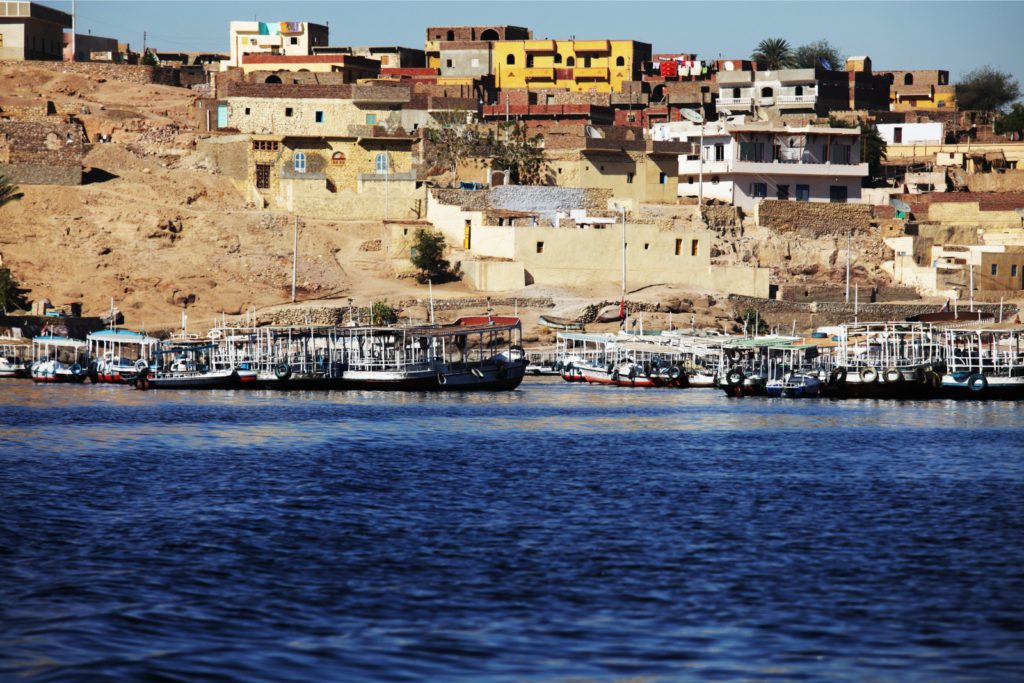
- The boat ride (30–45 minutes): the trip south from the Aswan corniche passes Elephantine and the granite boulders of the First Cataract, with the dunes of the west bank on one side. It is one of the most beautiful short journeys on the Nile.
- The village walk: houses with vaulted and domed roofs, painted in bright blues, yellows and pinks and decorated with geometric patterns, birds and hand-drawn scenes. Many are now guesthouses or cafés.
- A home visit: you sit in a courtyard, often with sand on the floor, and are offered hibiscus (karkade) or sweet tea. A family member will usually explain the house and Nubian customs.
- Henna: women from the village paint designs on hands or arms; it lasts one to two weeks.
- Shopping: stalls sell baskets, beadwork, scarves, spices and souvenirs.
The visit to Gharb Soheil itself, from its layout to the best time to arrive, is covered in our Gharb Soheil guide. Quieter alternatives include the two Nubian villages on Elephantine Island, Siou and Koti, which you can walk through from the island's ferry landing.
Is a Nubian village visit ethical?
It can be, if you treat it as a visit to people's homes rather than a show, pay fairly for what you use, and decline the parts that make you uncomfortable. Tourism brings real income to these villages, and many families welcome visitors with genuine pride. But the most visited villages have become commercial, and some practices deserve a second thought.
The crocodiles
Some houses keep young Nile crocodiles in tanks or pens and invite visitors to hold one for a photo. Families sometimes describe this as a Nubian tradition of keeping a crocodile for good fortune, but the photo-holding is a tourist-era business. The animals are wild, often kept in small enclosures, and handling them is stressful for them. Many travellers choose to look without touching; that is a perfectly polite choice, and your guide can explain it to your hosts.
Photographing people
Always ask before photographing anyone, especially women and children. Some people will ask for a small tip for posing, which is fair; others will say no, which you should accept without argument.
Giving to children
Children sometimes ask for sweets, pens or money. Giving directly encourages them to skip school to approach tourists. If you want to help, buy from local makers or ask your guide about a village school or community project.
How do you buy Nubian crafts fairly?
Buy from the people who make things, ask what is handmade locally, and expect to pay a fair price rather than drive the hardest bargain. Not everything on village stalls is Nubian: some scarves, figurines and printed fabrics are factory-made elsewhere, the same items you will see in Luxor and Cairo.
- Look for: hand-woven baskets and palm-fibre plates, beaded necklaces and bracelets, embroidered textiles, and small paintings of Nubian houses by local artists.
- Ask: who made it and where. A maker will usually be glad to show you the work in progress.
- Haggling: a little friendly negotiation is normal, but for handmade work in a small village, a modest discount is enough. The difference to you is small; to the maker it is not. Our haggling guide explains the etiquette.
- Spices and karkade: dried hibiscus, peanuts and spices are sold everywhere; check Australian biosecurity rules before you pack them.
For the bigger picture on shopping, including what is worth carrying home from Egypt, see what to buy in Egypt.
How do you visit a Nubian village respectfully?
Dress modestly, follow your hosts' lead, ask before photographing people or entering rooms, and remember that you are a guest in someone's home. Nubian villages are conservative, family places, even when they are used to visitors.
- Clothing: cover shoulders and knees. Swimwear is not appropriate in villages, even if your boat stops to swim nearby.
- Homes: remove shoes if your hosts do; accept tea with your right hand.
- Tipping: a tip for the family who hosted you for tea is customary unless it is included in your tour; your guide can advise. See tipping in Egypt for indicative amounts.
- Language: a few words of Arabic go a long way. Shukran (thank you) is understood everywhere.
- Mosques and private areas: do not wander into courtyards or rooms you have not been invited into.
When should you go, and how long do you need?
Go in the late afternoon and return by boat at sunset; allow three to four hours in total. From October to April, Aswan afternoons are warm and dry, and the light on the west bank dunes is beautiful as you return downstream. From May to September, daytime temperatures often exceed 40°C, so an early morning visit or a late afternoon start is essential.
On a Nile cruise, the Nubian village is often sold as an optional excursion on the Aswan day, sometimes combined with a felucca sail or a camel ride to the Monastery of St Simeon. If you are staying in Aswan on land, you have more freedom to time the visit and to stay for dinner, and a few village guesthouses offer overnight stays, which is the most rewarding way to experience a village after the day boats leave.
Our family adventure tour and Classic Egypt and Nile Cruise both include a Nubian village visit by boat from Aswan.
Is a Nubian village visit worth it?
Yes for most travellers, especially families and first-time visitors to Aswan, as long as you expect a warm but tourist-oriented experience rather than an untouched village. The boat ride alone is worth the time, the houses are lovely, and the conversations over tea are often a highlight of an Egypt trip.
It is less rewarding if you dislike being sold to, or if your only time in Aswan is a rushed cruise day. In that case, a felucca sail around Elephantine with a walk through Siou or Koti, or an evening at a Nubian restaurant on the west bank, gives you some of the same atmosphere with less commerce. Travellers who want depth should stay a night in a village guesthouse or spend longer at the Nubian Museum. Whichever you choose, going with a guide who knows the families personally changes the experience from a stop on a circuit to a genuine visit.
Frequently asked questions
Which Nubian village do tourists visit in Aswan?
Gharb Soheil, on the west bank south of Aswan, is the most visited. The villages of Siou and Koti on Elephantine Island are quieter alternatives reached by public ferry.
How do you get to the Nubian village from Aswan?
By motorboat from the Aswan corniche or from your cruise ship, about 30–45 minutes upriver to Gharb Soheil. There is also a road, but the boat ride is part of the experience.
Is it okay to hold the crocodiles at the Nubian village?
It is your choice, but the crocodiles are wild animals kept in small enclosures for tourist photos, and handling stresses them. Many travellers prefer to look without holding them.
Can you stay overnight in a Nubian village?
Yes. Several villages near Aswan, including Gharb Soheil, have family-run guesthouses. Standards vary, so book through someone who knows them.
What should I wear to a Nubian village?
Light, loose clothes covering shoulders and knees, a hat and sunscreen. Comfortable shoes help on sandy lanes.